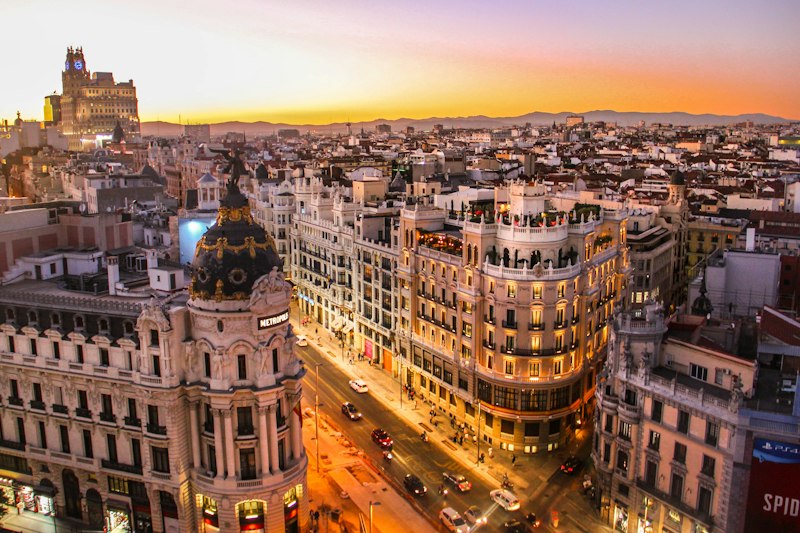
Walking Tours in Madrid
30 Landmarks in Madrid
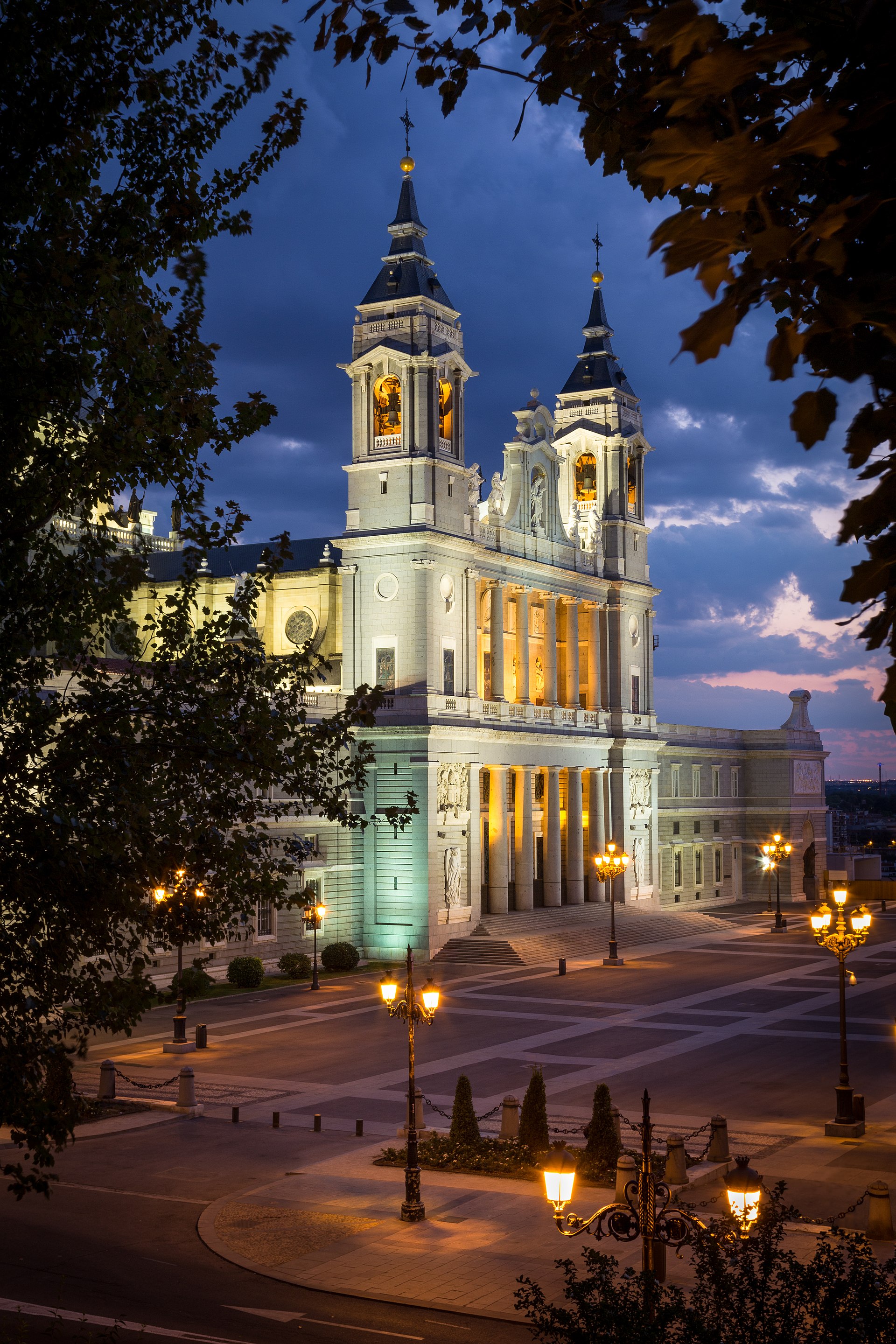
Almudena Cathedral
10 Calle de Bailén, Centro, Madrid, 28013, Spain
Madrid was the capital of the most powerful Catholic empire in history for over four centuries, and for almost all of that time, it didn't have a cathedral. When Philip II moved the capital from Toledo to Madrid in 1561, the archbishopric — and therefore the cathedral — stayed behind in Toledo. Spain spent the next three hundred years building cathedrals in colonial cities from Manila to Mexico City while its own capital made do with parish churches. Construction finally began on April 4, 1883, when Alfonso XII laid the first stone. Architect Francisco de Cubas designed it in a neo-Gothic style to rival the great medieval cathedrals of Europe. Then the money ran out. Then the Spanish Civil War happened. Then more money ran out. The project dragged on for 110 years through multiple architects, shifting styles, and national catastrophes. It wasn't consecrated until June 15, 1993, when Pope John Paul II flew in to do the honors — making it the first cathedral he consecrated outside of Rome. The result is architecturally... complicated. The exterior is neoclassical, designed to match the Royal Palace directly across the street. The interior is neo-Gothic. The crypt is neo-Romanesque. The pop-art-colored ceiling paintings by Kiko Arguello, added in 2004, look like nothing in any other European cathedral. Critics have called the building everything from "confused" to "audacious," but that mix of styles is honestly a pretty accurate reflection of Madrid itself. On May 22, 2004, the cathedral hosted the wedding of Crown Prince Felipe (now King Felipe VI) to Letizia Ortiz, watched by an estimated 1.5 billion viewers worldwide — finally giving the building a moment worthy of a four-century wait.
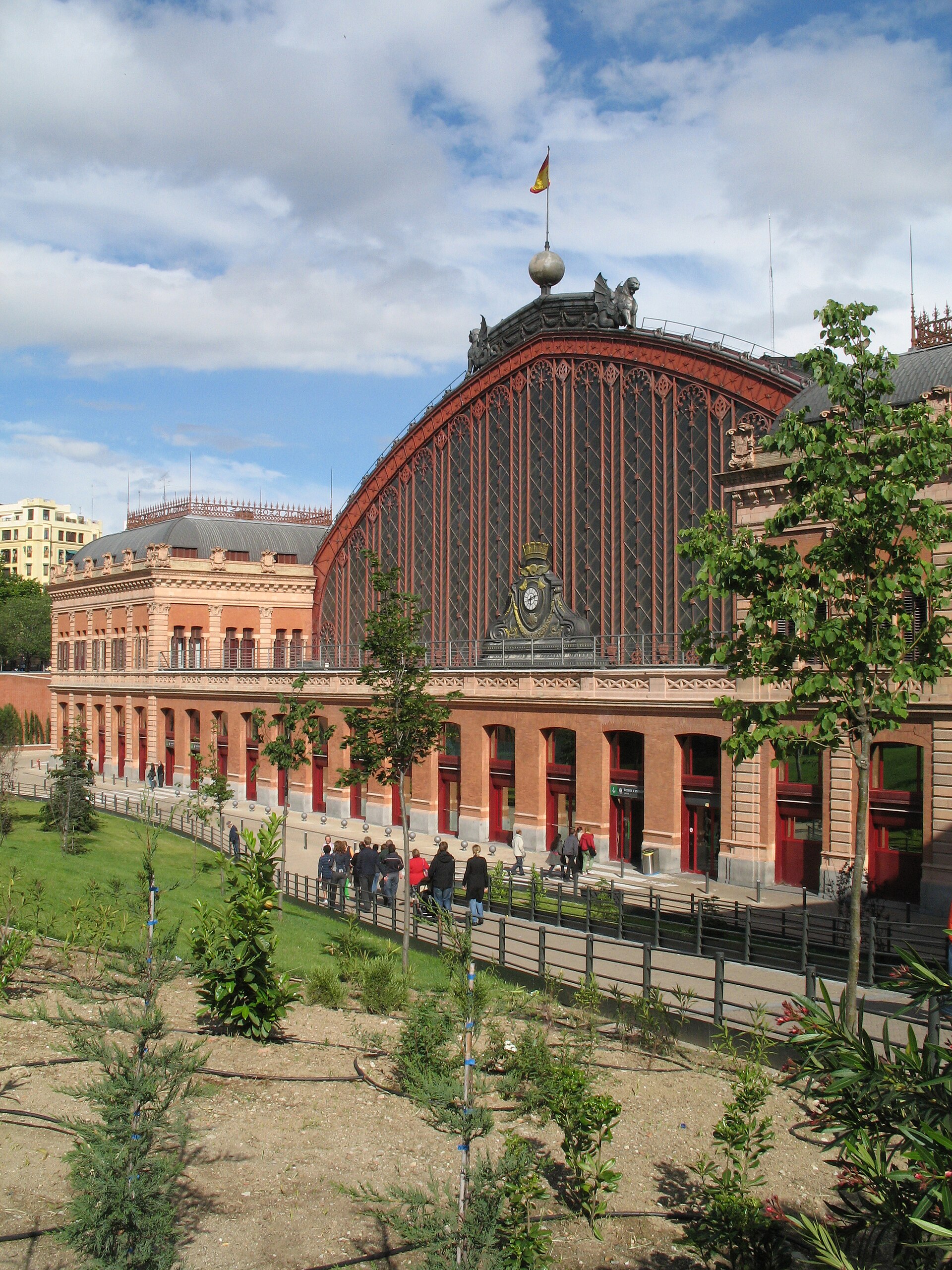
Atocha Station
Centro, Madrid, Spain
Walk into Madrid's main train station and you'll find yourself in a tropical rainforest. The old departure hall of Atocha — a soaring iron-and-glass train shed from the 19th century — now contains a 4,000-square-meter indoor botanical garden with over 7,000 plants representing more than 260 tropical species. Palm trees reach toward the glass ceiling, turtles paddle in a pond, and the humidity hits you like stepping off a plane in the Caribbean. It is, without question, the strangest train station in Europe. This transformation happened because Madrid needed a bigger station. Between 1985 and 1992, architect Rafael Moneo designed a completely new high-speed rail terminal behind the old building, and rather than demolish the beautiful 19th-century iron hall, he converted it into a public garden and commercial space. The original train shed, with its elegant wrought-iron arches, now shelters a miniature jungle instead of locomotives. The turtles in the pond were rescued from Madrid's rivers and streams, where irresponsible pet owners had dumped them. On March 11, 2004, the station was the site of Spain's worst terrorist attack. Coordinated bombings on four commuter trains killed 193 people and wounded nearly 2,000 more. A memorial forest of olive and cypress trees was planted outside the station, and inside, a cylindrical glass memorial tower rises from the lower concourse, inscribed with messages of condolence from around the world. It's a devastating and powerful space. The station now serves as the southern terminus for Spain's AVE high-speed rail network, connecting Madrid to Barcelona, Seville, and dozens of other cities. Trains arrive and depart from the sleek modern platforms behind Moneo's addition, while the old hall hums with the quiet sounds of water, birdsong, and travelers pausing to wonder at a garden growing inside a train station.
Barrio de las Letras
Calle de las Huertas, Centro, Madrid, 28012, Spain
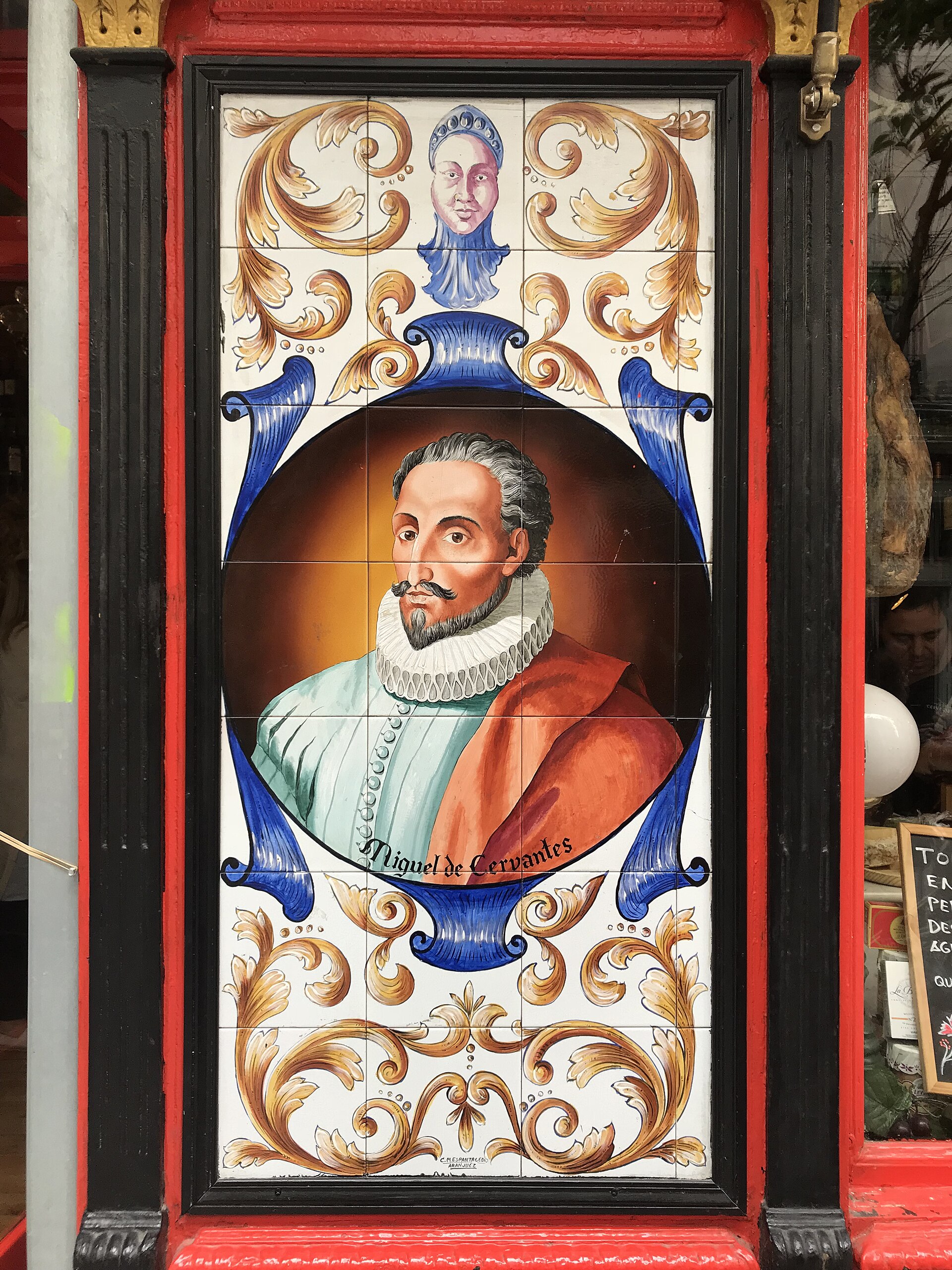
During the Spanish Golden Age, this small neighborhood contained the greatest concentration of literary genius in the history of the Spanish language — and most of them hated each other. Cervantes, Lope de Vega, Quevedo, and Gongora all lived within a few hundred meters of one another in the late 16th and early 17th centuries. Cervantes and Lope de Vega were bitter rivals who insulted each other in print for years. Quevedo and Gongora carried on a feud so vicious it produced some of the most brilliantly cruel poetry ever written in Spanish. The neighborhood is named for them — the "Literary Quarter" — and their words are literally set into the streets. Walk down Calle de las Huertas and you'll find quotes from these writers and others inlaid in bronze letters in the pavement, a literary treasure hunt stretching the length of the street. Cervantes lived on what is now Calle de Cervantes (naturally) and died there on April 22, 1616, possibly on the same day as Shakespeare — though calendar differences between Spain and England make the exact synchronicity debatable. Lope de Vega's house at Calle de Cervantes 11 (the irony of his rival's name on his street was not lost on anyone) is now a museum, preserved almost exactly as it was when the playwright lived there. His tiny walled garden, his writing desk, and the oratory where he prayed after being ordained as a priest in 1614 — all still there. Today the Barrio de las Letras is one of Madrid's liveliest nightlife zones, its narrow streets packed with bars, jazz clubs, and flamenco tablaos. The ghosts of the Golden Age writers share the cobblestones with revelers who rarely realize they're drinking in the most literary neighborhood in Spain.
Basilica de San Isidro
37 Calle de Toledo, Centro, Madrid, 28005, Spain
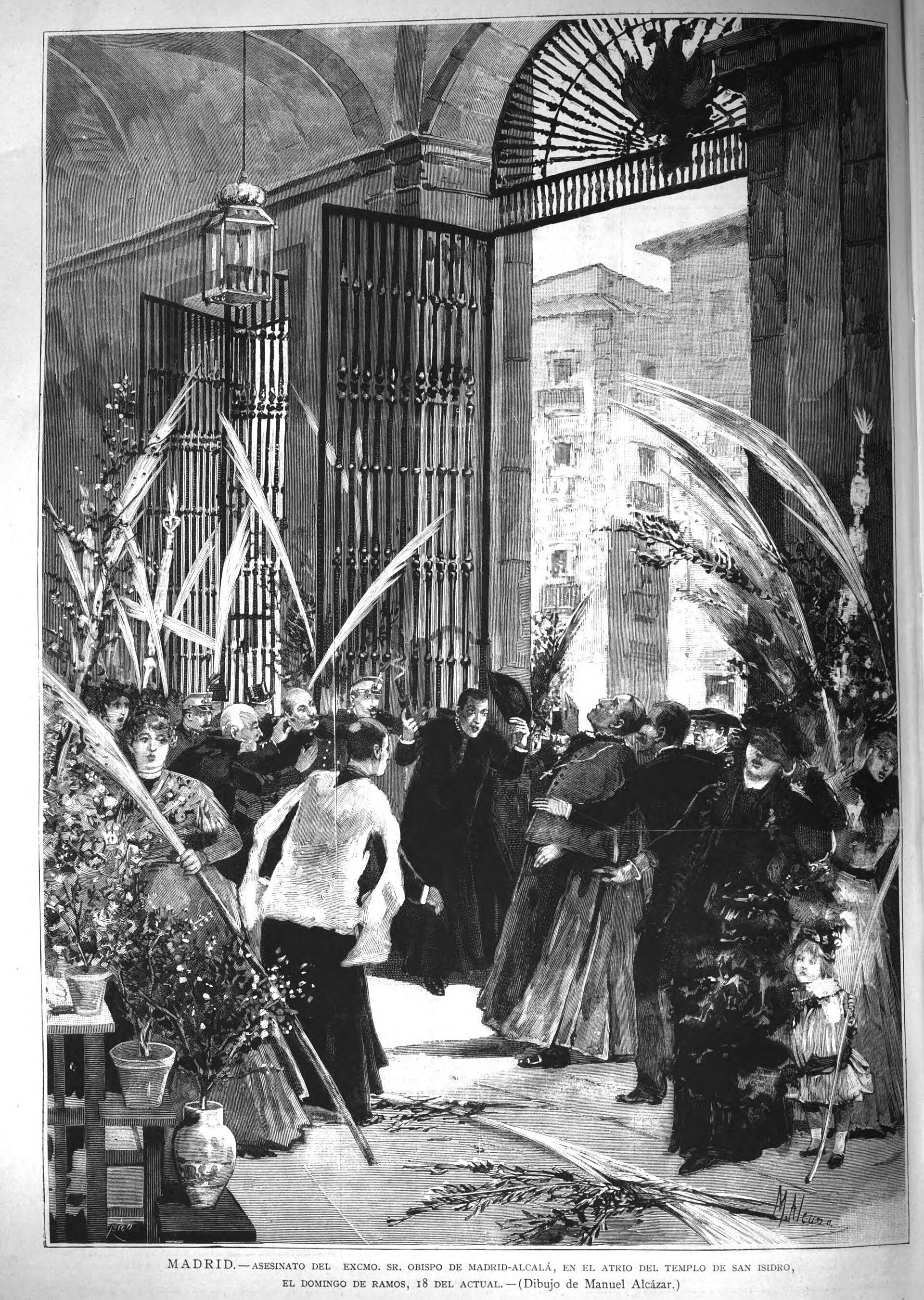
Before the Almudena Cathedral was finally consecrated in 1993, this was effectively Madrid's cathedral — the acting seat of the archbishopric for nearly two centuries. Built between 1622 and 1664 by the Jesuits as part of the Imperial College, the Basilica de San Isidro is a masterpiece of Spanish Baroque architecture that served as Madrid's pro-cathedral from 1885 until 1993. For over a hundred years, every major religious ceremony in the capital happened here. The church is dedicated to Madrid's patron saint, San Isidro Labrador — a 12th-century farmer who, according to legend, was so devout that angels plowed his fields while he prayed. His incorrupt body (miraculously preserved, the faithful say) was kept here for centuries, along with that of his wife, Santa Maria de la Cabeza. The couple is one of the very few married pairs in Catholic history to both be canonized. The Jesuits built the church and the adjoining Imperial College as a showcase of Counter-Reformation grandeur. When Charles III expelled the Jesuits from Spain in 1767, the church was reassigned to the secular clergy and the college became a prestigious school. The interior is classic Jesuit: a single nave, barrel vault, side chapels, and an overwhelming retable behind the altar. The dome rises 55 meters from the floor and fills the nave with diffused light. Look for the Chapel of San Isidro, added in the 18th century, with its elaborate frescoes and the silver urn that once contained the saint's remains. The basilica doesn't get the attention that flashier churches receive, but for almost four hundred years, this was where Madrid came to pray, to mourn, and to celebrate — the spiritual heart of a capital that kept promising to build a proper cathedral and never quite getting around to it.
Calle Mayor
Calle Mayor, Centro, Madrid, 28005, Spain
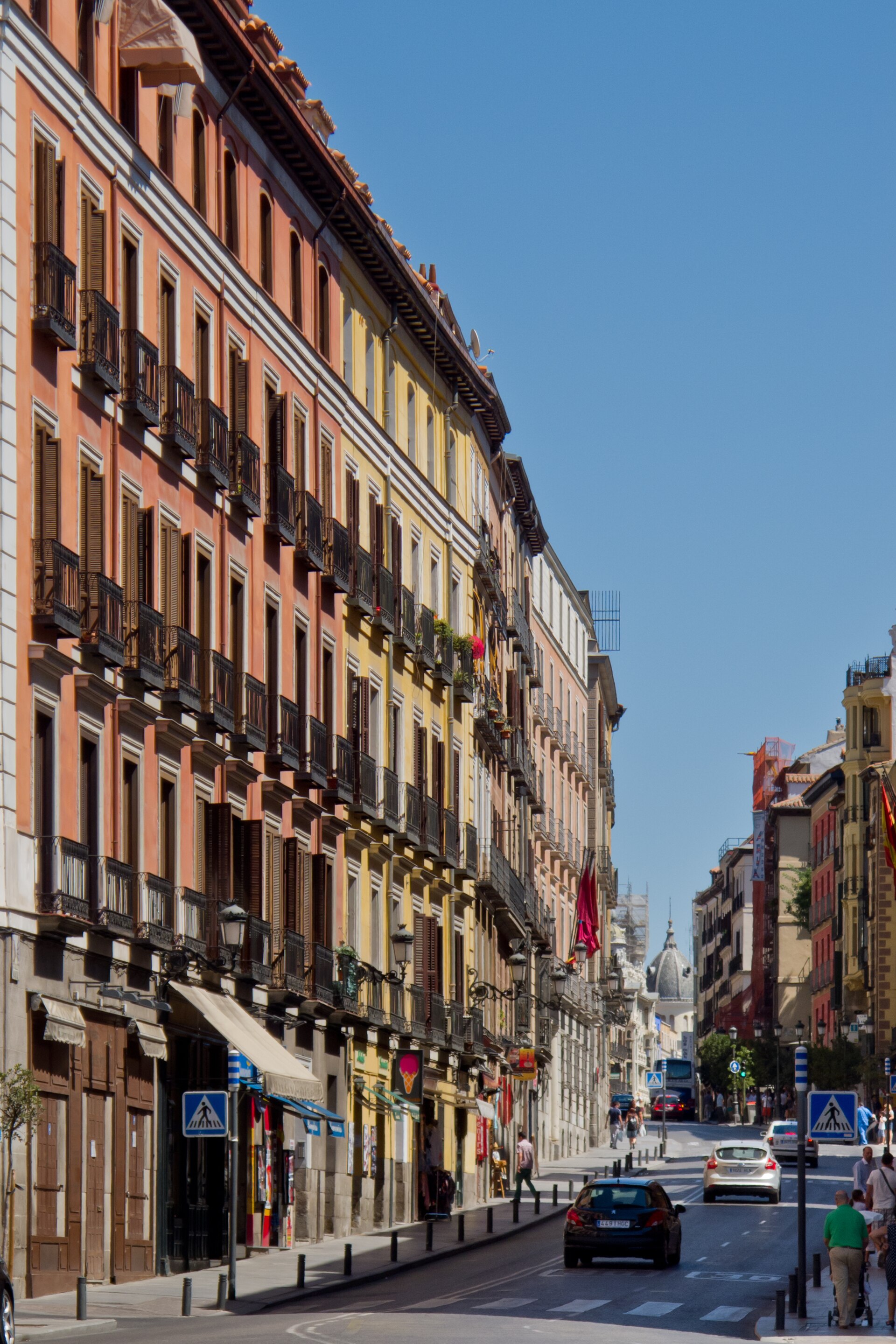
This 600-meter street is the oldest spine of Madrid, tracing a medieval ridge between the Arenal and Segovia valleys that once served as the main road connecting the Moorish alcazar to the east. In the 13th century, it was already the city's busiest artery — merchants, monks, and mule drivers all shared the same rutted path. When Madrid became Spain's capital in 1561, Calle Mayor became the address everyone wanted. The street has literary DNA running through it. Lope de Vega — the Shakespeare of Spanish theater, who wrote an estimated 1,800 plays — was born at number 50 in 1562. Calderon de la Barca, another giant of the Golden Age, lived nearby. Walk the street and you're walking through the setting of countless plays, poems, and novels that shaped the Spanish language. At number 1, the Casas del Cordero stands as Madrid's first modern residential building, constructed in 1845 — a building that felt shockingly urban when everything around it was still essentially medieval. Halfway along, look for the Casa de la Villa, the gorgeous 17th-century former town hall with its Baroque towers and Habsburg-era courtyard. Nearby, the Casa de Cisneros is a Renaissance palace from 1537 that once belonged to the nephew of Cardinal Cisneros, the power behind the Spanish throne. These buildings are easy to walk past — they don't announce themselves — but each one carried the weight of an empire at some point. Today Calle Mayor is a pleasant pedestrian stroll from Puerta del Sol to the Royal Palace, lined with bookshops, pastry shops selling Madrid's traditional rosquillas, and the occasional busker. But look past the shop fronts and you're walking the same path that connected a frontier fortress to the heart of an empire.
Chueca
Plaza de Chueca, Centro, Madrid, 28004, Spain
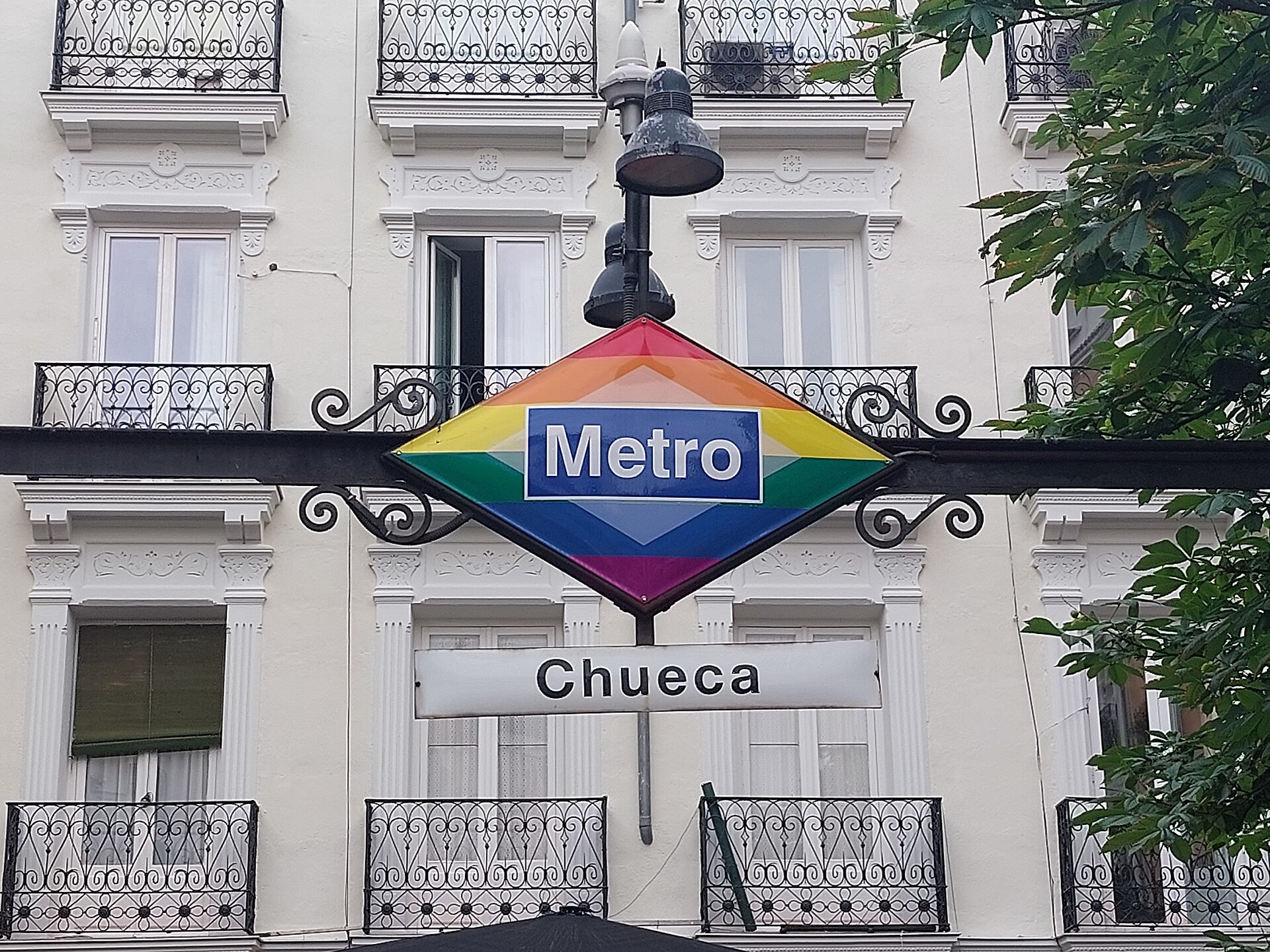
In the 1970s and 80s, Chueca was a neighborhood nobody wanted to live in. Prostitution, heroin, and abandonment had hollowed it out, emptying storefronts and driving families away. The buildings were beautiful — 19th-century apartments with ornate iron balconies — but the streets were dangerous. Then the LGBTQ community, priced out of other neighborhoods and drawn by cheap rents and a certain protective anonymity, began quietly moving in. What happened next was one of the most remarkable urban transformations in European history. Named after composer Federico Chueca, who composed popular zarzuelas (Spanish operettas) in the 19th century, the neighborhood sits in the heart of Madrid's central district. After Franco's death in 1975, the slow loosening of social repression created space for communities that had been forced underground. By the late 1980s, Chueca was concentrating gay bars and meeting points — Cafe Figueroa, Black & White, Sachas. In 1993, Berkana opened as Spain's first major LGBTQ bookstore. In 1989, Madrid Pride moved to Chueca, and its streets became the "kilometer zero" of a celebration that now draws over a million people each July. The transformation went beyond nightlife. LGBTQ business owners opened restaurants, shops, design studios, and galleries. Property values rose. Straight families moved back in. The neighborhood gentrified rapidly, but unlike many gentrification stories, the community that saved Chueca remained at its center rather than being displaced by its own success. Today Chueca is considered one of the largest LGBTQ districts in Europe, and Spain — which legalized same-sex marriage in 2005 — points to it as evidence of how far the country has traveled since the Franco years. Rainbow crosswalks mark the streets, and the annual Pride celebration is one of the biggest in the world. Chueca didn't just transform a neighborhood; it helped transform a nation.
Cuatro Torres Business Area
259 Paseo de la Castellana, Fuencarral-El Pardo, Madrid, 28046, Spain
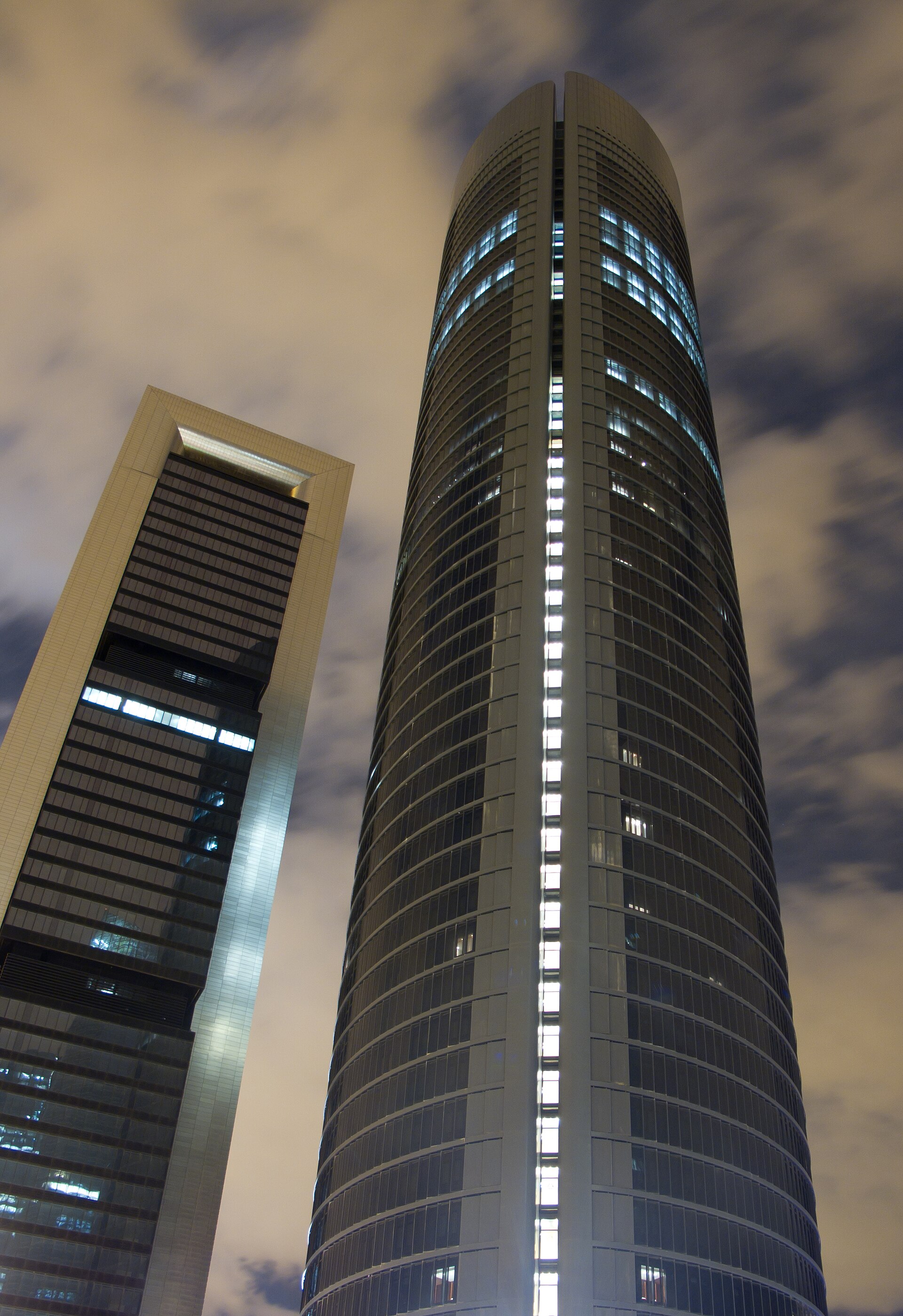
Madrid's skyline was resolutely flat for centuries — the Royal Palace dome and the Telefonica Building were about as ambitious as it got. Then, between 2004 and 2009, four skyscrapers erupted from the northern end of the Paseo de la Castellana and changed the city's silhouette overnight. The Cuatro Torres — Four Towers — are the tallest buildings in Spain, and they turned a former sporting complex into a statement of 21st-century ambition. Torre Cepsa, designed by Norman Foster, reaches 248 meters. Torre de Cristal, by Cesar Pelli, is the tallest at 249 meters — a shimmering glass spire that catches the Madrid sun and throws it back at the city. Torre PwC by Rubio and Alvarez-Sala stands at 236 meters. And Torre Emperador Castellana by Henry N. Cobb reaches 230 meters. Together they form a cluster visible from virtually anywhere in the city, a reminder that Madrid is still building, still growing, still reaching upward. The four towers were built on the site of the former Real Madrid training ground and sports complex, Ciudad Deportiva, which the club sold in 2001 for roughly 480 million euros — a real estate deal that helped finance the galactico era of Zidane, Beckham, and Ronaldo. So in a very real sense, these skyscrapers were built on football. The immediate neighborhood is corporate Madrid — glass lobbies, suited professionals, and expense-account restaurants — but the nearby park of the Chamartin area offers views of the towers from below. At sunset, when the glass facades turn gold and orange, the Cuatro Torres look like they belong in Dubai or Singapore rather than in the capital of a country that was still under a dictatorship fifty years ago. That contrast is the whole point.
El Rastro
Calle de la Ribera de Curtidores, Centro, Madrid, 28005, Spain
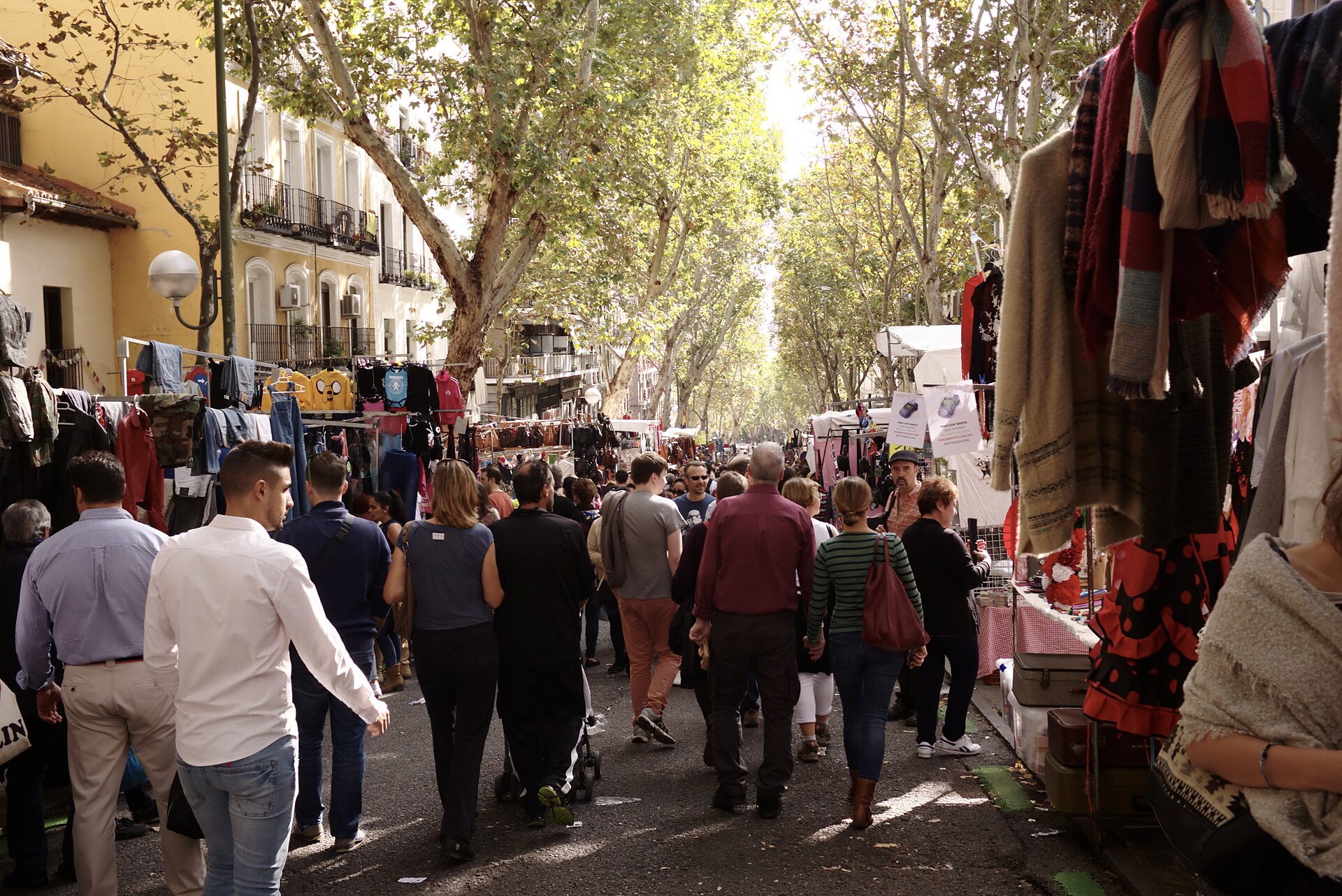
The name literally means "the trail" — and it refers to the bloody trail of animal carcasses that were dragged downhill from the old slaughterhouse in Plaza de Cascorro to the tanneries along the Ribera de Curtidores. For centuries, this was Madrid's meatpacking district, reeking of hides and slaughter. The tanners are long gone, but the name stuck, and every Sunday the same steep street fills with over a thousand vendors selling everything from antique furniture to bootleg sunglasses. El Rastro is Madrid's oldest flea market, with roots stretching back before Madrid was even Spain's capital. Documents mention trading activity here as early as the 15th century, though it wasn't formally regulated until 1811. By the 1960s and 70s, it was arguably the most important antique market in all of Europe — serious dealers came from London and Paris to hunt for Spanish colonial artifacts, Civil War memorabilia, and forgotten old master paintings. The market sprawls downhill from Plaza de Cascorro along Ribera de Curtidores and into dozens of side streets, each with its own specialty. One alley sells nothing but old magazines. Another is all vintage clothing. There are stalls of brass hardware, religious icons, flamenco records, military medals, used books, and things that defy categorization. The permanent antique shops on Calle de Carlos Arniches and the Galerias Piquer arcade are open all week and deal in genuinely valuable pieces. The real Rastro tradition, though, is the after-market. Once the stalls start packing up around 3 PM, the crowds migrate into the bars of La Latina for canas — small beers — and tapas. The energy of a Sunday Rastro morning spilling into a long, lazy La Latina lunch is one of Madrid's essential experiences.
Ermita de San Antonio de la Florida
5 Glorieta de San Antonio de la Florida, Moncloa-Aravaca, Madrid, 28008, Spain
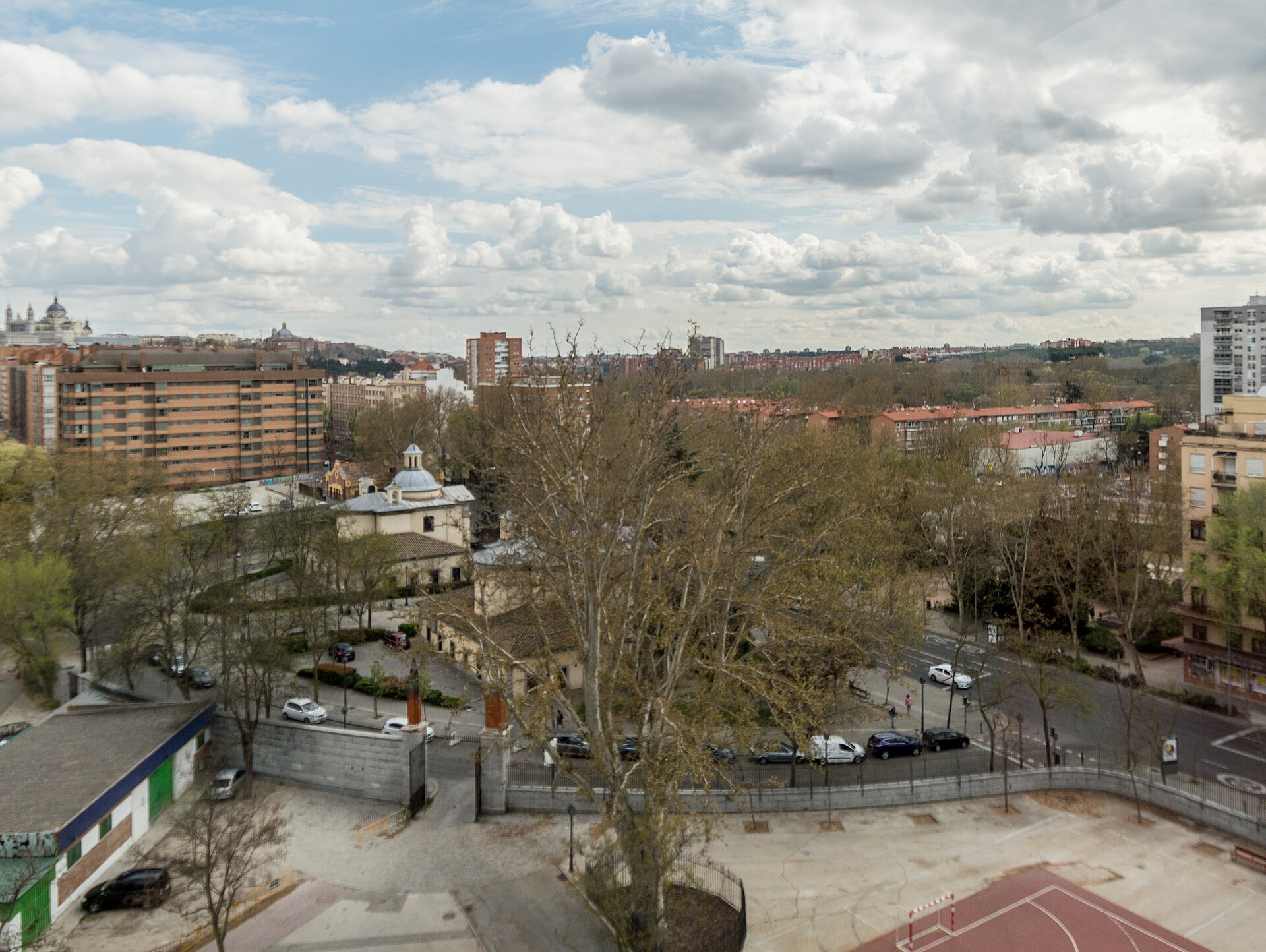
Goya is buried here, but his head is missing. When Spanish authorities decided to bring the painter's remains home from Bordeaux in 1919 — he'd died in self-imposed exile in 1828 — they opened the coffin and found a skeleton without a skull. The Spanish consul wired Madrid: "Send Goya, with or without head." They sent him headless, and he's been lying beneath this chapel floor ever since, his skull lost somewhere in France, possibly stolen by phrenologists who wanted to study the brain of a genius. Nobody has ever found it. But the real reason to come here is above your head, not below your feet. In 1798, Goya spent six months painting the interior of this small Neoclassical chapel with frescoes that broke every rule of religious art. The dome depicts the miracle of Saint Anthony of Padua raising a man from the dead to clear the saint's father of a murder charge — but instead of setting the scene in 13th-century Lisbon, Goya relocated it to contemporary Madrid. The crowd watching the miracle isn't a collection of medieval saints; it's a vivid snapshot of 18th-century Madrid society — aristocrats, majas, beggars, children, and women leaning over the railing with casual curiosity. Even more radical: Goya put the divine scene on top and the angels below, inverting the traditional hierarchy. The angels — voluptuous young women with wings — support the dome from underneath, looking more like flamenco dancers than celestial beings. In 1905, the chapel was declared a National Monument. In 1928, an identical chapel was built right next door to handle regular church services, so the original could be preserved purely as a museum. Stand beneath Goya's dome and look up — you're seeing the last great work of a man who would soon go deaf, paint nightmares on his walls, and flee his own country.
Gran Vía
Calle Gran Vía, Centro, Madrid, 28013, Spain
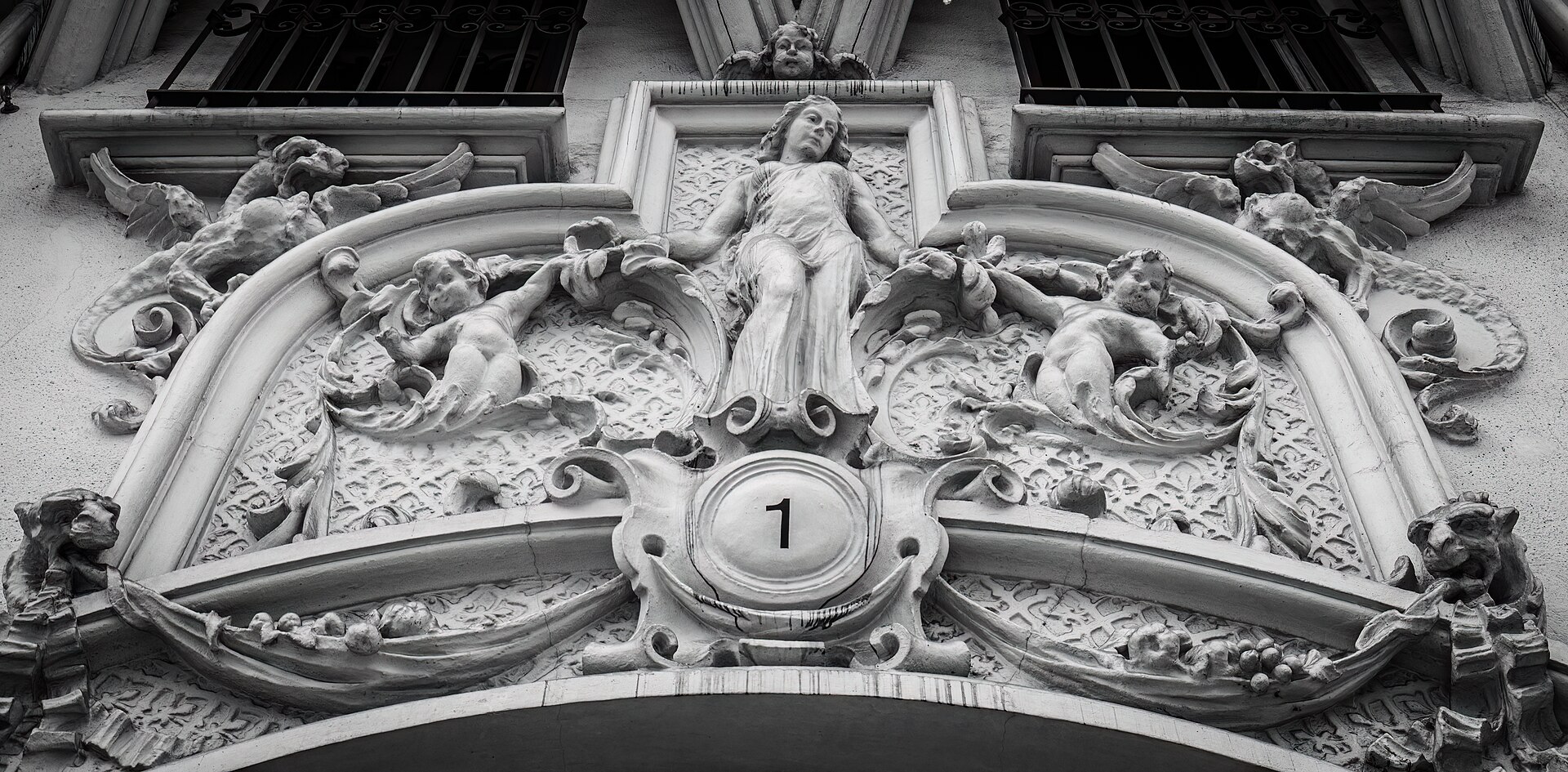
They demolished 300 houses and wiped fifteen streets off the map to build it. Gran Via was Madrid's answer to Haussmann's Paris — a grand boulevard smashed through the tangled medieval city center, designed to drag the Spanish capital into the 20th century. The project was talked about for decades, mocked by newspapers who sarcastically called it the "Great Way," and finally approved in 1904. Construction began in 1910 and wasn't fully completed until 1931, carried out in three stages that you can still read in the architecture as you walk. The first section, from Calle de Alcala to Red de San Luis, is French-influenced Beaux-Arts. The middle stretch leans Art Nouveau and Art Deco. The western end, completed last, goes full-blown American — because by the 1920s, Madrid was looking at New York, not Paris. The Telefonica Building, finished in 1929, was one of Europe's first skyscrapers at 89 meters tall, and it was the tallest building on the continent until 1940. During the Civil War, its height made it a prime artillery target — the Republican government used it as a telephone exchange while Nationalist shells slammed into it regularly. The Capitol Building, opened in 1933, still wears its iconic neon Schweppes sign — one of the most photographed pieces of advertising in Europe. At night, Gran Via's neon signs light up like a smaller, scrappier Times Square, and the street pulses with theater-goers, shoppers, and tourists. Madrid's Broadway, some call it, because the density of theaters here rivals London's West End. Look up as you walk — the rooftop architecture is extraordinary. Domes, turrets, sculptures, and cupolas compete for attention on every block. The Edificio Metropolis at the corner of Alcala, with its golden winged victory statue, might be the most photographed building in Madrid.
La Latina
Plaza Paja, Centro, Madrid, 28005, Spain
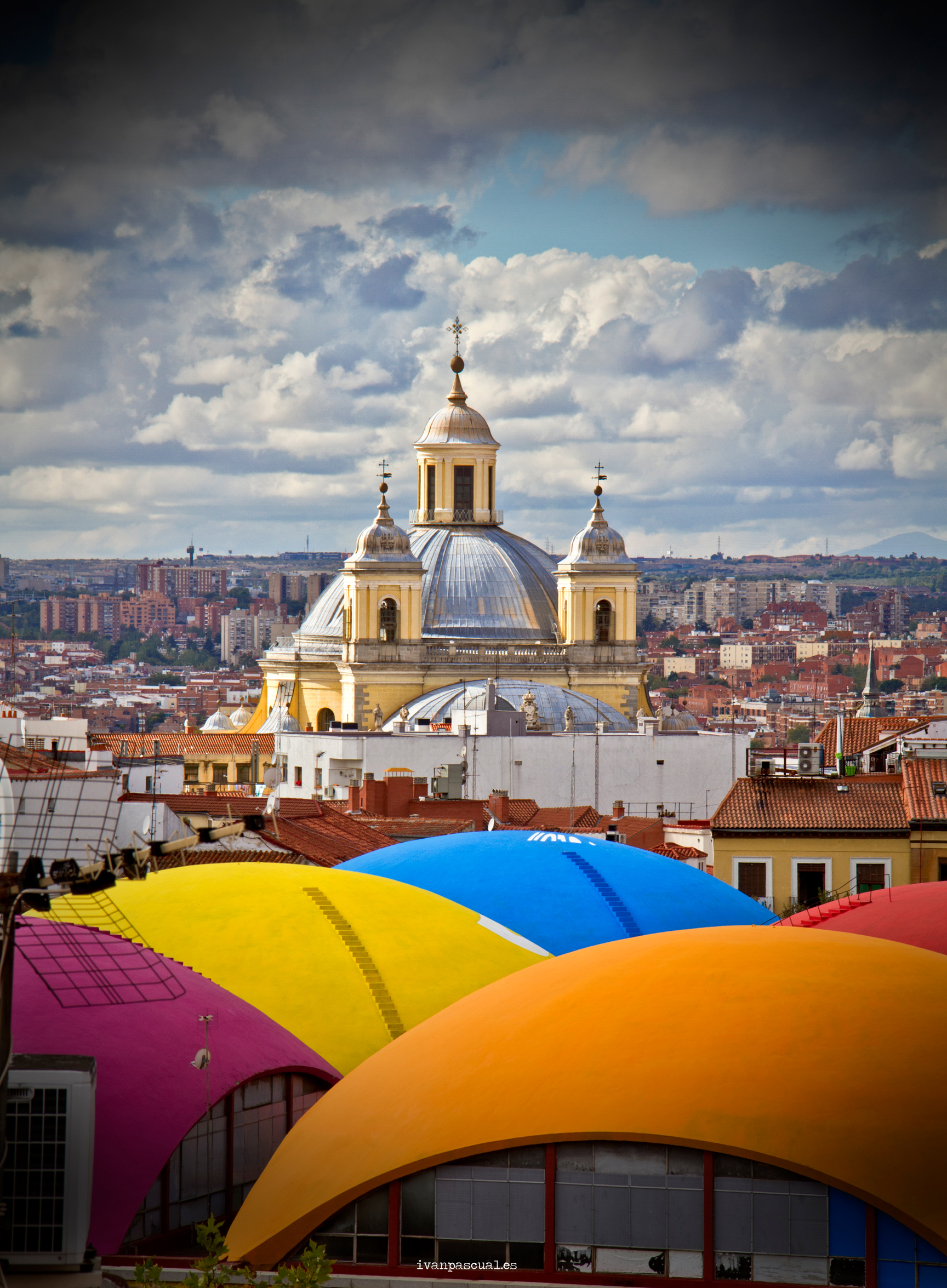
This is where Madrid began. La Latina sits on the exact footprint of the 9th-century Islamic fortress — the original walled citadel of Mayrit, founded by Muhammad I of Cordoba around 860 AD as a military outpost to defend Toledo from Christian kingdoms to the north. The narrow, winding streets follow the medieval street plan almost perfectly, tracing paths that Muslim soldiers and merchants walked over a thousand years ago. The neighborhood's name comes from Beatriz Galindo, known as "La Latina" for her extraordinary command of Latin. Born around 1465, she became tutor to Queen Isabella I and one of the most educated women in 15th-century Europe. She founded a hospital on this site in 1499, and the neighborhood eventually took her nickname. It's a rare case of a major urban neighborhood being named after a woman — and a scholar at that. The Plaza de la Paja (Straw Square) was the most important square in medieval Madrid, where farmers brought straw as a tithe to the Church. Today it's a quiet, leafy plaza surrounded by old palaces and churches that most tourists walk right past. The nearby Plaza de la Cebada was the old barley market. These names — straw, barley — are fossils of the agricultural economy that fed a frontier town. But modern La Latina is all about Sunday. After the Rastro flea market wraps up, the entire neighborhood becomes an outdoor bar. Cava Baja, a narrow street lined with tapas bars and tascas, is ground zero for Madrid's Sunday afternoon ritual: standing in the street with a cana in one hand and a plate of croquetas in the other, shoulder to shoulder with half the city. La Latina on a Sunday afternoon is not a tourist experience — it's Madrid at its most authentically, gloriously social.
Malasaña & Plaza del Dos de Mayo
Centro, Madrid, Spain
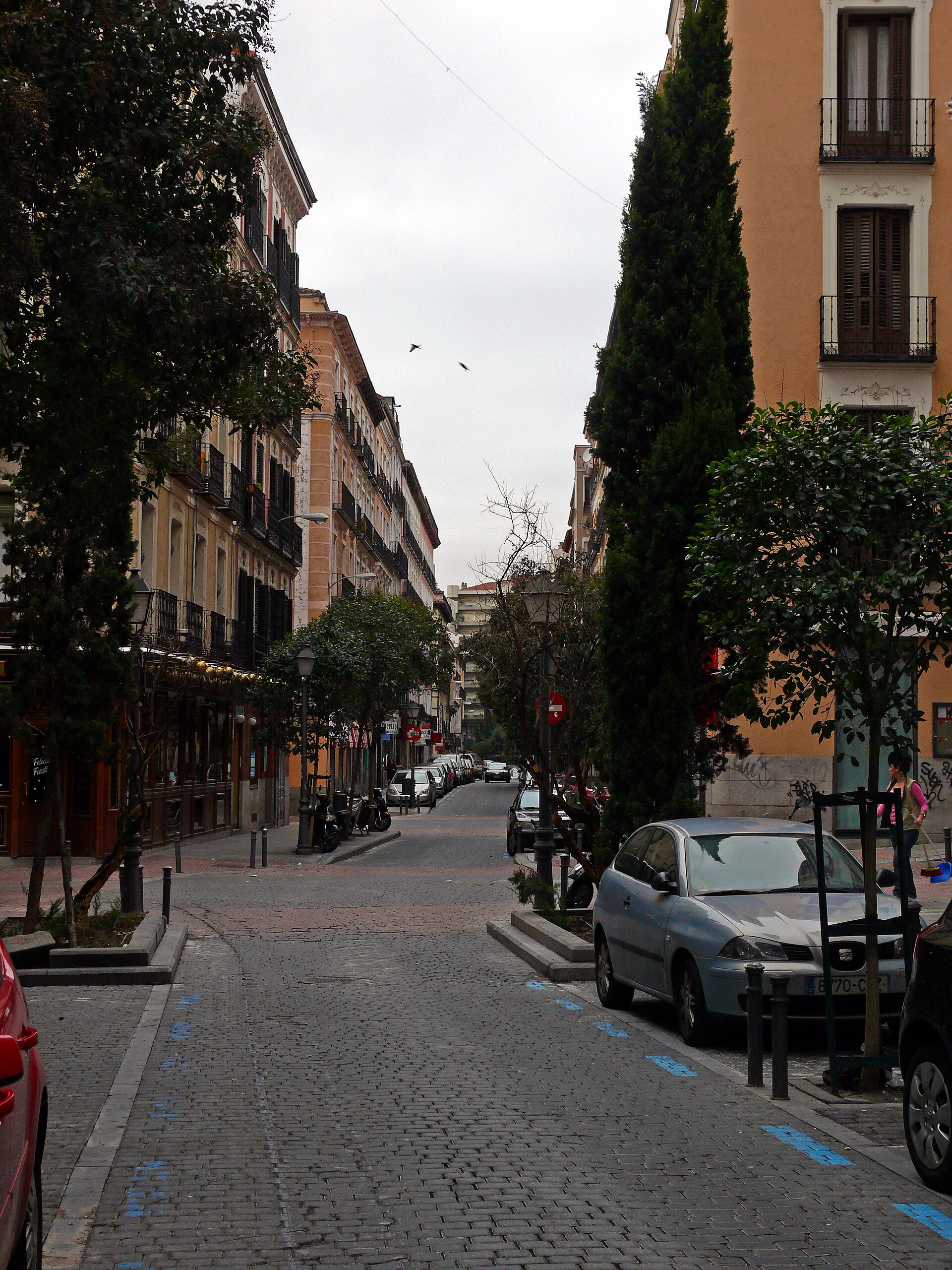
The neighborhood is named after a fifteen-year-old seamstress who was killed by French soldiers. On May 2, 1808, the citizens of Madrid rose up against Napoleon's occupying army in a bloody, desperate, doomed uprising. Manuela Malasana was caught in the fighting and shot — some accounts say she was carrying scissors and accused of carrying a weapon. The uprising was crushed, the reprisals were savage, and Goya immortalized the horror in two of history's most famous paintings. The neighborhood that grew up around the old artillery barracks where some of the fiercest fighting occurred took her name. The Plaza del Dos de Mayo sits at the heart of Malasana, built on the site of the Monteleón artillery barracks. A statue of officers Daoiz and Velarde, who defied orders and opened the arsenal to the civilian fighters, stands in the center. The arch behind it is all that remains of the barracks entrance — a stone doorway to a building that no longer exists, framing nothing but sky. Nearly two centuries later, Malasana became the epicenter of another revolution — this time cultural. After Franco died in 1975, decades of repression exploded into La Movida Madrilena, a wild, creative, hedonistic countercultural movement centered right here. Punk bands, underground filmmakers, drag performers, and artists of every stripe colonized the bars and basements of Malasana. Pedro Almodovar got his start in these streets, screening his early films in local cinemas and hanging out in the same dives as everyone else. Today Malasana is Madrid's hipster heartland — vintage shops, craft coffee, vinyl record stores, and bars that open at midnight. The counterculture has been commodified, but the spirit of rebellion still pulses through the neighborhood. The best time to feel it is any Saturday night after 1 AM, when the plaza fills with people sitting on the ground, sharing bottles, and carrying on a tradition of defiance that started with a seamstress and a pair of scissors.
Matadero Madrid
8 Plaza de Legazpi, Arganzuela, Madrid, 28045, Spain
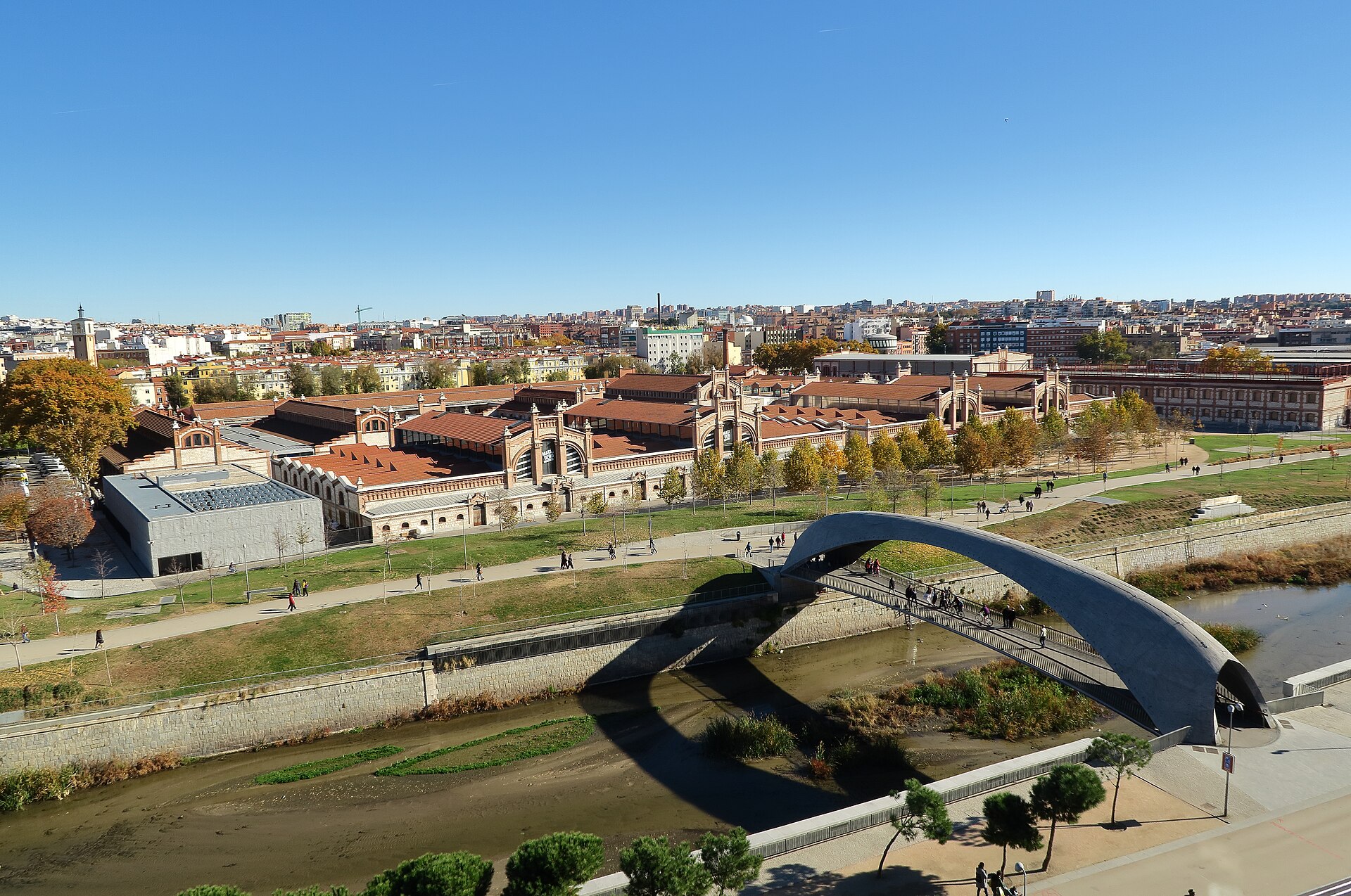
Madrid's most exciting contemporary art center is a converted slaughterhouse, and the irony is entirely intentional. The Matadero — literally "slaughterhouse" — was designed by architect Luis Bellido y Gonzalez in 1911 as the city's Municipal Slaughterhouse and Cattle Market. The complex of 48 Neo-Mudejar brick buildings spread across 165,000 square meters along the Manzanares River processed livestock for the capital for over seventy years, until the last animals were slaughtered here in 1996. A decade of disuse followed, during which the abandoned industrial complex became a canvas for graffiti artists and urban explorers. Then the Madrid city council made one of its best cultural decisions: instead of demolishing the complex for apartments, they converted it into a sprawling contemporary arts center. The first spaces opened in 2007, and the transformation has been ongoing ever since, with different architects tackling different pavilions — each one preserving the industrial bones while creating wildly inventive interior spaces. The former refrigeration room, where carcasses once hung from ceiling hooks, is now a cavernous gallery for site-specific art installations. The old cattle ramps lead to theater spaces. A former granary houses a cinema. The mix of red brick, exposed steel, and contemporary insertions creates an atmosphere unlike any other arts venue in Europe — part factory, part gallery, part public park. Almost everything at the Matadero is free. Exhibitions, performances, workshops, film screenings, and community events run year-round. On summer weekends, the terraces along the Manzanares fill with locals who come to drink vermouth, watch outdoor cinema, and enjoy the fact that Madrid turned a place of death into a place of creation.
Mercado de San Miguel
Plaza de San Miguel, Centro, Madrid, 28005, Spain
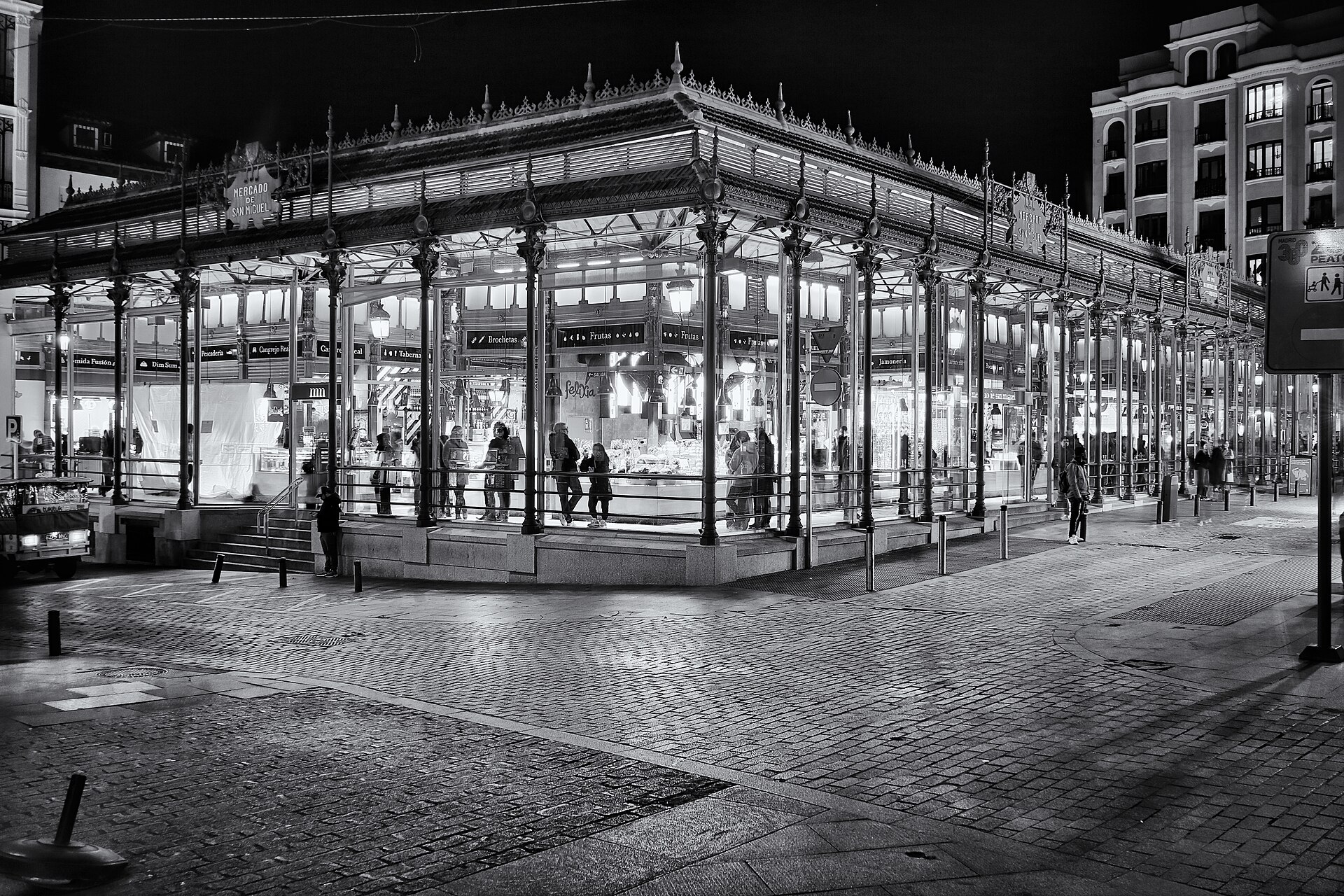
Before this iron-and-glass jewel box existed, there was a 13th-century church here — the Iglesia de San Miguel de los Octoes. The church caught fire in 1790 and was damaged badly enough that Joseph Bonaparte ordered it demolished in 1809, making way for an open-air fish market on the site. That market was a mess — unsanitary, chaotic, and increasingly embarrassing for a European capital. So in the early 1900s, the city hired architect Alfonso Dube to build something better. What Dube created, inaugurated on May 13, 1916, was a masterpiece of iron architecture inspired by Les Halles in Paris. The wrought-iron frame and glass panels flood the interior with natural light, and the 1,764-square-meter structure is now the only iron-framed market building left in Madrid. All the others were torn down in the 20th century in favor of concrete. San Miguel survived because it was too beautiful to demolish — and too stubborn to die. By the late 20th century, the market had fallen into disrepair and was threatened with closure. Private investors bought it in 2003, spent years restoring the iron structure, and reopened it in 2009 as a gourmet food hall. It was acquired again in 2017 for a reported 70 million euros. Today it draws more than seven million visitors a year, making it one of the most visited food markets in Europe. The stalls are a curated tour through Spanish gastronomy: jamón ibérico sliced so thin you can read through it, anchovy-stuffed olives from the south, Galician oysters on ice, vermouth on tap, and tiny glasses of Asturian cider poured from shoulder height. It's touristy now, sure, but the building itself remains genuinely stunning — a cathedral of iron built for food instead of prayer.
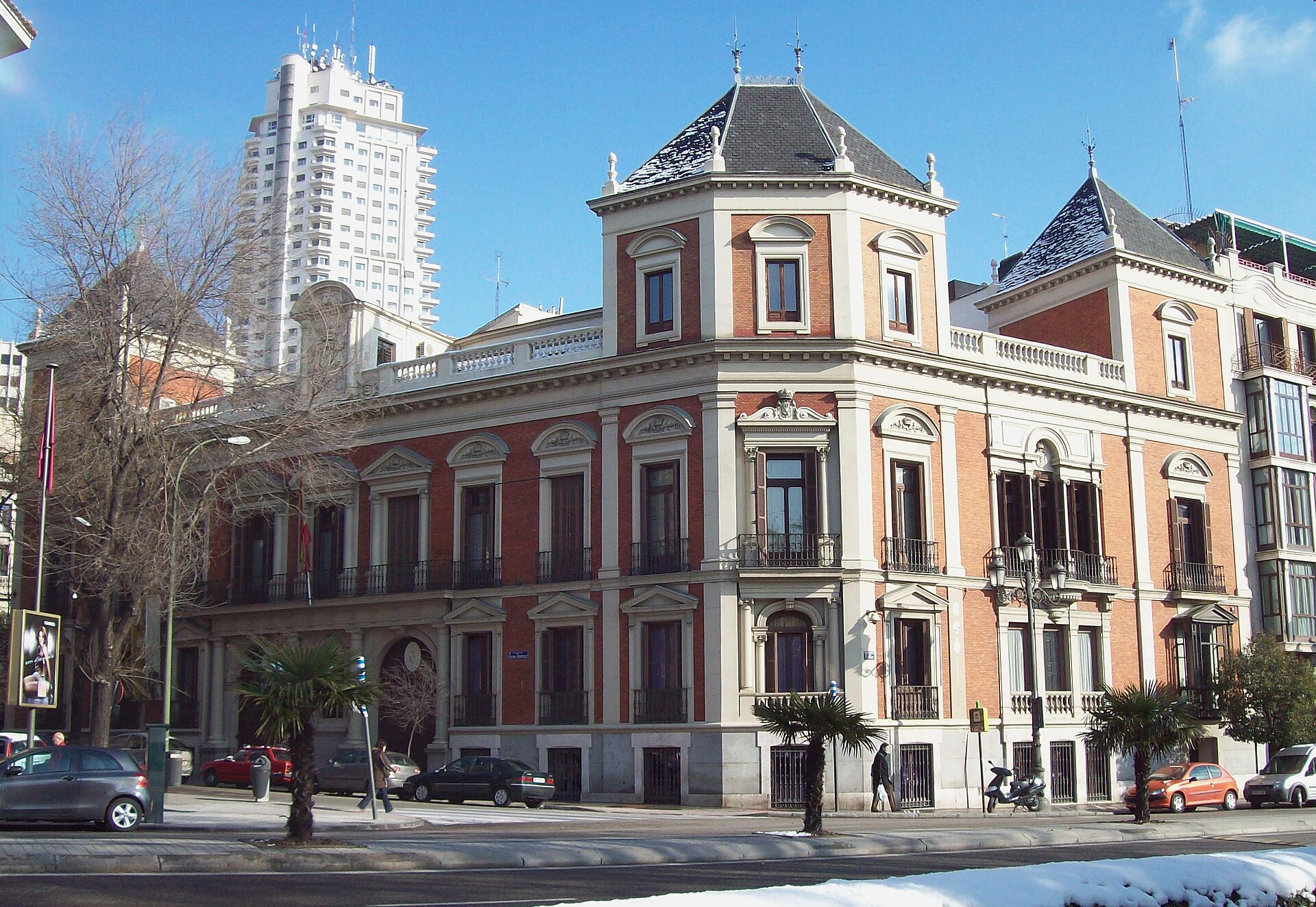
Museo Cerralbo
17 Calle de Ventura Rodríguez, Moncloa-Aravaca, Madrid, 28008, Spain
If you've ever wondered what it was like to be obscenely wealthy in 19th-century Madrid, this is your answer. The Museo Cerralbo is the former home of the 17th Marquis of Cerralbo, Enrique de Aguilera y Gamboa — politician, poet, archaeologist, and compulsive collector. Over his lifetime (1845-1922), the Marquis and his family amassed over 50,000 objects: paintings, sculptures, ceramics, tapestries, furniture, clocks, weapons, armor, coins, medals, and archaeological finds from excavations across Spain and Europe. The palace itself was built between 1883 and 1893 with a dual purpose: to be a family home and a museum. The Marquis designed the rooms specifically to display his collection, and the result is a Neo-Baroque fever dream of gilded mirrors, crystal chandeliers, and velvet-draped salons crammed with art from floor to ceiling. The Ballroom alone, with its ceiling paintings and sparkling fixtures, rivals anything in the Royal Palace. Works by El Greco, Zurbaran, Tintoretto, and Van Dyck hang on the walls alongside hundreds of lesser-known but equally beautiful pieces. When the Marquis died in 1922, he bequeathed the entire palace and its contents to the Spanish state on one condition: that everything remain exactly where he had placed it. The museum opened in 1944, and a few decades later was declared a Historic-Artistic Monument and Asset of Cultural Interest. It's one of the few 19th-century aristocratic palaces in Madrid that still has its original decoration intact. Almost nobody comes here. While the Prado and Reina Sofia draw millions, the Cerralbo sees a fraction of those visitors — which makes it one of the most pleasant museum experiences in the city. Entry is free on Saturdays and Sundays. You walk through rooms that look exactly as the Marquis left them a century ago, and the only sound is your footsteps on the parquet.
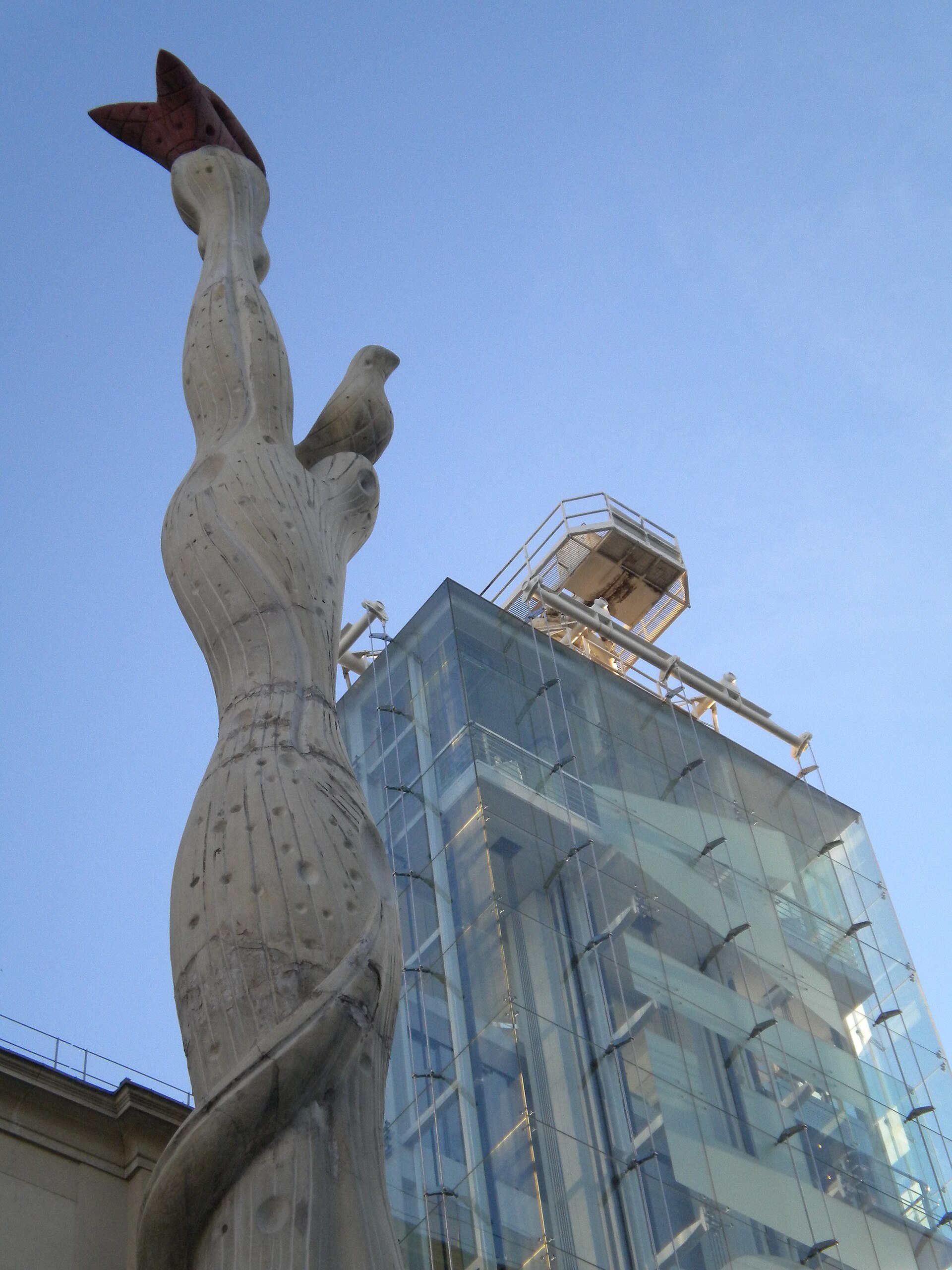
Museo Reina Sofía
52 Calle de Santa Isabel, Centro, Madrid, 28012, Spain
Every day, hundreds of people file into Room 206 and stand in silence before a painting that's 7.76 meters wide and 3.49 meters tall, rendered entirely in shades of black, white, and gray. Picasso's Guernica is the most famous anti-war painting ever made, and it spent more time outside Spain than inside it. Picasso painted it in his Paris studio in 1937, responding to the Nazi bombing of a Basque town that killed hundreds of civilians in a three-hour aerial assault. The painting was exhibited at the Paris World's Fair, then spent decades at the Museum of Modern Art in New York because Picasso refused to let it enter Spain while Franco was in power. The painting finally came home in 1981, six years after Franco's death. It first went to the Prado, then moved to the Reina Sofia in 1992 when the museum opened in a converted 18th-century hospital. The building itself is a fascinating hybrid — the austere stone walls of the original Hospital General, designed in 1566, now punctuated by three glass elevator towers added by British architect Ian Ritchie in 1988. A massive Jean Nouvel expansion in 2005 added a striking red-roofed annex on the south side. But everything revolves around Guernica. The painting cannot be loaned, cannot travel, and cannot be photographed (though people try constantly). It sits behind a barrier, filling an entire wall, and the screaming horse at its center remains one of the most gut-wrenching images in all of art. Picasso completed the canvas in just over a month, working in a frenzy documented by his partner Dora Maar's photographs. Beyond Guernica, the Reina Sofia houses Spain's national collection of 20th-century art, including major works by Dali, Miro, and Juan Gris. But let's be honest — most people come for one painting, and that painting delivers.
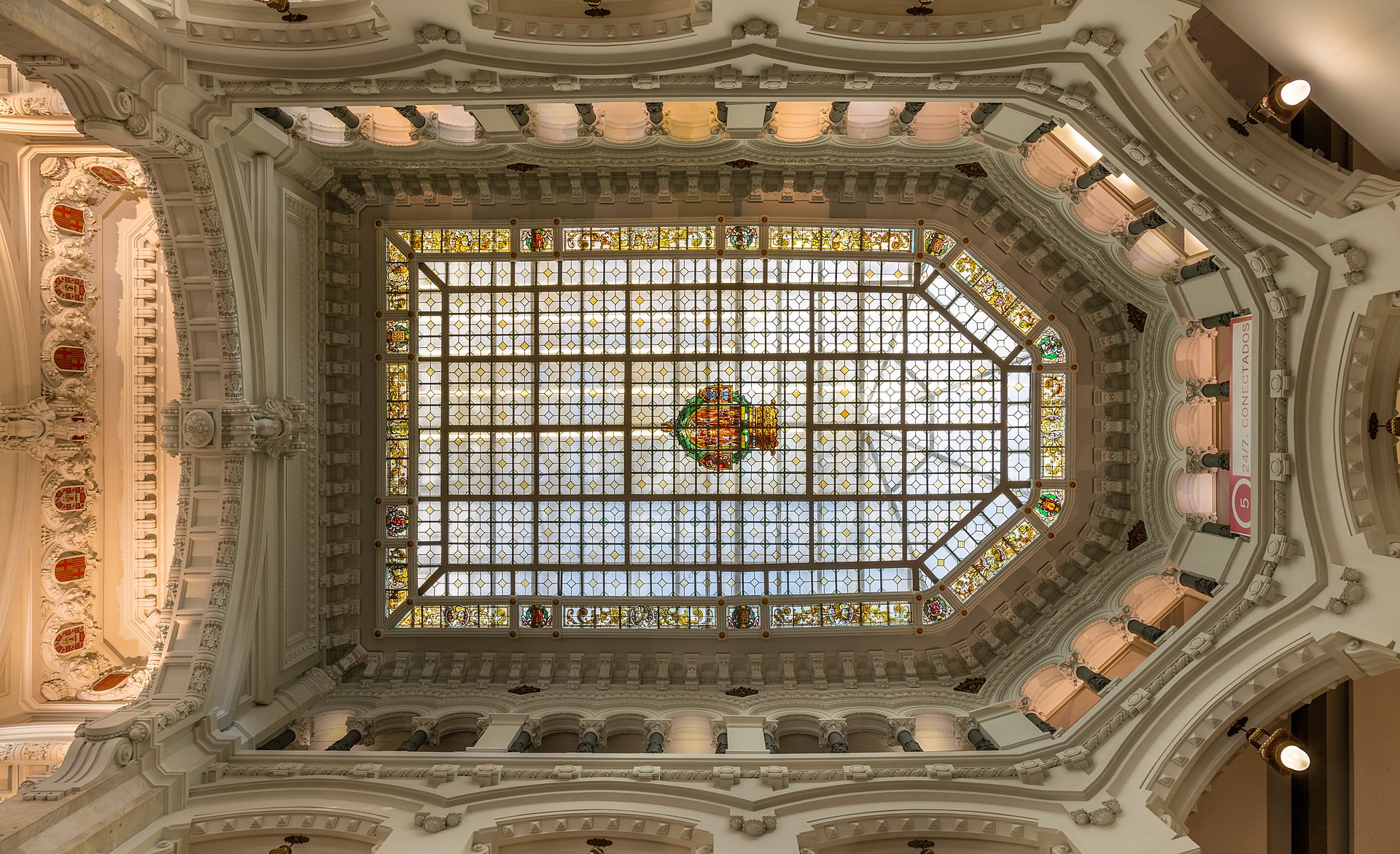
Plaza de Cibeles
Plaza Cibeles, Centro, Madrid, 28014, Spain
If Real Madrid wins the Champions League, this is where a million people come to scream about it. The Cibeles fountain — a goddess riding a chariot pulled by lions — has been the unofficial celebration point for Real Madrid victories since the 1980s. Players climb onto the fountain to drape it in the team's white scarf, while fans pack every square meter of surrounding pavement. The city has had to reinforce the statue multiple times to survive the love. The fountain itself predates football by two centuries. King Carlos III commissioned it in 1777 as part of his grand plan to beautify Madrid, and architect Ventura Rodriguez designed a statue of Cybele, the Phrygian goddess of fertility, holding a scepter and key — symbolizing the keys to the capital. Sculptors Francisco Gutierrez and Roberto Michel carved the figures from marble, and the fountain was inaugurated in 1782, originally positioned across the square from where it sits today. It was moved to its current central location in the 19th century. The real showstopper behind the fountain is the Palacio de Cibeles — the absurdly grand wedding-cake building that looks like it should house a parliament or an opera company. It was actually built as a post office. Architects Antonio Palacios and Joaquin Otamendi won a competition in 1904 and created what might be the most beautiful mail-sorting facility ever constructed, completed in 1919. Since 2007, it's served as Madrid's city hall, and the top-floor observation deck offers panoramic views of the entire city. At night, when the fountain and palace are lit up, the plaza becomes one of the most spectacular urban scenes in Europe — a crossroads where neoclassical elegance meets the raw emotion of a footballing city.
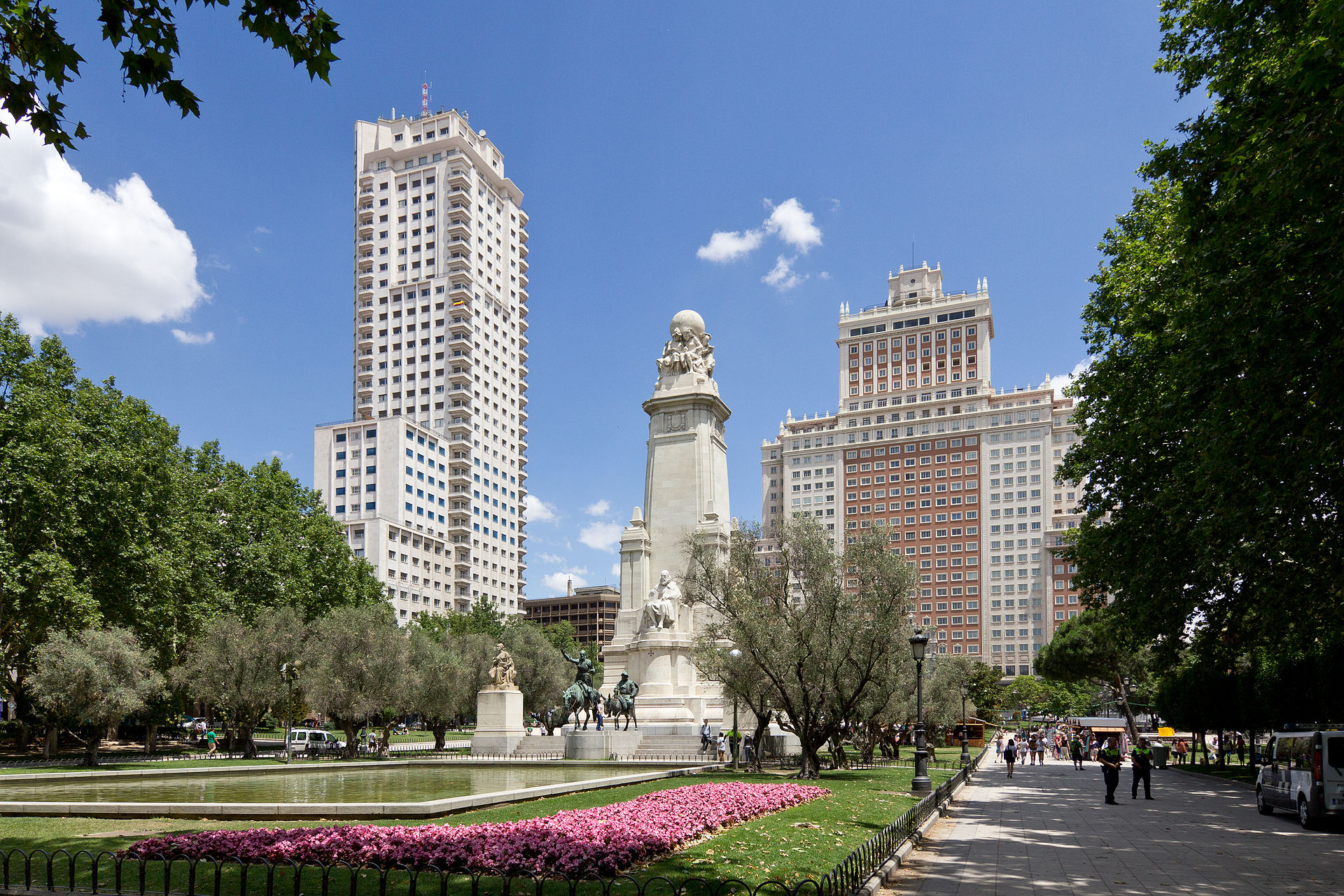
Plaza de España
Plaza de España, Moncloa-Aravaca, Madrid, 28013, Spain
At the center of this grand square, Don Quixote and Sancho Panza sit in bronze, staring up at their creator. The Cervantes Monument was commissioned in 1915 to celebrate the 300th anniversary of the publication of the second part of Don Quixote, and it turned out to be one of the most enduring literary tributes in the world. Cervantes sits enthroned in stone above his two most famous characters — the gaunt knight on his horse and the rotund squire on his donkey — while figures of Dulcinea and the real-life Aldonza Lorenzo stand to the sides, fiction and reality separated by a few meters of granite. The square sits at the western terminus of Gran Via and was, for decades, Madrid's attempt at a Manhattan skyline. The Edificio Espana, completed in 1953 at 117 meters, was the tallest building in Spain when it opened. Four years later, the Torre de Madrid rose to 142 meters — the tallest concrete building in the world at the time, earning the nickname "La Jirafa" (The Giraffe) from Madrilenos who couldn't quite believe a building that tall could exist in their low-rise city. For years, the plaza was a traffic-choked concrete island that nobody lingered in. Then in 2019, after a massive and controversial renovation, the city pedestrianized most of the square, planted hundreds of trees, and turned it into one of Madrid's most pleasant public spaces. Locals who had avoided it for decades suddenly rediscovered it. Today the plaza works as a gateway: Gran Via's commercial buzz flows in from the east, the Templo de Debod's sunset views lie just to the north, and the Royal Palace grounds stretch to the south. Don Quixote, as always, is tilting at windmills that only he can see.
Plaza Mayor
Plaza Mayor, Centro, Madrid, 28012, Spain
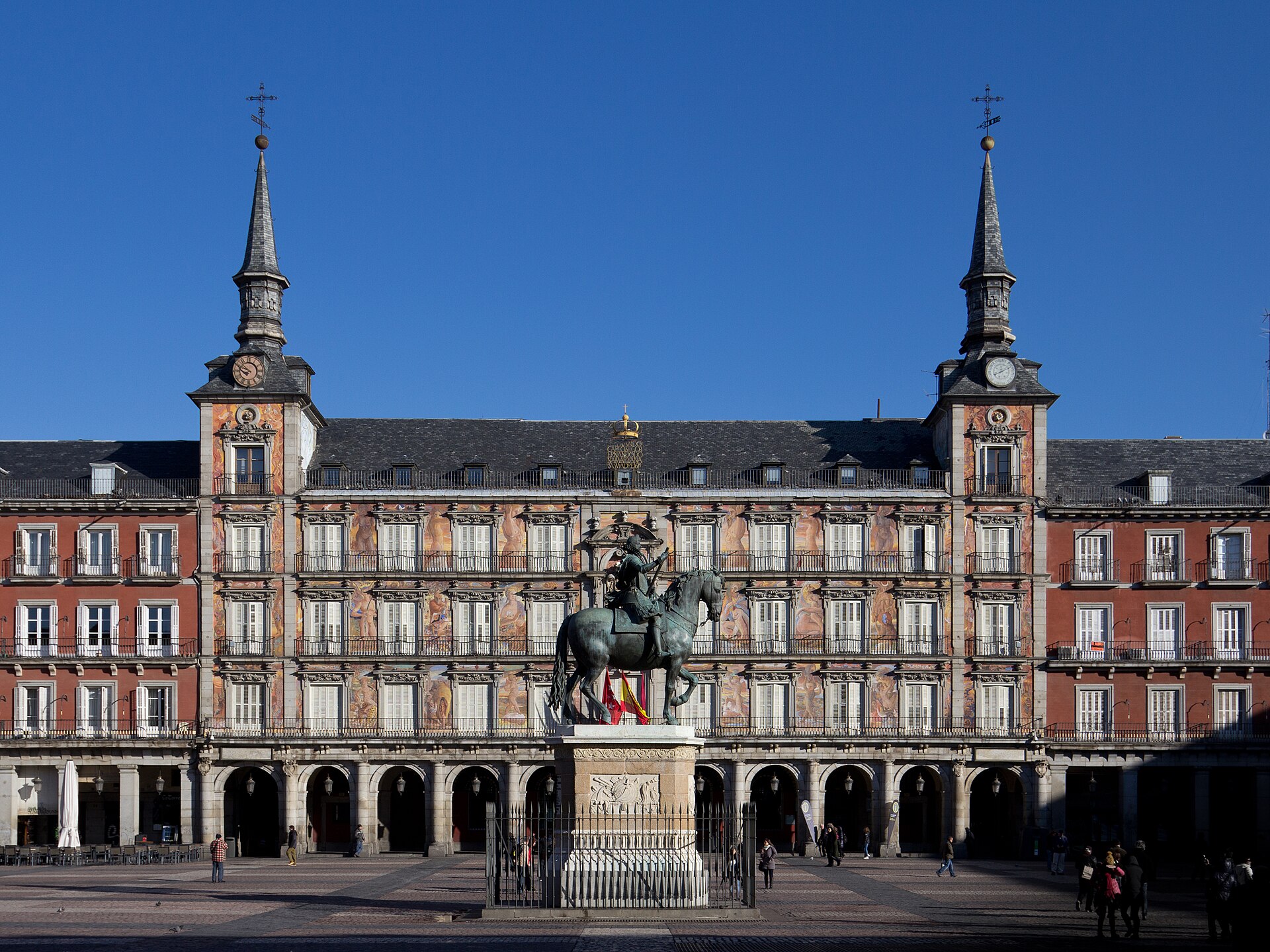
This grand rectangle of rust-red facades and slate rooftops has been the stage for some of Spain's most dramatic public spectacles — bullfights, royal coronations, theatrical performances, and executions by the Inquisition. On June 30, 1680, the plaza hosted a massive auto-da-fe in which 117 people were sentenced before a roaring crowd, with twenty-one condemned to burn. The cobblestones beneath your feet have soaked up more history than most countries' entire capitals. Philip III commissioned the plaza in 1580, and architect Juan Gomez de Mora finished the job in 1619, creating a fully enclosed rectangular square ringed by 237 balconies — each one a VIP box for watching whatever spectacle was playing below. The equestrian statue of Philip III in the center looks serene now, but it nearly killed someone during its installation. The bronze horse was found to be hollow, and over the centuries, sparrows nested inside it — a colony of birds living in the belly of a king on horseback. During a 1930s restoration, workers discovered hundreds of bird skeletons inside the statue. Fire has ravaged the plaza three times — in 1631, 1670, and 1790. After the last and worst blaze, architect Juan de Villanueva rebuilt it, reducing the buildings from five stories to three and closing off the corners with arched entranceways. The nine arched gates you walk through today are his design. Now the plaza is mostly cafes and Christmas markets, portrait artists and street performers. But look up at the Casa de la Panaderia on the north side — the old bakery guild hall, covered in mythological frescoes painted in 1992 — and you can still feel the weight of four hundred years of spectacle.
Prado Museum
23 Calle de Ruiz de Alarcón, Retiro, Madrid, 28014, Spain
The building was never supposed to hold art. Charles III commissioned architect Juan de Villanueva in 1785 to design a Natural History Cabinet — a temple to science, not painting. Then Napoleon invaded, the Peninsular War trashed the construction site, and the half-finished building sat abandoned for years. When Ferdinand VII finally opened it in 1819, his wife Maria Isabel persuaded him to fill it with the royal art collection instead. Science's loss was art's gain, and the Prado was born — with a first catalogue listing just 310 works. Today the collection has grown to roughly 8,200 drawings, 7,600 paintings, 4,800 prints, and 1,000 sculptures. The museum can only display about 1,500 works at a time — roughly 14 percent of what it owns. The rest lives in storage, on loan, or in satellite buildings. Francisco Goya is the most extensively represented artist, with an entire wing dedicated to his work, from luminous early tapestry cartoons to the nightmarish Black Paintings he smeared directly onto the walls of his own house in his old age. But the Prado's crown jewel is Velazquez's Las Meninas, painted in 1656 — a painting of a painter painting the king and queen while the princess and her attendants look on. It's a hall-of-mirrors puzzle about who's watching whom, and it still stops people in their tracks after nearly four centuries. Hieronymus Bosch's Garden of Earthly Delights, a triptych of heavenly pleasures and hellish torments from around 1500, is the other must-see — acquired by Philip II, who was allegedly so obsessed with it he had it hung in his bedroom. In 2007, Pritzker Prize-winning architect Rafael Moneo completed a major expansion, adding 22,000 square meters of new gallery space. The Prado keeps growing, just like it always has.
Puerta de Alcalá
Plaza de la Independencia, 28001 Madrid
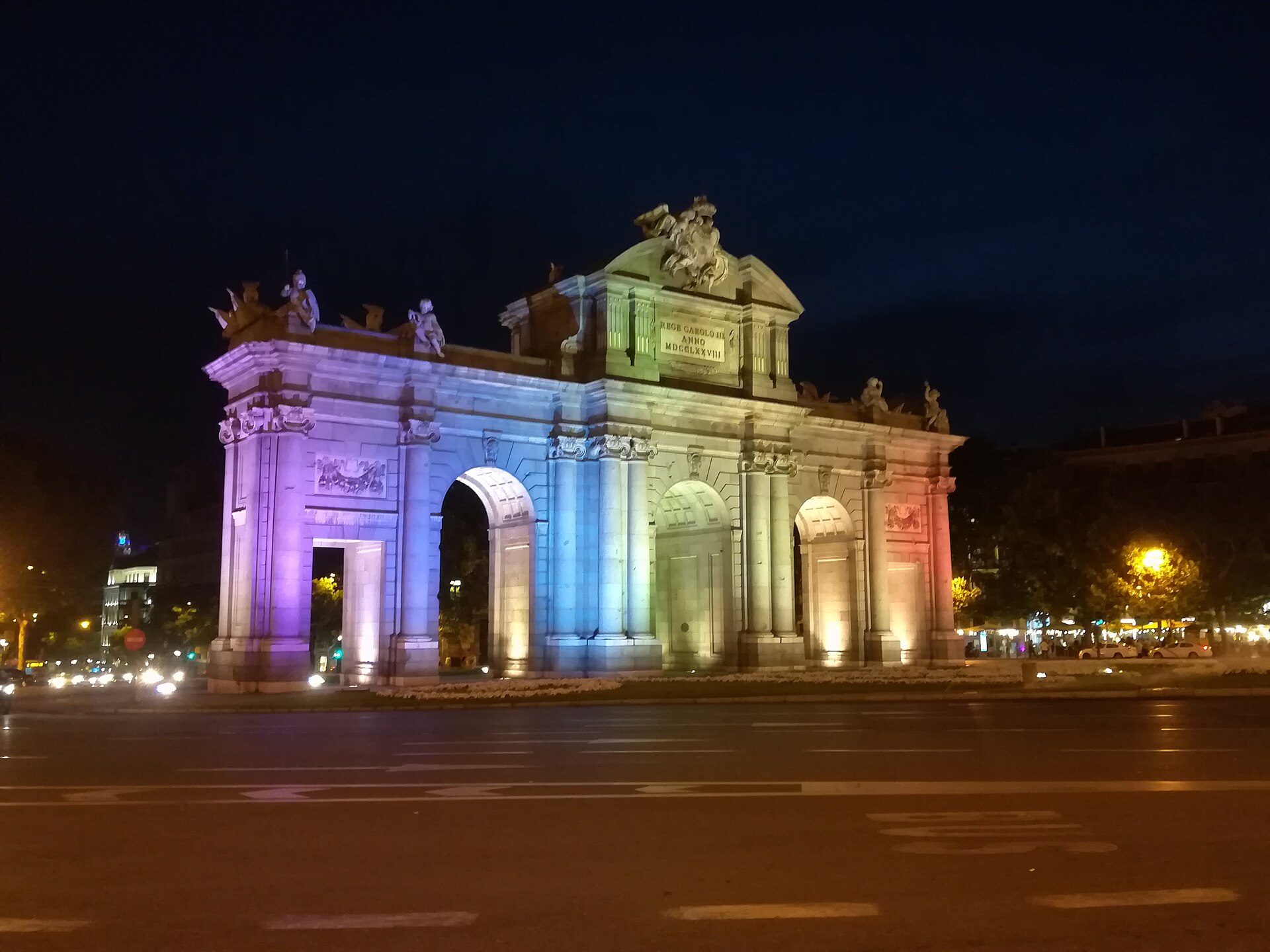
This is the first modern triumphal arch built in Europe after the fall of the Roman Empire — or at least, that's the claim Madrilenos love to make. Commissioned by Charles III in 1778 and designed by Francesco Sabatini, the Puerta de Alcala replaced an earlier, less impressive gate that marked the eastern entrance to Madrid on the road to Alcala de Henares. Charles III wanted something monumental, something to announce that Madrid was a European capital worthy of the name. Sabatini delivered a five-arched neoclassical gate in granite, standing 19 meters tall. Look closely and you'll notice something odd: the two facades are different. The outer face (facing away from the city center) has pilasters with Ionic capitals. The inner face has engaged columns. This asymmetry wasn't a mistake — Sabatini designed each side to respond to its surrounding architecture — but it makes the gate one of the few major monuments that looks different depending on which direction you approach it from. The gate has witnessed some of Madrid's most dramatic moments. During the 1808 uprising against Napoleon, fighting raged around it. During the Civil War, Republican forces built defensive positions nearby. In 1986, it became the symbol of Madrid's cultural awakening when singer Ana Beltran's hit song "Puerta de Alcala" turned the monument into a pop culture icon. Today it stands on a traffic island in the Plaza de la Independencia, the grand entrance to Retiro Park just behind it. At night, dramatically lit against the dark sky, it's one of the most photographed monuments in Madrid — a stone gateway to a city that doesn't need walls anymore but keeps its doors standing anyway.
Puerta del Sol
Plaza de la Puerta del Sol, 28013 Madrid
Stand on the small bronze plaque in the pavement here and you're standing at the exact center of Spain. Kilometer Zero — the point from which every radial road in the country is measured — sits right at your feet, embedded in the sidewalk in front of the old post office building. Every distance marker on every highway in Spain counts from this spot. It's the belly button of a nation, and most people walk right over it without looking down. The name means "Gate of the Sun," after a gate in the 15th-century city wall that faced east toward the sunrise. The gate is long gone, demolished centuries ago, but the name stuck. The crescent-shaped square you see today took its current form between 1857 and 1862, when the government bulldozed a clutch of medieval buildings to create a grand civic space. The old post office — now the regional government headquarters — was built even earlier, between 1766 and 1768, by French architect Jacques Marquet, and its clock tower has become the emotional center of Spain's New Year celebrations. Every December 31st, millions of Spaniards watch those clock hands on television, stuffing twelve grapes into their mouths — one per chime at midnight. Get them all down in time and you'll have good luck for the year. It's harder than it sounds, and the square fills with tens of thousands of people attempting the feat together, cheeks bulging, champagne at the ready. This is also where modern Spanish protest was reborn. In May 2011, the 15-M movement — Spain's version of Occupy — turned Puerta del Sol into a tent city for weeks, with thousands camping out against austerity measures. The square has always been where Madrid comes to celebrate, mourn, and demand change.
Real Academia de Bellas Artes de San Fernando
Calle de Alcalá, 13, 28014 Madrid
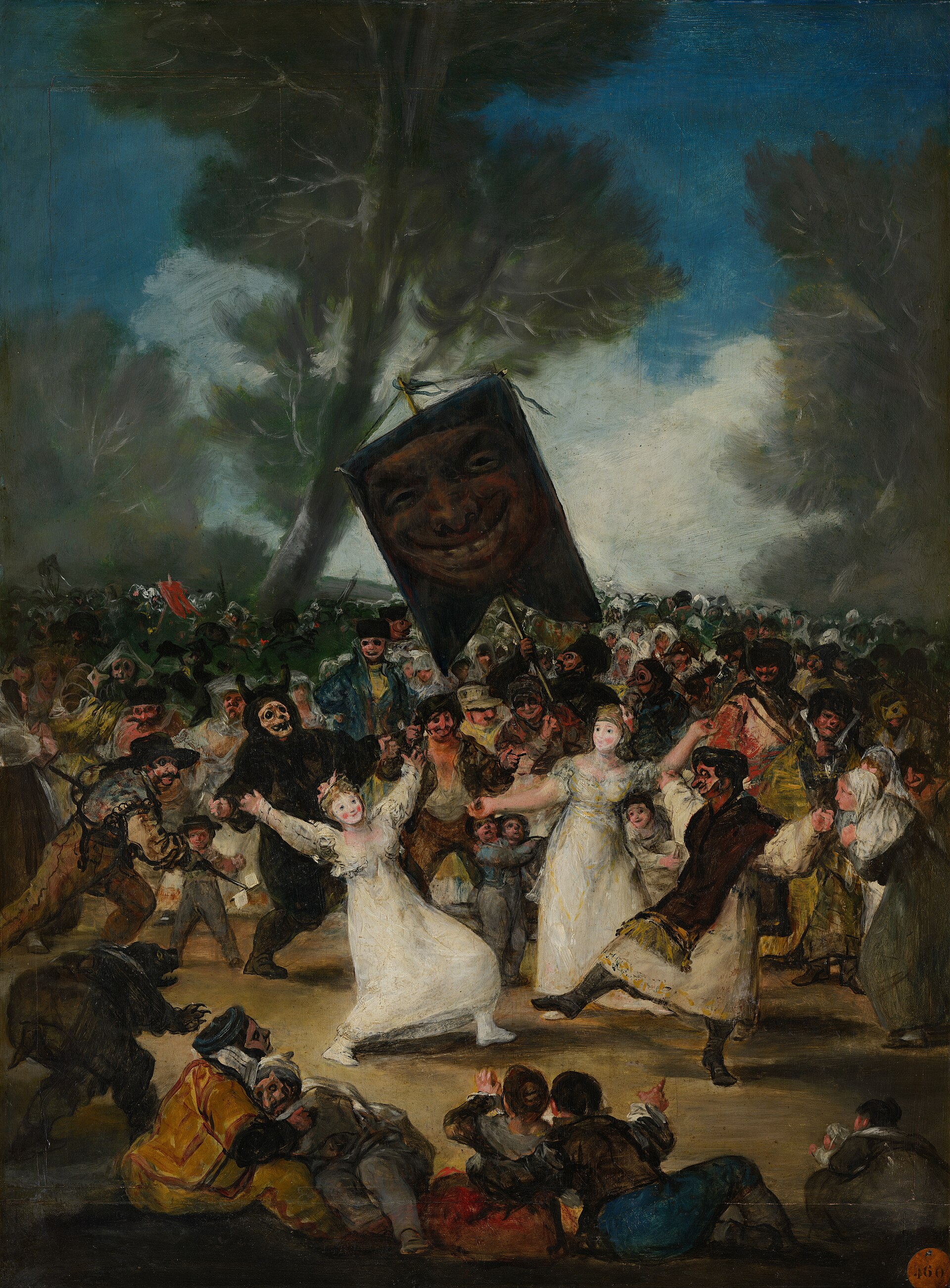
Picasso studied here. Dali was expelled from here. Goya directed the painting department. And almost no one visits. The Real Academia de Bellas Artes de San Fernando is one of Madrid's most extraordinary museums, hiding in plain sight on the busy Calle de Alcala, five minutes from Puerta del Sol. The building has been shaping Spanish art since 1752, when it was established by royal decree, and its collection of paintings from the 15th to 20th centuries rivals many national museums. Goya's connection runs deepest. He was elected to the Academy in 1780 and became Director of Painting in 1795, teaching classes here until his increasing deafness — the result of a mysterious illness in 1792 — made it impossible. The Academy holds thirteen of his paintings, including the riotous "Burial of the Sardine," a scene of carnivalesque chaos that seems to throb with music and madness. Picasso arrived in 1897, formally enrolling at the Academy's School of Painting, Sculpture and Etching at just sixteen. He found it stifling. Dali enrolled in 1922, lived in the famous Residencia de Estudiantes nearby, and promptly declared in 1926 that no professor at the Academy was qualified to examine him. He was expelled. Both artists found the institution too rigid for their revolutionary ideas — but both were shaped by it. The collection goes far beyond its famous alumni. Works by Arcimboldo, Rubens, Bellini, and Zurbaran hang in grand salons that most tourists never discover because they're too busy queuing for the Prado. The Academy also houses a remarkable collection of prints and drawings, including an astonishing 978 copper printing plates used to produce Goya's etchings. Entry is remarkably cheap, the rooms are quiet, and the art is world-class.
Real Jardín Botánico
Plaza de Murillo, 2, 28014 Madrid
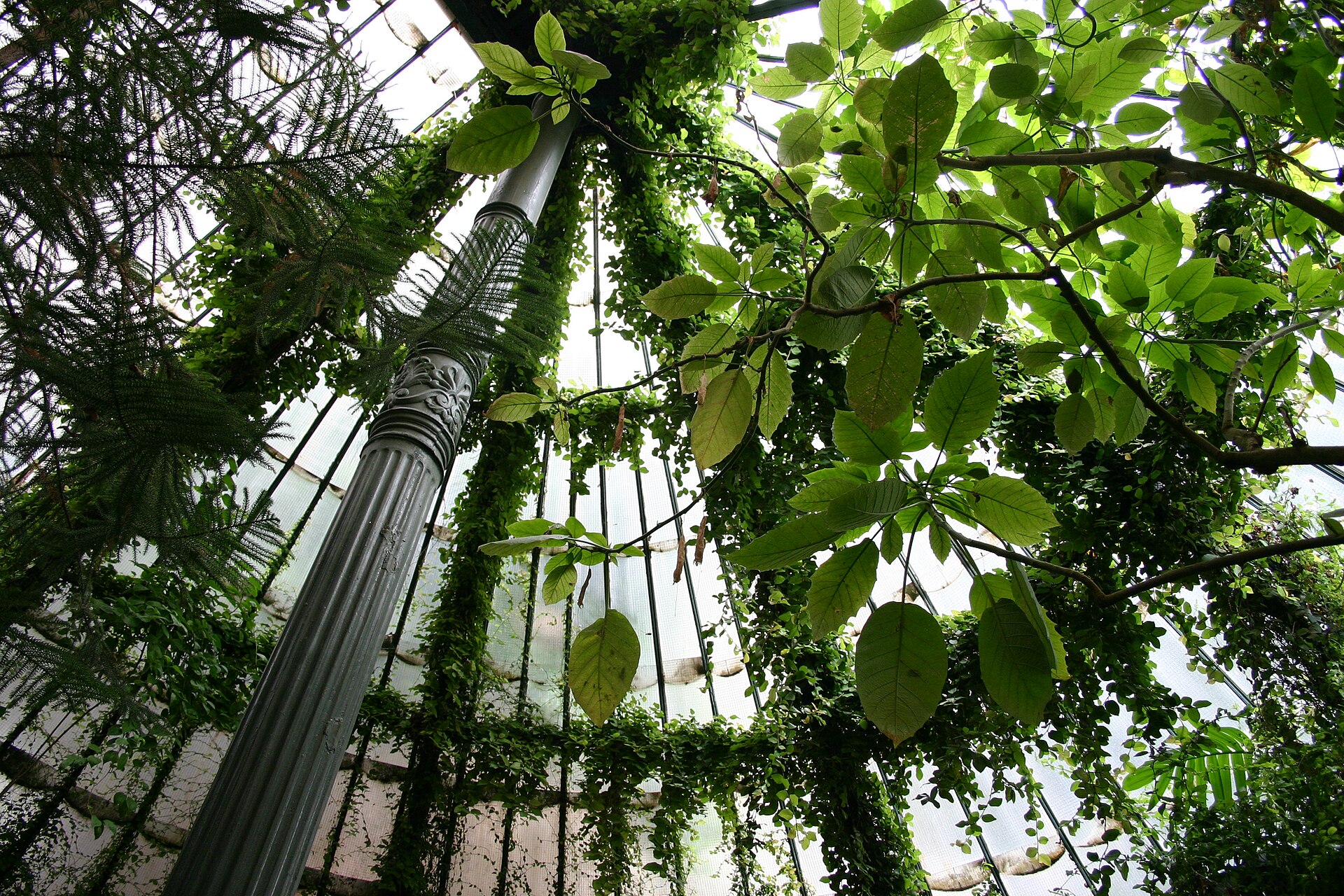
Tucked right next to the Prado, this garden is one of Madrid's most overlooked treasures — millions of people walk past its walls every year on the way to the museum without ever stepping inside. Founded by King Ferdinand VI on October 17, 1755, the Royal Botanical Garden was originally planted on the banks of the Manzanares River with over 2,000 species collected by Jose Quer y Martinez, the royal botanist and surgeon. Charles III moved it to its current location in 1781 as part of his grand plan to create a boulevard of science and culture along the Paseo del Prado. The garden was meant to be a living laboratory, not just a pretty park. Spanish expeditions to the Americas, the Philippines, and the Pacific brought back thousands of specimens — the collection exploded after Alessandro Malaspina's famous 1794 expedition added 10,000 plants. For a brief, glorious period, this small Madrid garden was the botanical nexus of the largest empire on Earth, cataloguing species from Manila to Patagonia. Then Napoleon showed up. The Peninsular War devastated the garden, and it went through decades of neglect before being revived in the mid-19th century. Since 1939, it's been managed by Spain's National Research Council. Today it contains about 90,000 plants and flowers, 1,500 trees, and a herbarium with over a million pressed specimens — one of the most important botanical archives in the world. The garden is divided into seven outdoor sections and five greenhouses, each creating its own microclimate in a city where summer temperatures regularly exceed 40 degrees Celsius. The terraced layout descends from the Paseo del Prado in three levels, each greener and quieter than the last. On a sweltering August afternoon, it's the coolest place in Madrid — in every sense of the word.
Retiro Park
Plaza de la Independencia, 7, 28001 Madrid
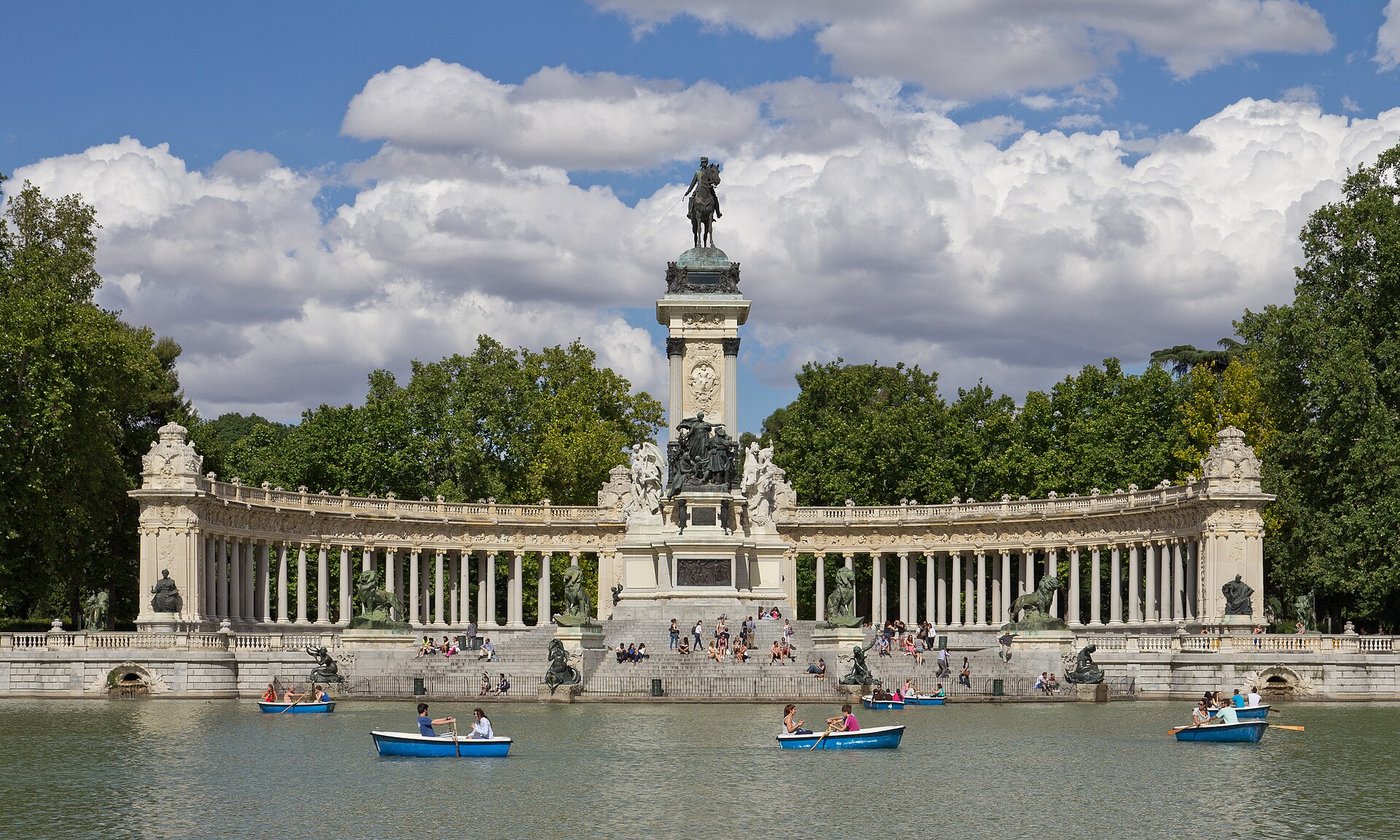
For two hundred years, this 125-hectare garden was the private playground of Spanish royalty — off-limits to common people, guarded by walls, and filled with peacocks, fountains, and theatrical stages built for an audience of kings. The park only opened to the public in 1868, after Queen Isabella II was overthrown and exiled. The revolution literally gave Madrid its favorite park. The Retiro was originally part of a vast royal palace complex built for Philip IV in the 1630s. The palace itself was destroyed during the Napoleonic Wars — French troops used it as a barracks and fortification, and it was largely demolished. All that remains of the original Buen Retiro Palace is the Salon de Reinos (Hall of Realms) and the Cason del Buen Retiro, both now administered by the Prado. But the gardens survived and grew. The Crystal Palace alone is worth the visit. Built in 1887 by architect Ricardo Velazquez Bosco, it's a soaring glass-and-iron greenhouse originally designed to display tropical plants from the Philippines for a colonial exposition. The Spanish-American War of 1898 ended the Philippines connection, and the building became an art space — it now hosts temporary exhibitions for the Reina Sofia. Stand inside when the light pours through the glass ceiling and the turtles paddle in the artificial lake outside, and you'll understand why locals consider it the most beautiful building in Madrid. In 2021, the Retiro was inscribed as a UNESCO World Heritage Site along with the Paseo del Prado. The park's central lake, where you can rent rowboats under the gaze of a massive Alfonso XII monument, is the social heart of Madrid on weekends. Fortune tellers, puppet shows, and a lone man who's been playing crystal glasses by the lake for decades — the Retiro is a city within a city.
Royal Palace
Calle de Bailén, s/n, 28071 Madrid
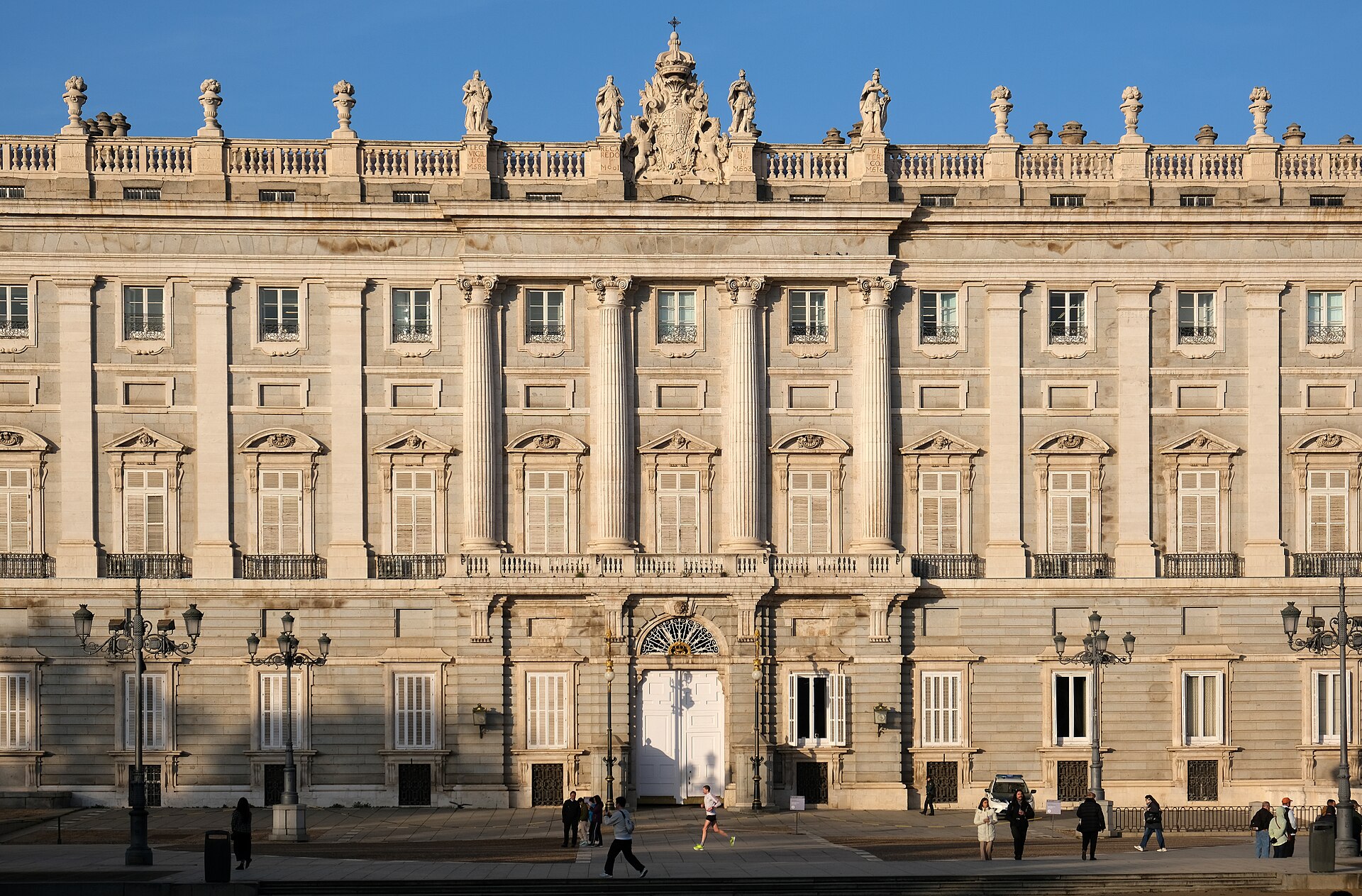
With 3,418 rooms, the Royal Palace of Madrid is the largest royal palace in Europe — bigger than Buckingham Palace, bigger than Versailles in sheer room count. The Spanish royal family hasn't actually lived here since Alfonso XIII left in 1931, but it remains the official residence of the monarchy, and King Felipe VI still uses it for state ceremonies. It's a working palace that nobody sleeps in. The current building rose from ashes — literally. The old Alcazar, a medieval Moorish fortress expanded by the Habsburgs, burned to the ground on Christmas Eve 1734. Philip V, who'd grown up at Versailles and never much liked the drafty old castle, saw the fire as an opportunity. He ordered an entirely new palace in the Italian Baroque style, insisting it be built entirely of stone and brick so it could never burn again. Construction started in 1738 under architect Filippo Juvara, continued under Giovanni Battista Sacchetti after Juvara's death, and wasn't finished until 1764 under Charles III, who became the first king to live in it. Inside, the opulence is staggering. The Throne Room drips with Tiepolo ceiling frescoes. The Royal Pharmacy still displays centuries-old apothecary jars. And the Royal Armoury preserves one of the world's finest collections of arms and armor, including the personal gear of Charles V and Philip II. But the palace's most extraordinary possession might be the Stradivarius Quartet — actually a quintet — the only complete set of Stradivarius string instruments in the world, all built by Antonio Stradivari between 1696 and 1709. The gardens of Campo del Moro behind the palace stretch down to the Manzanares River, offering one of the best views of the building's western facade — a perspective most visitors miss entirely.
Sabatini Gardens
Calle de Bailén, 2, 28013 Madrid
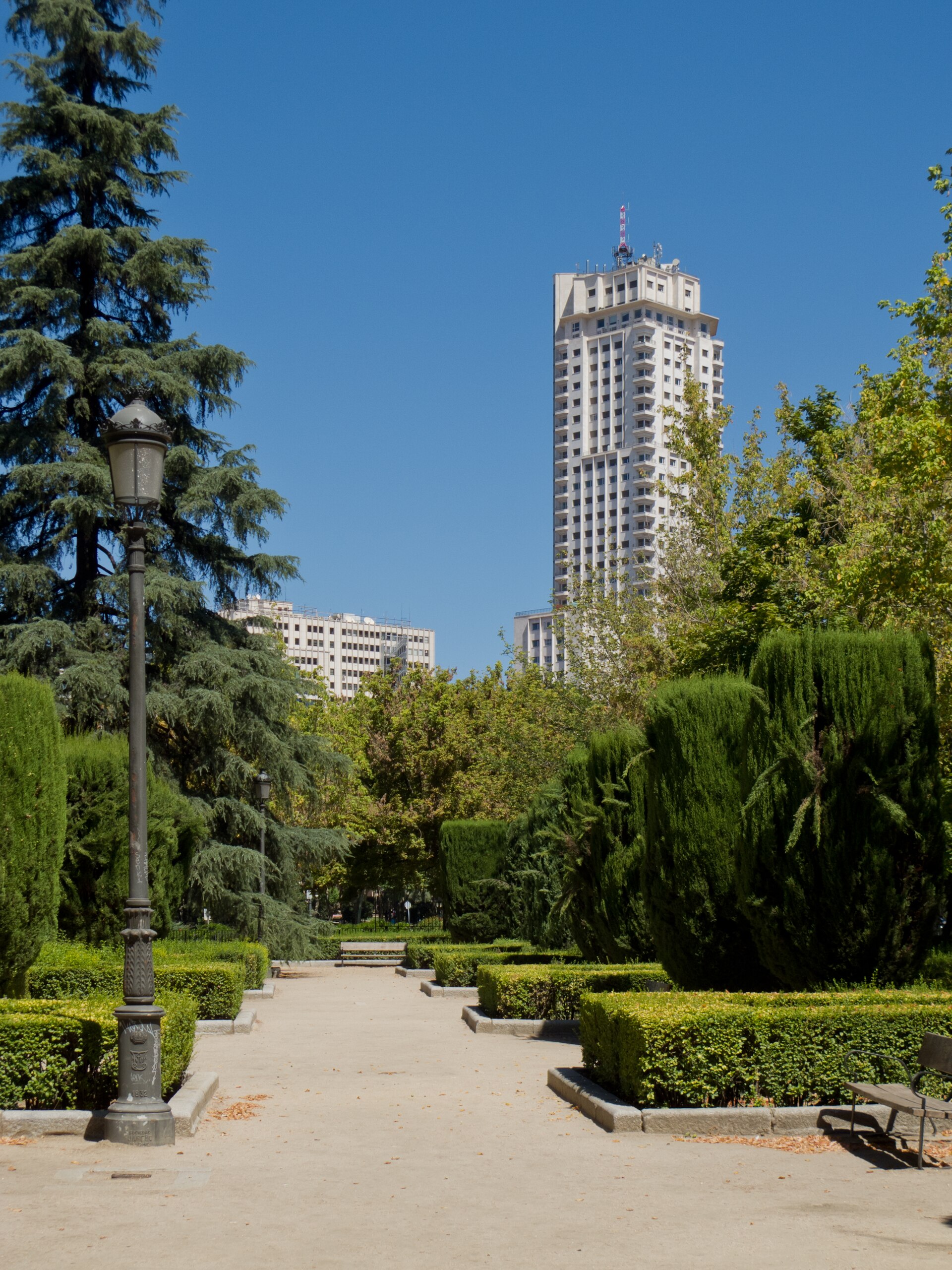
Where Spanish kings once kept their horses, Madrilenos now keep their evening rituals. The Sabatini Gardens occupy the site of the Royal Stables, which Philip II ordered built in 1553 to house the palace's horses. For nearly four centuries, this was a working stable yard — grooms, carriages, and the smell of hay. The stables were designed by Francesco Sabatini, the Italian architect who also expanded the Royal Palace, and when they were finally demolished in the 1930s, the space was turned into one of Madrid's most elegant gardens. The formal French-style layout was designed by Fernando Garcia Mercadal, a Zaragozan architect, and construction began in 1933 under the new Spanish Republic. Politics, civil war, and decades of dictatorship delayed completion — the gardens weren't finished and opened to the public until 1978, when King Juan Carlos I inaugurated them. The symmetrical hedges, geometric pathways, rectangular reflecting pool, and rows of white marble statues give the space a Versailles-in-miniature quality, but at a scale that feels intimate rather than overwhelming. The marble statues lining the garden are known as the "Gothic Kings" — a series of Spanish monarchs originally commissioned between 1750 and 1753 for the roofline of the Royal Palace. They were deemed too heavy for the rooftop and were removed, eventually finding a home down here among the hedges. Kings who were meant to survey Madrid from on high now stand at eye level, surrounded by box hedges and magnolia trees. At night, the gardens are lit softly and the north facade of the Royal Palace glows above the tree line. It's one of the most romantic spots in Madrid, and it's completely free. Most visitors focus on the palace's south side; the Sabatini Gardens reward those who walk around to the quieter north.
Sorolla Museum
Paseo del General Martínez Campos, 37, 28010 Madrid
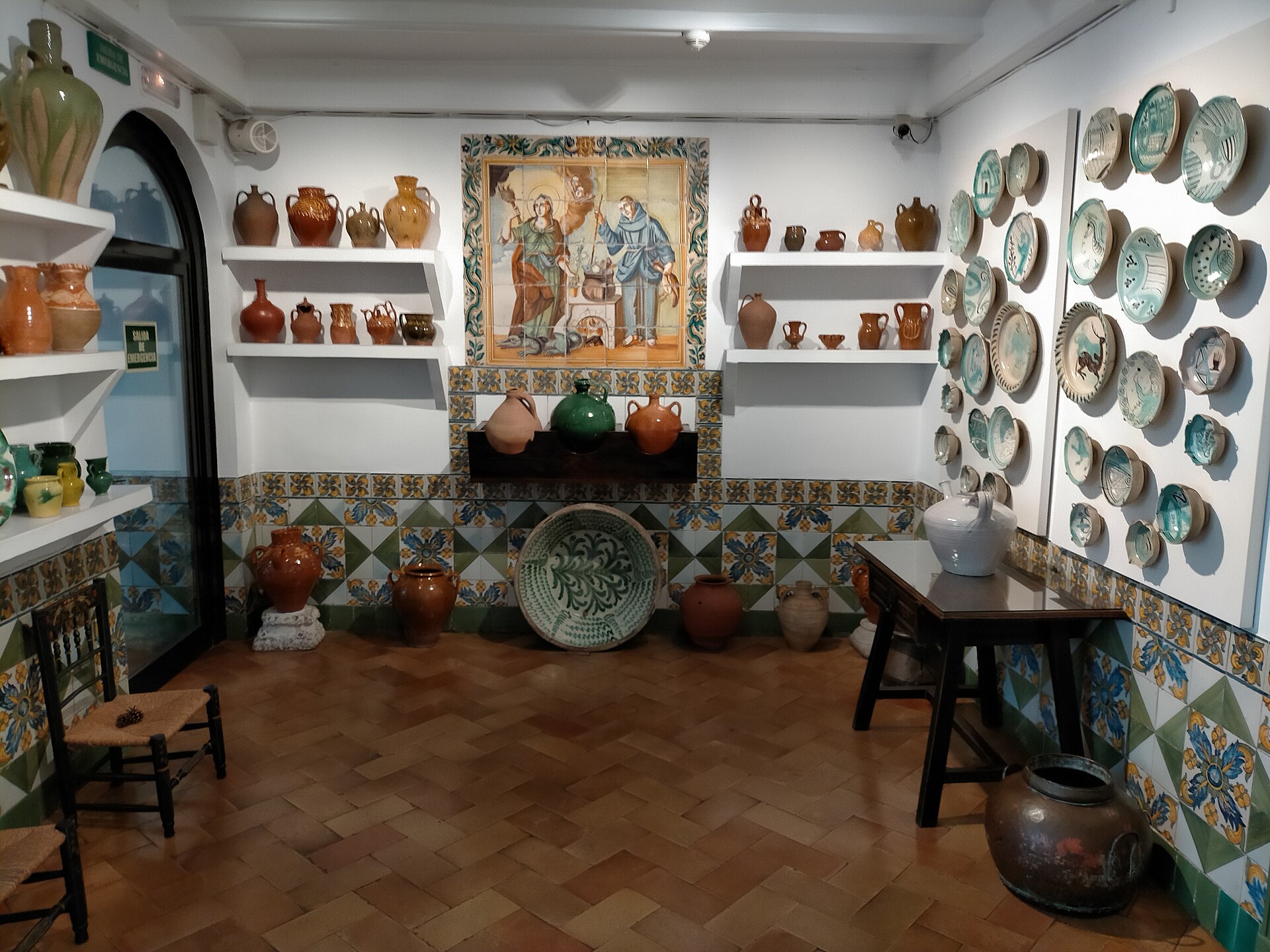
Joaquin Sorolla was the painter of light — Mediterranean sunlight bouncing off wet sand, children wading in surf, white linen billowing in coastal wind. He captured the Spanish coast with such luminous intensity that his paintings seem to glow from within. And the best place to see his work is not in some grand museum, but in his own home, exactly where he lived and painted until a stroke took the brush from his hand forever. Sorolla was born in Valencia in 1863. Two years later, both his parents died in a cholera epidemic. Raised by relatives, he showed enough talent to enter the Academy of San Carlos at just fifteen. By the 1890s, his career was a breathless succession of international exhibitions — Munich, Paris, Chicago, Vienna, Buenos Aires. His 1909 exhibition at the Hispanic Society of America in New York was a sensation, drawing over 160,000 visitors and cementing his reputation as Spain's greatest living painter. He built this house in 1911, designing the Andalusian-style garden himself — a private oasis of tiled fountains, climbing roses, and orange trees that served as both refuge and studio. On a June day in 1920, Sorolla was painting in this very garden when he suffered a massive stroke. The painting was left unfinished. He never held a brush again and died three years later at age 60. His widow, Clotilde, bequeathed the house and its entire contents to the Spanish state in 1925, requesting it be turned into a museum. It opened in 1932 and remains one of the best-preserved artist house-museums in Europe. You can stand in his studio, see his palette, his easels, his unfinished canvases — and then step into the garden where it all ended, still blooming exactly as he designed it.
Templo de Debod
Calle de Ferraz, 1, 28008 Madrid
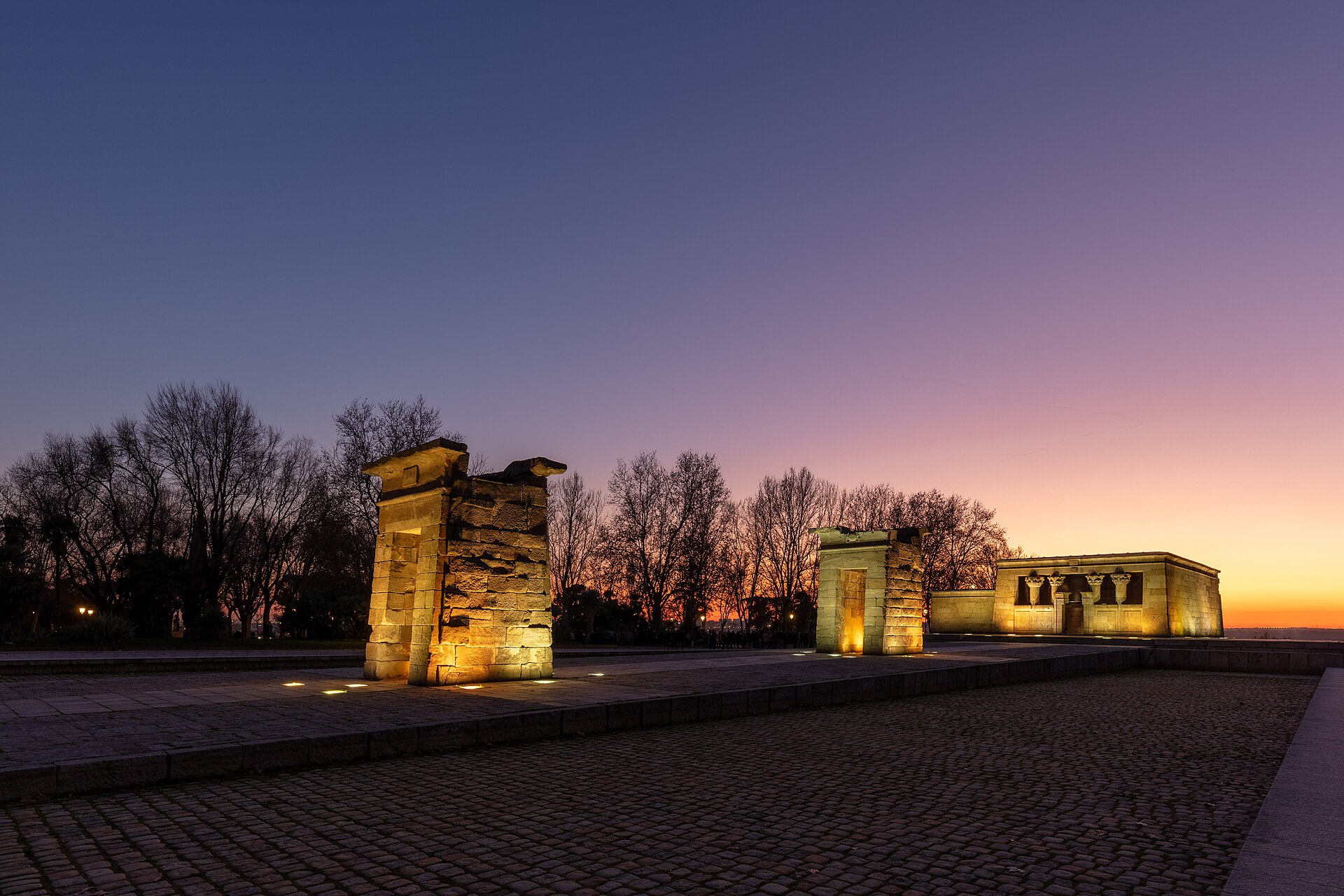
There is a 2,200-year-old Egyptian temple sitting in a park in Madrid, and it got here by boat. The Templo de Debod was originally built in the early 2nd century BC, about 15 kilometers south of Aswan in Upper Egypt, commissioned by Nubian King Adijalamani of Meroe as a chapel to the gods Amun and Isis. Over the following centuries, Ptolemaic pharaohs and Roman emperors — Augustus, Tiberius, possibly Hadrian — kept adding to it, expanding a modest shrine into a proper temple complex. Then in the 1960s, Egypt began building the Aswan High Dam, and hundreds of ancient monuments along the Nile were about to be drowned. UNESCO launched an international rescue campaign, and Spain sent engineers and archaeologists to help dismantle and relocate the temples of Abu Simbel. In gratitude, Egypt gifted the Temple of Debod to Spain in 1968. The temple was dismantled stone by stone, shipped from Alexandria to Valencia by sea, trucked to Madrid, and painstakingly reassembled in the Parque del Oeste, reopening to the public in 1972. It's one of the only ancient Egyptian temples visible outside Egypt, and the only one of its kind in Spain. The hieroglyphs on the interior walls, the original stone blocks, the carved reliefs showing offerings to the gods — they're all real, all authentic, all profoundly strange sitting on a hillside overlooking Madrid's skyline. But the temple's second life has given it a new purpose that Adijalamani never imagined: it's become Madrid's favorite sunset spot. The reflecting pool in front of the temple mirrors the building and the sky, and on clear evenings, half of Madrid seems to gather here with wine bottles and picnic blankets, watching the sun drop behind the Casa de Campo. An Egyptian temple, a Spanish sunset, and two millennia of accumulated wonder.
Thyssen-Bornemisza Museum
Paseo del Prado, 8, 28014 Madrid
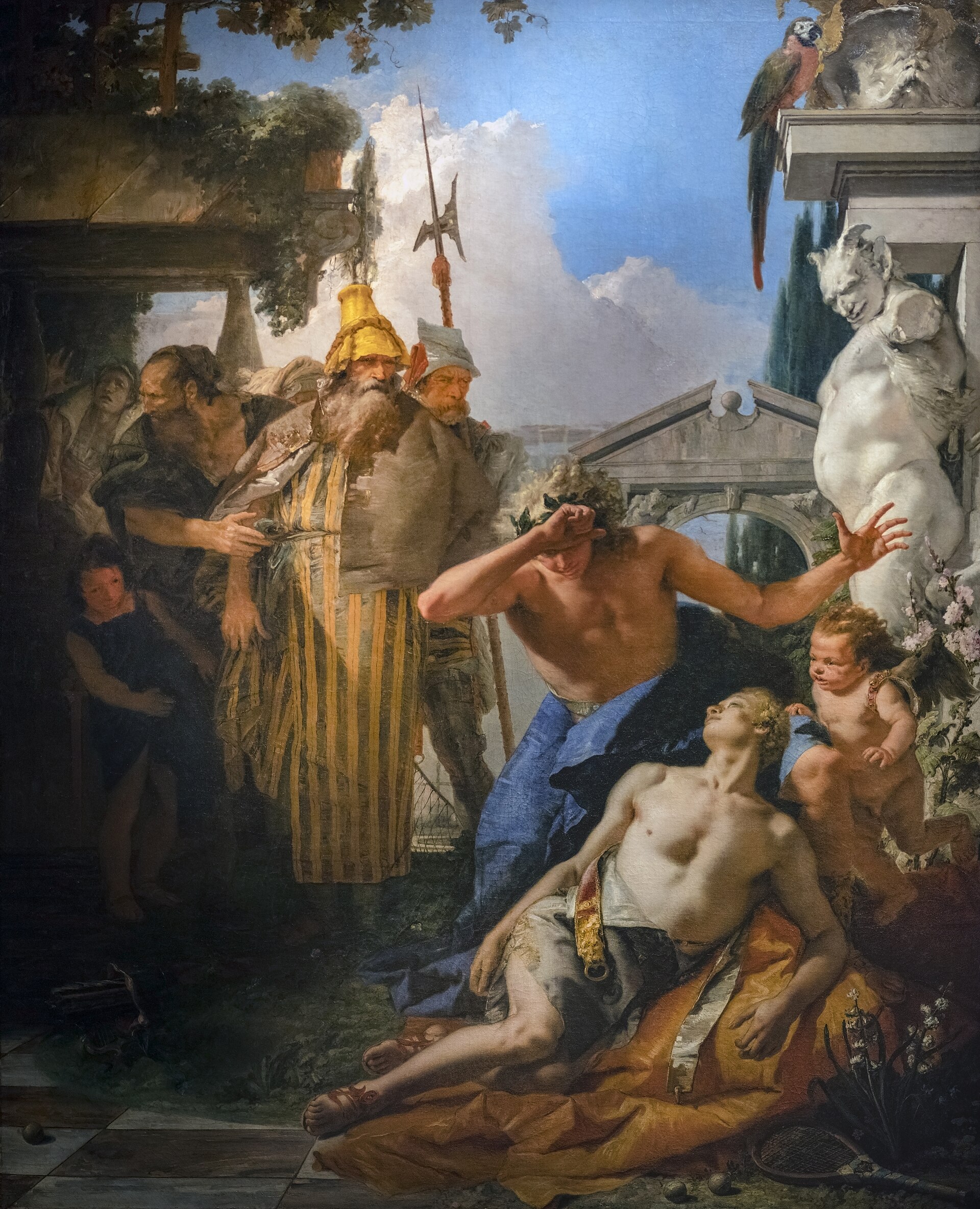
The story of how Madrid ended up with one of the world's greatest private art collections reads like a romantic thriller. Baron Hans Heinrich Thyssen-Bornemisza, a Swiss-German steel magnate, had spent decades expanding his father's art collection into a hoard of over 1,600 paintings — the second-largest private collection on Earth after the British Royal Family's. Countries competed to host it. Britain, Germany, and the United States all bid. Then the Baron married his fifth wife, Carmen "Tita" Cervera, a former Miss Spain, and she convinced him the collection belonged in her home country. The museum opened in 1992 in the Villahermosa Palace, an 18th-century neoclassical building right next to the Prado. A year later, the Spanish government bought the core collection of 775 paintings for $350 million — widely considered one of the greatest art deals in history. The Thyssen fills a specific gap: while the Prado covers old masters and the Reina Sofia handles 20th-century art, the Thyssen bridges both, with particular strength in Impressionism, German Expressionism, and early American painting — all areas the other two museums lack. Walk through the three floors chronologically and you're taking a compressed journey through eight centuries of Western art: medieval gold-ground altarpieces on the top floor, Dutch landscapes and Caravaggio in the middle, then Monet, Van Gogh, Hopper, and Lichtenstein as you descend. It's the only museum in Madrid where you can see a Duccio and a Rothko under the same roof. Together with the Prado and the Reina Sofia, the Thyssen completes Madrid's "Golden Triangle of Art" — three world-class museums within a five-minute walk of each other, a concentration of masterpieces that rivals any city on Earth.