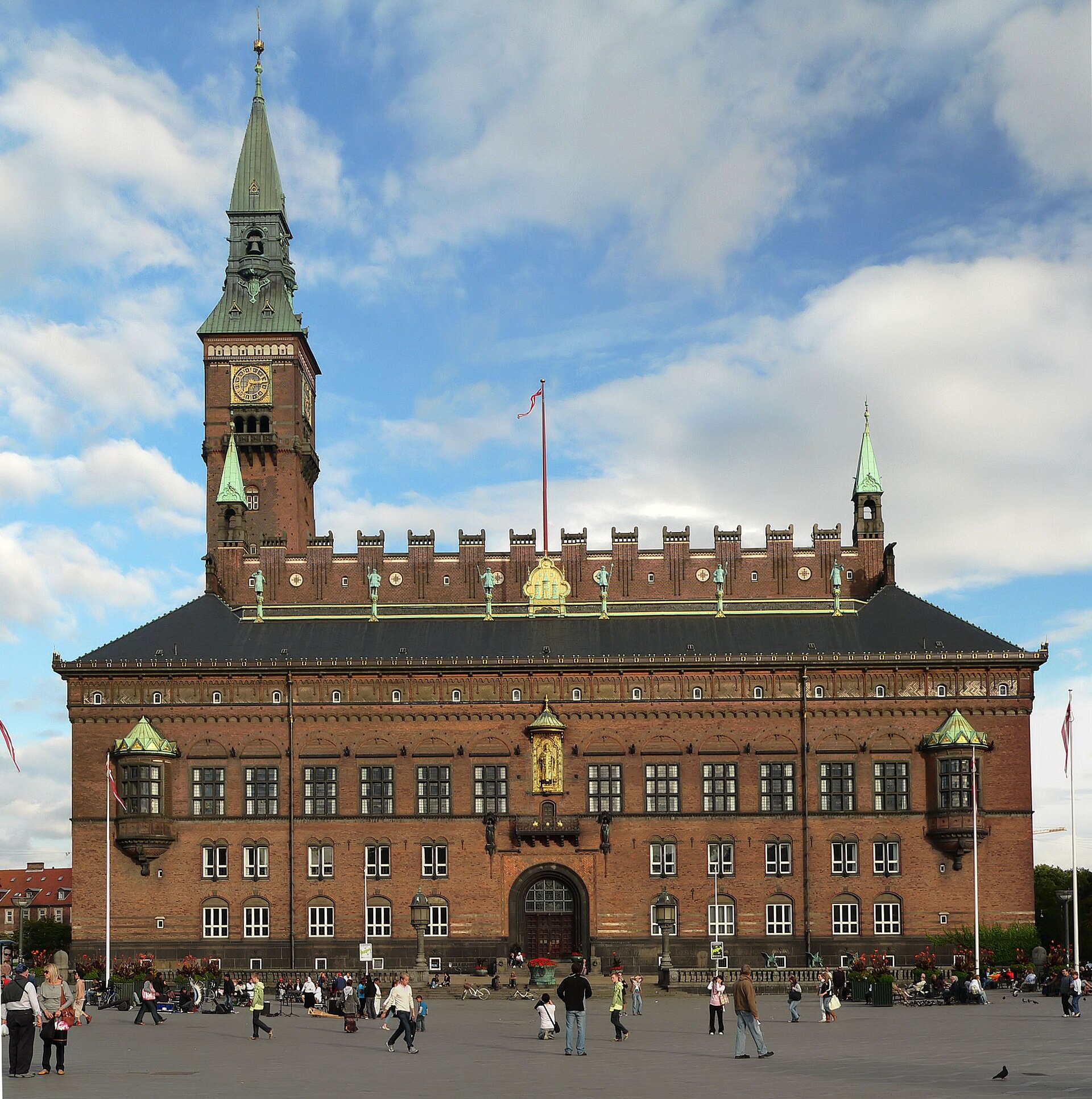
Copenhagen's City Hall was designed by Martin Nyrop and completed in 1905 in the National Romantic style, drawing heavily on the medieval town halls of Siena and other Italian cities. The red-brick facade with its gilded details, the tall clock tower, and the arcaded ground floor create a building that is simultaneously massive and welcoming. The tower stands 105.6 metres tall, making it one of the tallest structures in a city that has historically kept its skyline low, and the 300-step climb to the top rewards you with a panorama that includes Tivoli, the harbour, and on clear days, the coast of Sweden.
But the real treasure is hidden in a glass case inside: Jens Olsen's World Clock, one of the most complex mechanical clocks ever built. Olsen was a locksmith who taught himself clockmaking and spent twenty-seven years designing this astronomical masterpiece, which contains 15,448 parts arranged in twelve movements. The fastest gear completes a revolution every ten seconds; the slowest takes 25,753 years. The clock displays local time, solar time, sidereal time, the positions of planets, the dates of moveable holidays, sunrises and sunsets, and a perpetual calendar. Olsen died in 1945, a decade before the clock was finished. On December 15, 1955, King Frederik IX and Olsen's youngest grandchild Birgit set it in motion.
Rådhuspladsen — City Hall Square — is the closest thing Copenhagen has to a Times Square, where busy streets converge and the city's main bus routes terminate. The bronze statue of Hans Christian Andersen sits on the boulevard side, gazing across traffic toward Tivoli Gardens. A gilded weather vane on the corner of the building shows a girl on a bicycle: sunny when facing forward, carrying an umbrella when facing the other way. In Copenhagen's climate, the umbrella gets more exercise.
The Great Hall inside, with its polychrome brick arches and massive chandeliers, hosts everything from council meetings to concerts. The building was controversial when completed — critics called it too Italian for a Danish city — but over a century later, it has become as synonymous with Copenhagen as the buildings that inspired it are with Siena.
Verified Facts
Designed by Martin Nyrop, completed in 1905 in the National Romantic style
The tower is 105.6 metres tall with 300 steps to the top
Jens Olsen's World Clock contains 15,448 parts; its slowest gear takes 25,753 years per revolution
King Frederik IX and Olsen's grandchild Birgit started the clock on December 15, 1955
Get walking directions
1 Rådhuspladsen, Copenhagen, København V, 1550, Denmark