Walking Tours in Copenhagen
Classic Copenhagen Walk
From the candy-coloured canal of Nyhavn to the twinkling lights of Tivoli Gardens, this walk winds through Copenhagen's old city, past hidden medieval alleys, a tower you climb on horseback, a castle with invisible music, and a food market built on centuries of trade. You'll discover how a beer magnate built a world-class museum, why a locksmith spent decades building the most complex clock on earth, and how a fairy-tale writer found inspiration in a sailor's dive.
Copenhagen — Christianshavn & the Alternative Side
Explore the counterculture and waterfront side of Copenhagen. Climb past the golden spiral of Our Saviour's Church, stroll along Amsterdam-inspired canals, enter the anarchist commune of Christiania, discover the warehouse where Noma was born, cross a bridge designed by Olafur Eliasson, and end at the only palace on earth housing all three branches of government.
Copenhagen: Nyhavn to Christiania
Stroll Copenhagen's most iconic waterfront — from the candy-coloured townhouses of Nyhavn to the Tivoli Gardens, Christiansborg Palace, and the free-spirited Christiania.
30 Landmarks in Copenhagen
Amalienborg Palace
5 Amaliegade, Copenhagen, København K, 1256, Denmark
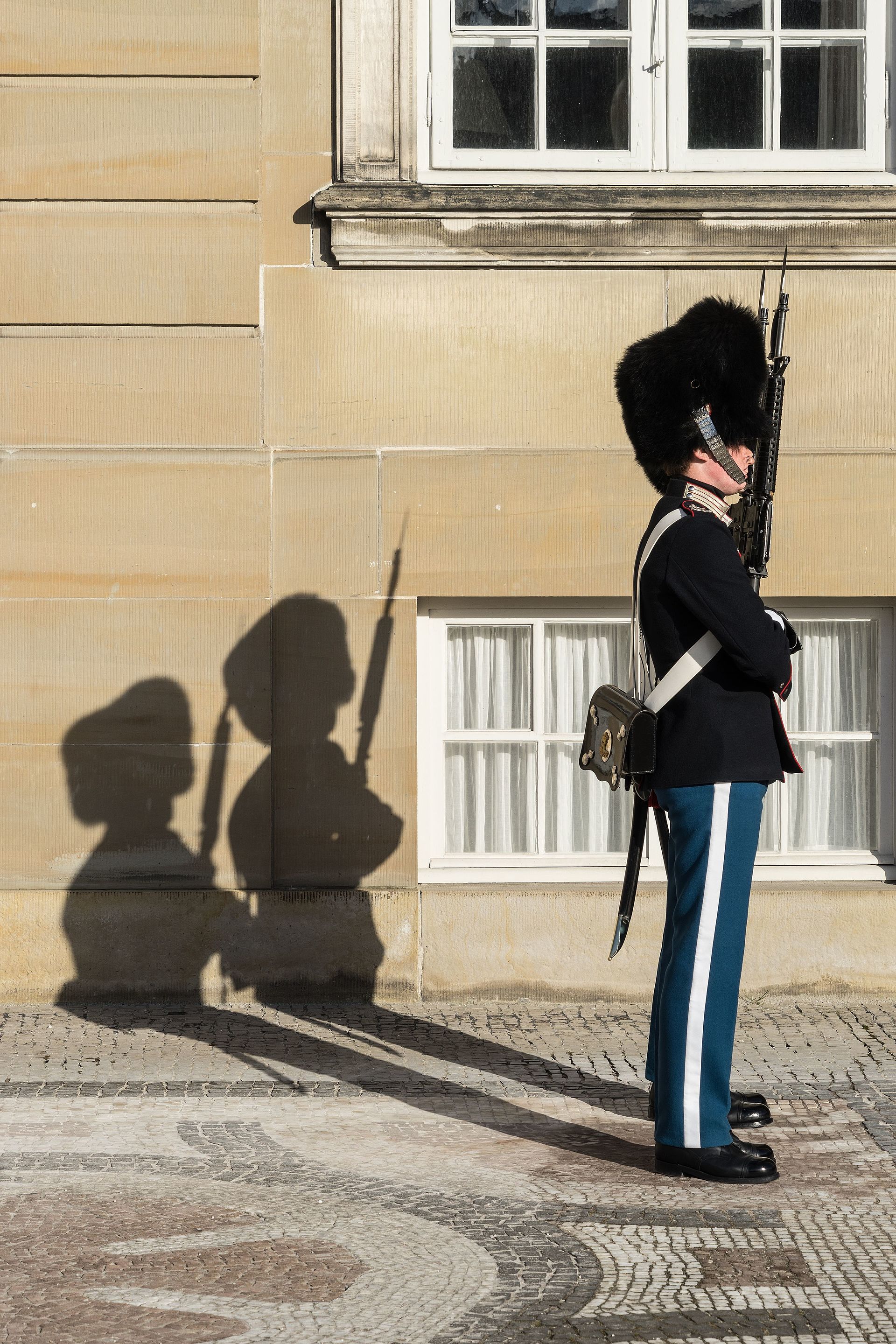
Four identical Rococo palaces arranged around an octagonal courtyard, with an equestrian statue of Frederick V at the centre — Amalienborg is one of the finest examples of 18th-century urban planning in Europe, and it only became a royal residence by accident. The four palaces were originally built between 1750 and 1760 for four noble families, designed by architect Nicolai Eigtved as the centrepiece of the new Frederiksstaden district. The royal family had no intention of living here. Then Christiansborg burned down in 1794, and the royals needed somewhere to go. They bought the palaces, moved in, and never left. The daily changing of the guard is one of Copenhagen's great free spectacles. At 11:30 every morning, the Royal Guard marches from Rosenborg Castle through the streets of the city, arriving at Amalienborg at noon for the ceremony. The parade includes up to 36 musicians, a fife and drum corps of 12 drummers, and 35 guards wearing the iconic bearskin hats — the same hats that have topped Danish royal guards since 1805. When the monarch is in residence, the flag flies from the palace and the ceremony is extended with a full band performance. Eigtved died in 1754 before Frederiksstaden was complete, but his vision for the district — a planned neighbourhood radiating outward from the palace square — became one of the most influential urban designs in Scandinavian history. The Marble Church, originally intended as the neighbourhood's crowning glory, ran out of money and sat as an unfinished ruin for over a century before being completed in 1894, nearly 150 years after construction began. The Amalienborg Museum occupies one of the four palaces and contains private chambers preserved exactly as the royal family used them, including the study of King Christian IX, known as "the father-in-law of Europe" because his children married into virtually every royal house on the continent.
Assistens Cemetery
4 Kapelvej, Copenhagen, København N, 2200, Denmark
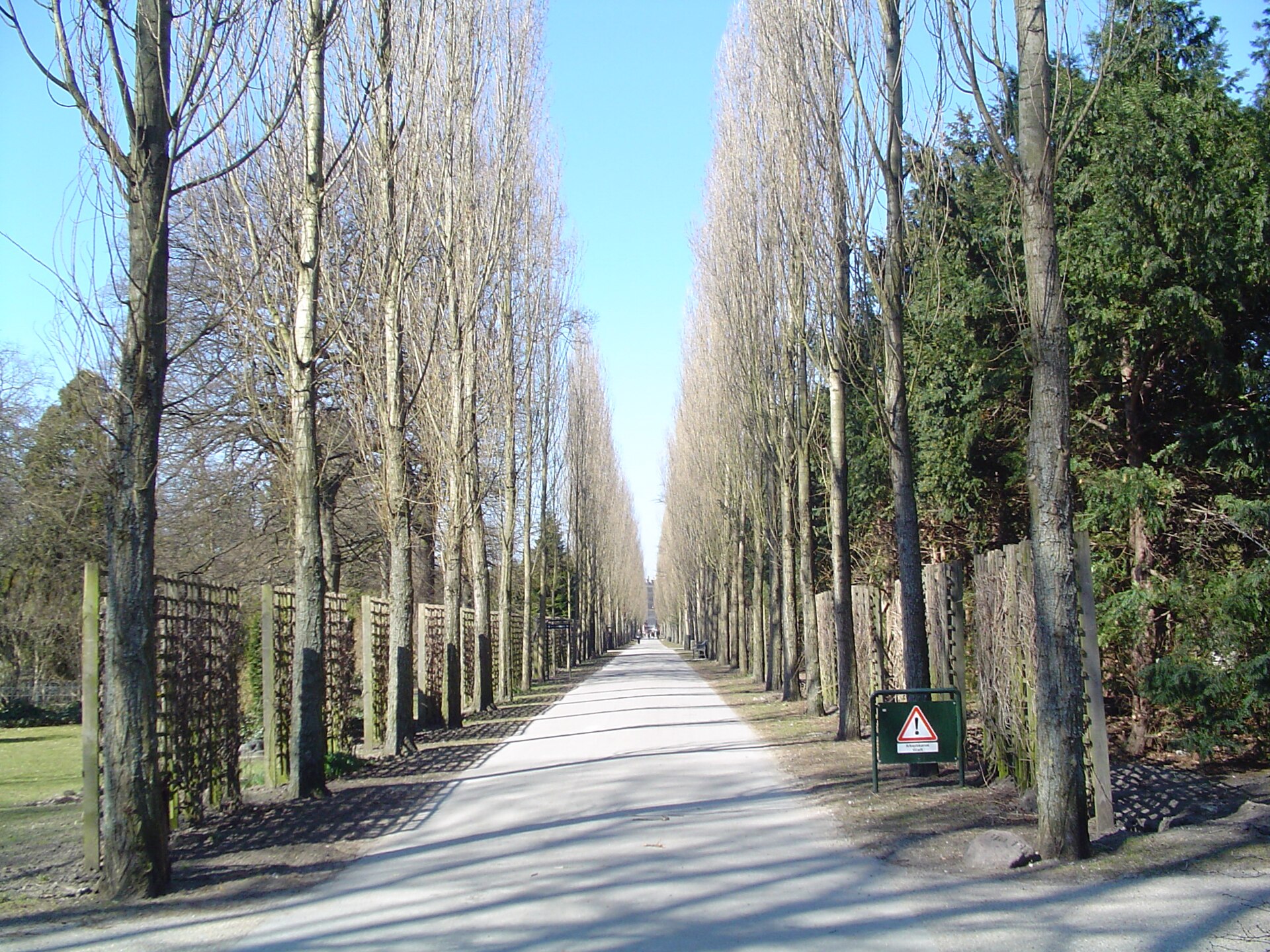
This is where Copenhagen buries its famous dead and takes its living for a picnic. Assistens Cemetery was established in 1760 as a burial ground for the poor — the name literally means "the assisting cemetery" — laid out to relieve the overcrowded graveyards inside the walled city. A plague outbreak in 1711 had killed around 23,000 citizens, making the burial capacity problem impossible to ignore any longer. For its first twenty-five years, it served exclusively as a paupers' cemetery, and the city had to raise prices for burials within the walls to convince wealthier citizens that a cemetery this far out was acceptable. It worked. During Copenhagen's Golden Age in the early 19th century, Assistens became fashionable, and today it reads like a who's-who of Danish culture. Hans Christian Andersen is buried here. Søren Kierkegaard, the father of existentialism, lies in Section A. Painter Christen Købke, physicist Niels Bohr, and several American jazz musicians who settled in Copenhagen during the 1950s and 1960s — including Ben Webster and Kenny Drew — all rest within these walls. The cemetery is simultaneously a memorial park and a living cultural document. But what makes Assistens genuinely unusual is how Copenhageners use it. In summer, the cemetery functions as Nørrebro's primary green space. People sunbathe on the grass between headstones, read books against 19th-century monuments, and have picnics within sight of Kierkegaard's grave. Joggers run the perimeter path. It is not considered disrespectful — it is considered perfectly Danish. The cemetery was designed in the Romantic style with large, rare trees and a long parkway lined with poplars, and it is one of the most beautiful green spaces in the city. The dead here are in good company, and the living treat the place with a warmth that says something profound about how Denmark relates to mortality.
BLOX / Danish Architecture Center
10 Bryghusgade, Copenhagen, København K, 1473, Denmark
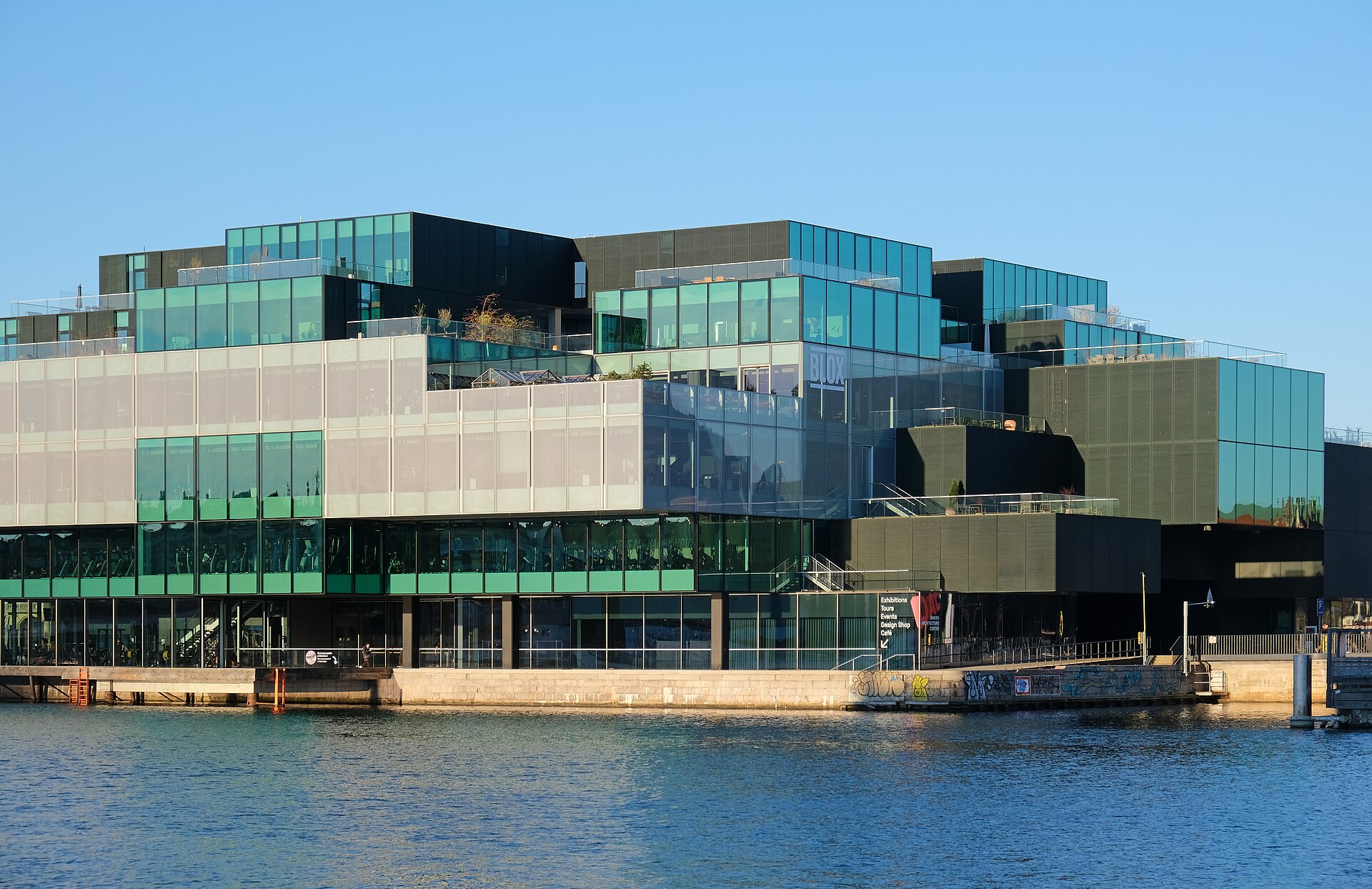
When Rem Koolhaas and OMA designed BLOX, they described it as "an inhabited infrastructure knot" — which is exactly the kind of thing architects say when they know a building is going to be controversial. Completed in 2018 on the site of a former brewery at the Copenhagen waterfront, BLOX is a stack of green glass volumes that straddle a road, connect the parliament district to the harbour, and manage to house exhibition spaces, offices, co-working areas, a cafe, a bookstore, a fitness centre, a restaurant, twenty-two apartments, and an underground automated car park all within a single building. It is either a masterpiece of mixed-use urbanism or an overcomplicated Tetris game, depending on who you ask. The building is home to the Danish Architecture Center (DAC), which moved here from its previous location to take advantage of the harbour-front setting. DAC's exhibitions explore architecture, design, and urbanism with a focus on how buildings shape daily life — a fitting mission for a country that has produced Jørn Utzon, Bjarke Ingels, and some of the most thoughtful urban planning in the world. The rooftop playground, designed as a public space accessible to anyone, offers views across to Christiansborg Palace and the harbour. Ellen van Loon, the OMA partner who led the project, positioned BLOX at a deliberate crossroads: between the old city and the new waterfront, between parliament and the water, between high culture and daily life. The building bridges Frederiksholms Kanal physically, with public paths passing through and around it at multiple levels. It achieves the Low Energy Class for sustainability with primary energy usage under 40 kWh per square metre annually. Love it or hate it — and Copenhageners do both, loudly — BLOX represents exactly the kind of architectural ambition that the Danish Architecture Center exists to champion. Housing the centre in a building this polarising is either deeply ironic or perfectly logical.
Botanical Garden & Palm House
128 Gothersgade, Copenhagen, København K, 1123, Denmark
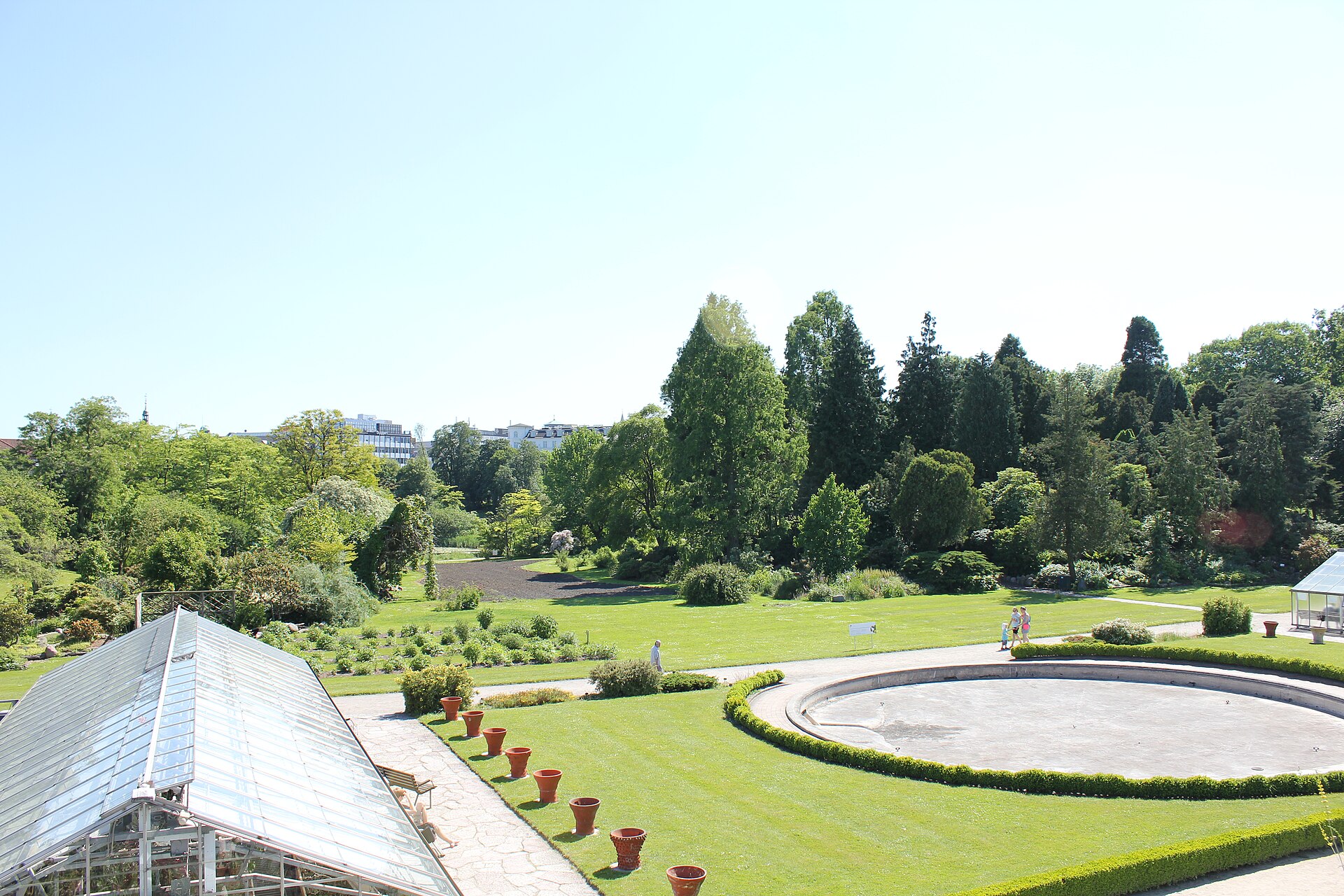
Copenhagen's Botanical Garden has existed in one form or another since 1600, making it over four centuries old, but it only settled into its current location in 1870 after two previous moves. The gardens span ten hectares next to Rosenborg Castle and contain over 13,000 species of plants from every corner of the globe, making it one of the most comprehensive living collections in Northern Europe. Admission is free, and yet most tourists walk right past it on their way to the castle next door. The centrepiece is the Palm House, a magnificent Victorian glasshouse built between 1872 and 1874 with brewer J.C. Jacobsen — father of the Carlsberg empire — as one of the driving forces behind the project. Designed by architect Peter Christian Bønecke and inspired by the Crystal Palace in London, the Palm House rises 16 metres at its peak and is constructed from cast iron and glass in a style that makes it look like something from a Jules Verne novel. Narrow cast-iron spiral stairs lead to a passageway at the top, where you can look down on the canopy of tropical trees in the middle of Scandinavia. Inside the Palm House, a palm tree planted in 1824 still grows — making it nearly two hundred years old. The cycad collection includes specimens over a century old, and the entire conservatory complex spans 3,000 square metres. The warmth, humidity, and lush green density inside create a genuinely disorienting contrast to the Danish climate outside, especially in winter when you step from freezing rain into a tropical greenhouse. The outdoor gardens include an extensive rock garden representing Scandinavian alpine flora, a pond system, and a herbaceous garden arranged by botanical families. In spring, the flowering cherry trees near the lake turn the garden into one of Copenhagen's most photogenic corners — a secret that Copenhageners jealously guard from the tourist crowds descending on Rosenborg next door.
Christiansborg Palace
1 Prins Jørgens Gård, Copenhagen, København K, 1218, Denmark
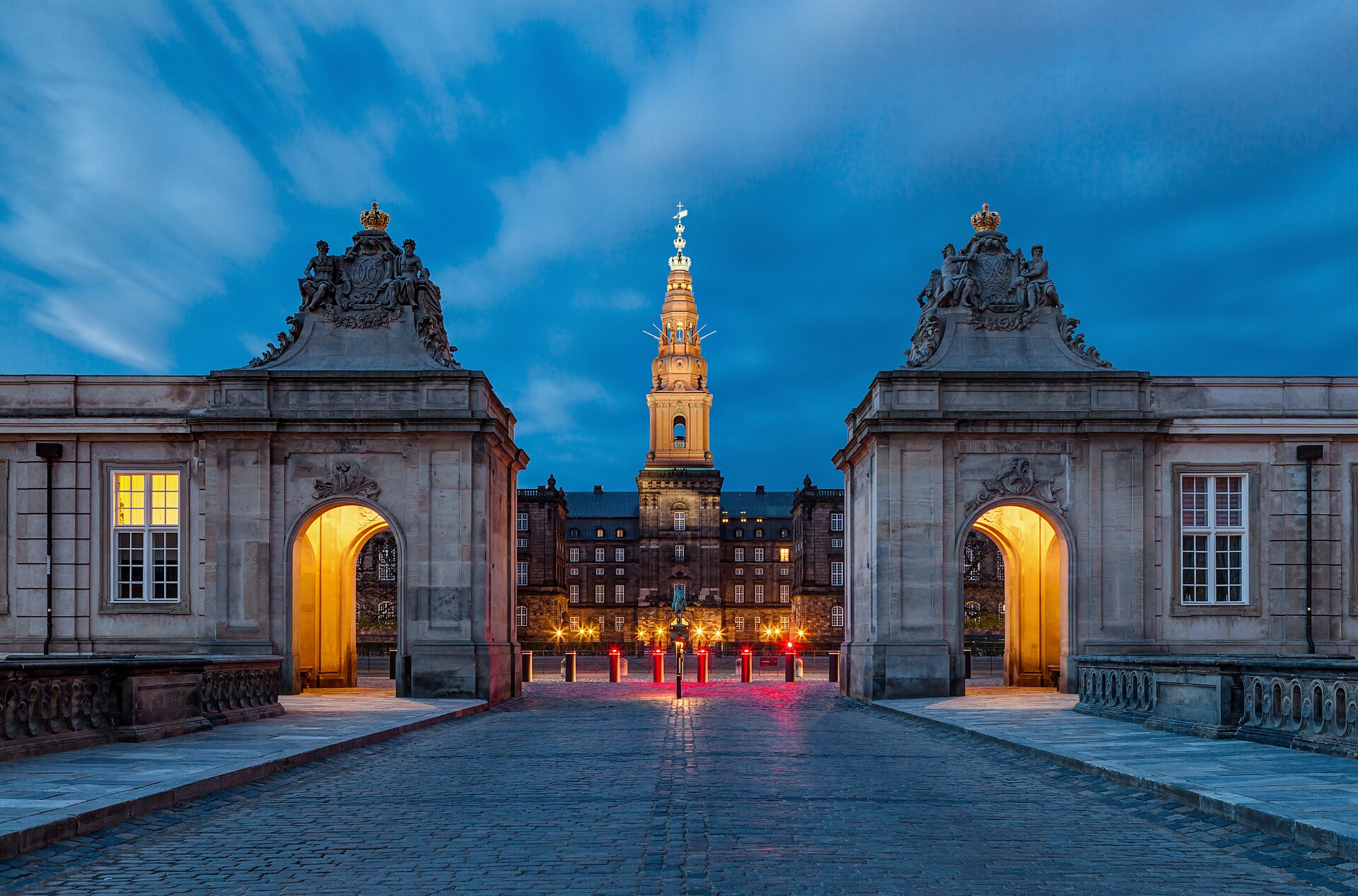
This is the only building in the world that houses all three branches of a nation's government under one roof — the Danish Parliament, the Prime Minister's Office, and the Supreme Court all operate from Christiansborg. The palace sits on the tiny island of Slotsholmen, where Bishop Absalon built Copenhagen's first castle in 1167. That original fortress was eventually replaced, then replaced again, and the current building is essentially version five of a structure that has occupied this island for over 850 years. Beneath the modern palace, you can still walk through the excavated ruins of Absalon's castle — limestone walls from 1167 sitting under a building completed in 1928. The first Christiansborg was commissioned by Christian VI in 1733 and designed as the largest palace in Northern Europe. It burned in 1794. The second Christiansborg, completed in 1828, burned again in 1884. At that point, the Danes essentially shrugged and built a third one, this time with better fire safety. The current palace was designed by Thorvald Jørgensen in granite sourced from across Denmark, with every region contributing stone so the building would literally be made of the entire country. The Royal Reception Rooms upstairs contain seventeen tapestries by Bjørn Nørgaard depicting one thousand years of Danish history in a style that is aggressively modern and deliberately provocative. Queen Margrethe II commissioned them in 2000, and they caused considerable controversy when unveiled — which was, by all accounts, exactly the queen's intention. The Great Hall ceiling is covered in a massive painting by Kræsten Iversen, and the throne room still hosts formal receptions. The tower, at 106 metres, is the tallest in Copenhagen — taller than City Hall, taller than any church spire. Since 2014, visitors can climb it for free, making it the best free viewpoint in the city.
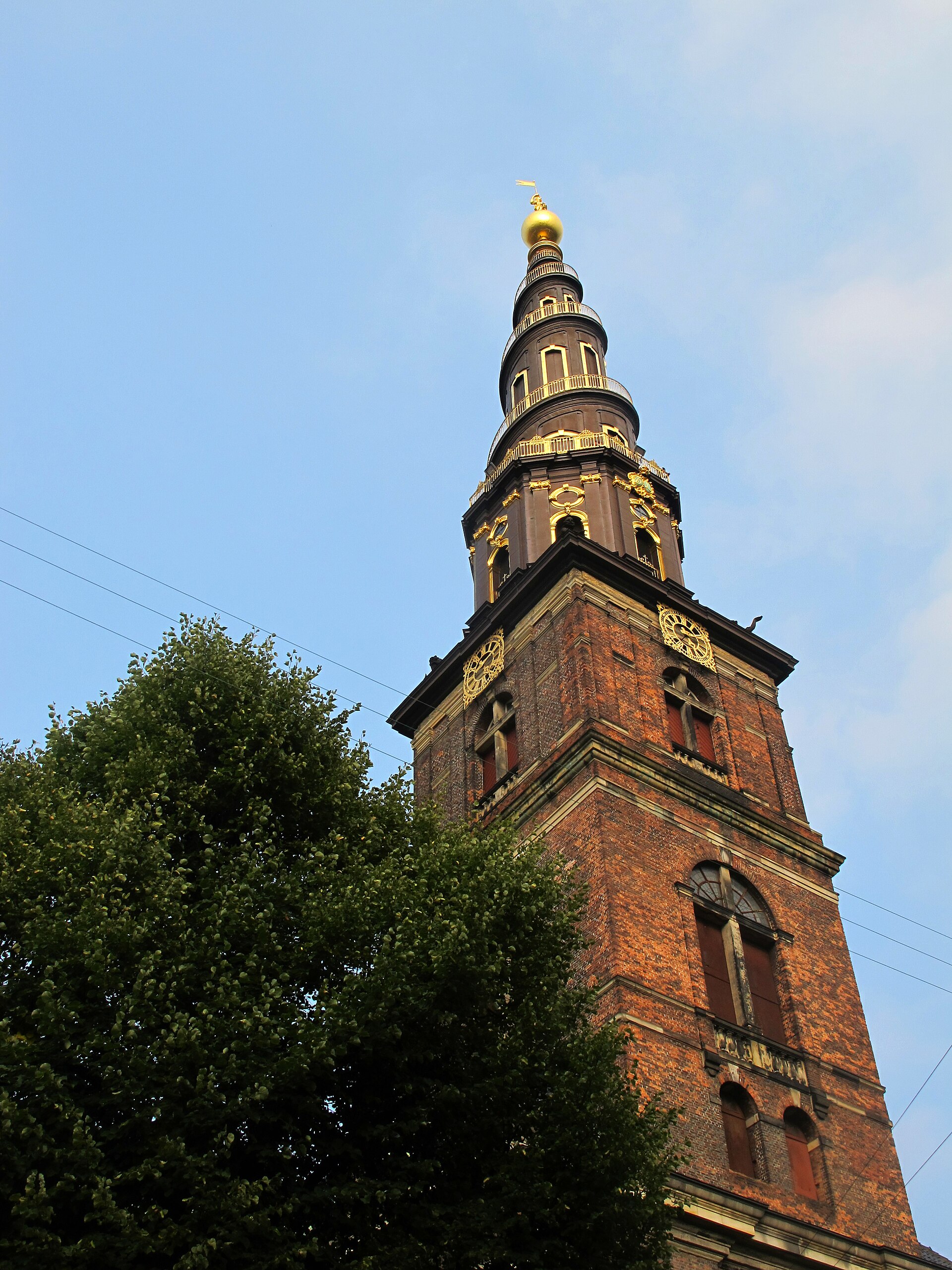
Church of Our Saviour
29 Sankt Annæ Gade, Copenhagen, København K, 1416, Denmark
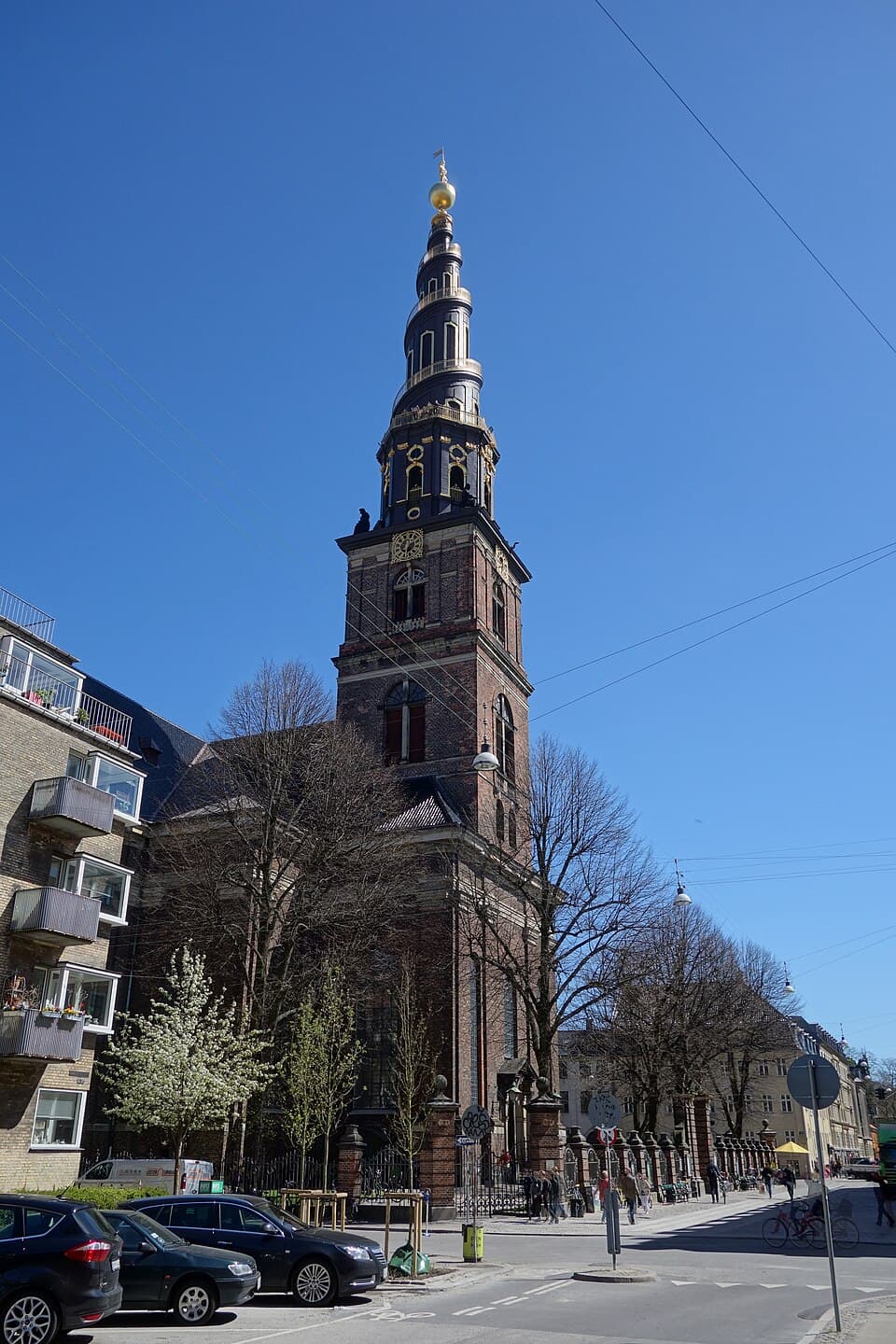
The external spiral staircase winding around the spire of this Baroque church is one of the most vertiginous experiences in Northern Europe. Four hundred steps take you from ground level to the gilded globe at the top, with the final 150 steps clinging to the outside of the spire as it narrows to a point 90 metres above the Christianshavn canal. The staircase winds counterclockwise four times around the spire, and as you climb higher, the steps get narrower and the railing gets lower. It is not for the faint of heart, and roughly 60,000 visitors attempt it every year. The church itself was completed in 1696 and is one of the finest Baroque churches in Denmark, with an interior featuring a massive three-storey altar carved in marble and gilded wood by Nicodemus Tessin the Younger, the same architect who designed the Royal Palace in Stockholm. The elephant-supported organ from 1700 is one of the largest Baroque organs in Scandinavia. But it is the spire that draws the crowds, and it was added much later — designed by architect Lauritz de Thurah and completed in 1752, over fifty years after the church opened. De Thurah took his inspiration from the spiral lantern of Borromini's Sant'Ivo alla Sapienza in Rome, which winds in the same counterclockwise direction. Legend says that de Thurah climbed his spire after completion, realised it spiralled the wrong way compared to other towers, and threw himself from the top in despair. This is entirely false — he died peacefully in 1759 — but it is the kind of story Copenhageners love to tell tourists on the way up. From the top, you get an unmatched panorama: the Copenhagen skyline to the west, Christiania's green rooftops to the south, and the Øresund strait stretching to Sweden on a clear day. The gilded globe and four-metre Christ figure crowning the spire can be seen from almost anywhere in the city.
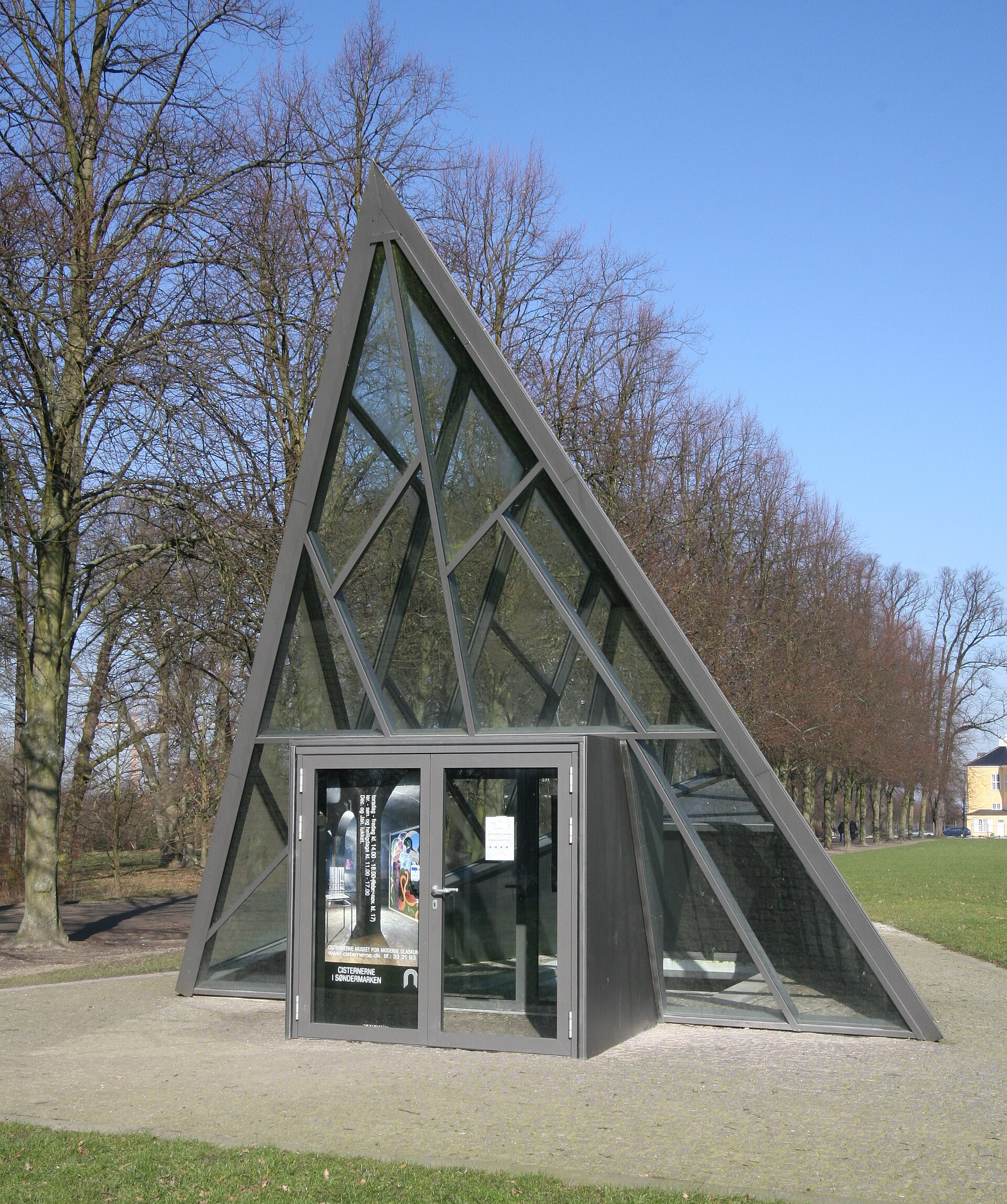
Cisternerne
Frederiksberg, Denmark
Beneath a gentle hill in Søndermarken Park lies Denmark's only dripstone cave — except it is not a cave at all. It is a 4,320-square-metre underground water reservoir that supplied drinking water to all of Copenhagen from the 1850s until 1933, and then sat full of stagnant water for nearly fifty years before anyone thought to empty it. When they finally drained it in 1981, they discovered that decades of mineral-rich water dripping from the ceiling had created natural stalactites and stalagmites on the concrete surfaces. An industrial cistern had accidentally become a geological formation. Excavation began in 1856 under Frederiksberg Hill, and when the three enormous rooms were completed three years later, they solved Copenhagen's chronic water supply problems. Each room has ceilings 4.2 metres high, and at maximum capacity, the reservoir held 16 million litres of water. The cisterns also served as a reflection pool for nearby Frederiksberg Castle, which sat elegantly on the hill above, blissfully unaware of the vast plumbing infrastructure beneath its gardens. In 1996, during Copenhagen's year as European City of Culture, the cisterns were first used as an exhibition space. Gallery owner Max Seidenfaden ran them as a museum of modern glass art from 2001 to 2013, which was a fitting use for a space defined by water, light, and transparency. Since 2013, Cisternerne has been part of the Frederiksberg Museums and invites internationally recognised artists to create large-scale site-specific installations each year. The experience of visiting is genuinely surreal. The humidity is permanently near 100 percent, the temperature swings between 4 and 16 degrees Celsius depending on the season, and the stalactites — ranging from delicate needles to thick mineral columns — create an atmosphere that feels more like exploring a cave system than visiting a gallery. This is one of Copenhagen's strangest and most rewarding hidden gems.
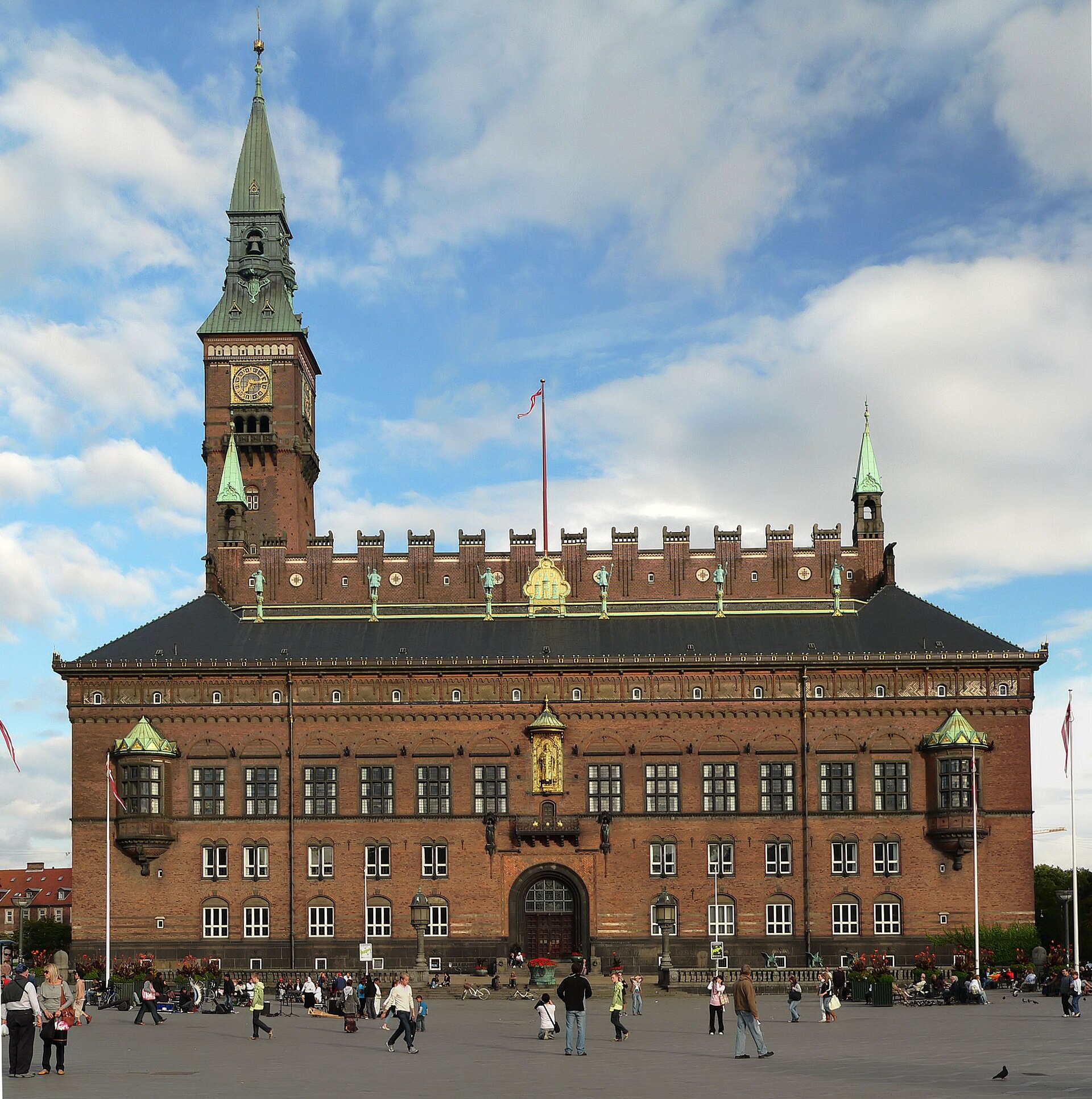
Copenhagen City Hall
1 Rådhuspladsen, Copenhagen, København V, 1550, Denmark
Copenhagen's City Hall was designed by Martin Nyrop and completed in 1905 in the National Romantic style, drawing heavily on the medieval town halls of Siena and other Italian cities. The red-brick facade with its gilded details, the tall clock tower, and the arcaded ground floor create a building that is simultaneously massive and welcoming. The tower stands 105.6 metres tall, making it one of the tallest structures in a city that has historically kept its skyline low, and the 300-step climb to the top rewards you with a panorama that includes Tivoli, the harbour, and on clear days, the coast of Sweden. But the real treasure is hidden in a glass case inside: Jens Olsen's World Clock, one of the most complex mechanical clocks ever built. Olsen was a locksmith who taught himself clockmaking and spent twenty-seven years designing this astronomical masterpiece, which contains 15,448 parts arranged in twelve movements. The fastest gear completes a revolution every ten seconds; the slowest takes 25,753 years. The clock displays local time, solar time, sidereal time, the positions of planets, the dates of moveable holidays, sunrises and sunsets, and a perpetual calendar. Olsen died in 1945, a decade before the clock was finished. On December 15, 1955, King Frederik IX and Olsen's youngest grandchild Birgit set it in motion. Rådhuspladsen — City Hall Square — is the closest thing Copenhagen has to a Times Square, where busy streets converge and the city's main bus routes terminate. The bronze statue of Hans Christian Andersen sits on the boulevard side, gazing across traffic toward Tivoli Gardens. A gilded weather vane on the corner of the building shows a girl on a bicycle: sunny when facing forward, carrying an umbrella when facing the other way. In Copenhagen's climate, the umbrella gets more exercise. The Great Hall inside, with its polychrome brick arches and massive chandeliers, hosts everything from council meetings to concerts. The building was controversial when completed — critics called it too Italian for a Danish city — but over a century later, it has become as synonymous with Copenhagen as the buildings that inspired it are with Siena.
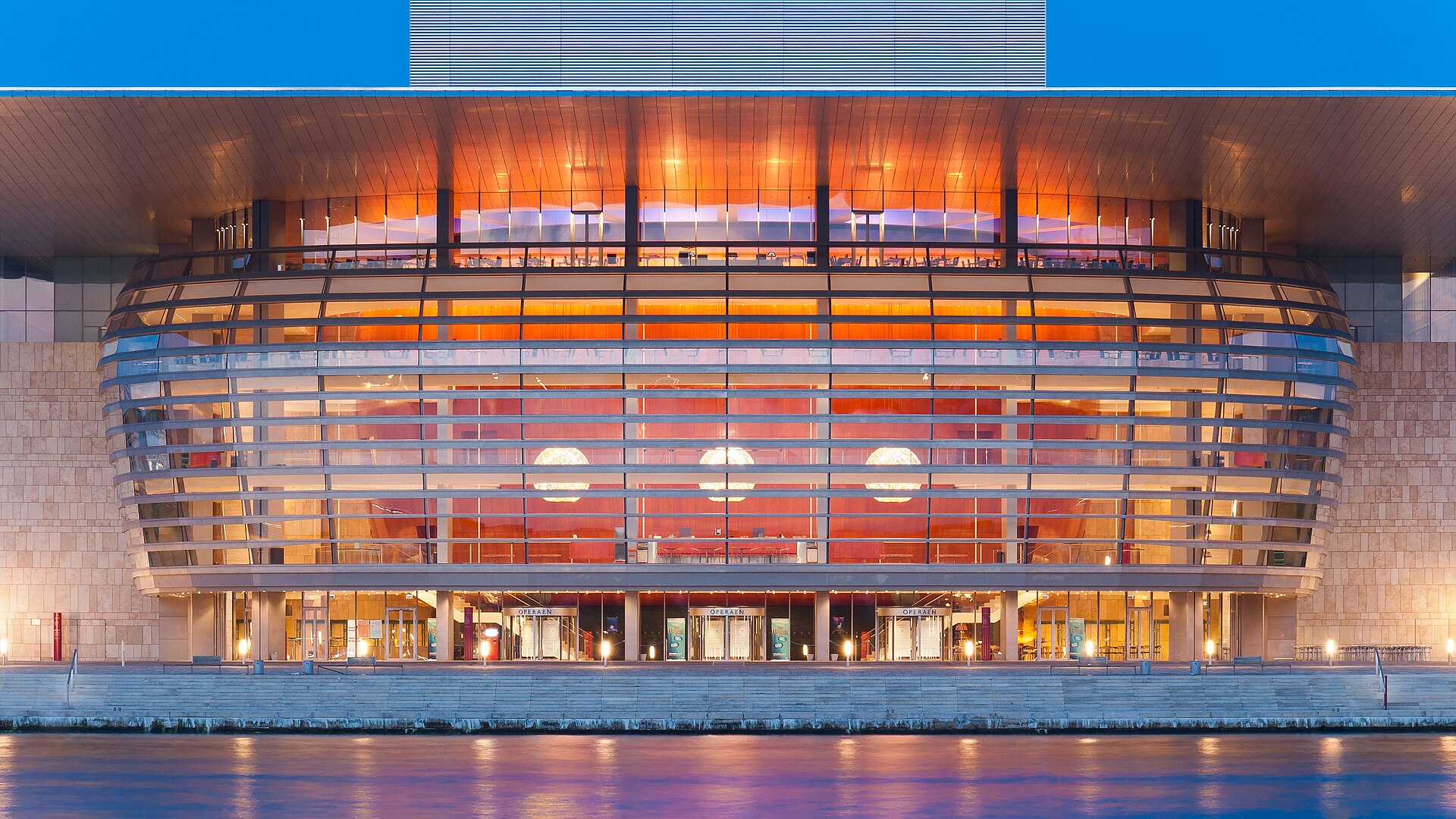
Copenhagen Opera House
10 Ekvipagemestervej, Copenhagen, København K, 1438, Denmark
The Copenhagen Opera House was a gift — but the kind of gift that comes with strings attached, a controlling donor, and enough drama to fill several operas. Shipping magnate Mærsk Mc-Kinney Møller, one of the richest men in Danish history, donated the building to the state in August 2000 at a cost of 2.5 billion Danish kroner, roughly 370 million US dollars, making it one of the most expensive opera houses ever built. The catch was that Møller had very specific opinions about how his gift should look, and architect Henning Larsen, one of Denmark's most celebrated designers, found himself in a prolonged battle with his patron over nearly every design decision. The result is a building that locals have nicknamed "the toaster" — a massive rectangular block of German Jura limestone with a cantilevered roof that extends 32 metres over the harbour front like a giant awning. Opinions are violently divided: some consider it a masterpiece of contemporary architecture that won the IABSE Outstanding Structure Award in 2008; others think it looks like an appliance. Henning Larsen himself reportedly called the compromises forced by Møller his greatest professional regret. The building sits directly across the harbour from Amalienborg Palace, on an axis so precise that you can draw a straight line from the queen's dining room to the opera stage. Inside, the political disputes evaporate. The main auditorium seats 1,800 in a classical horseshoe configuration and is acoustically superb. The foyer, with its maple-leaf ceiling panels and floor-to-ceiling harbour views, is one of the most dramatic public interiors in Scandinavia. A smaller experimental stage, Takkelloftet, seats 200 for contemporary performances. In total, the building contains over 1,100 rooms spread across 14 floors — an entire city of performance hidden behind that controversial facade. Inaugurated on January 15, 2005, with a gala performance attended by the queen, the Opera House has become Copenhagen's most architecturally debated landmark. The harbour ferries that pass in front of it give you the best view — and the best opportunity to decide for yourself whether it is a masterpiece or a toaster.
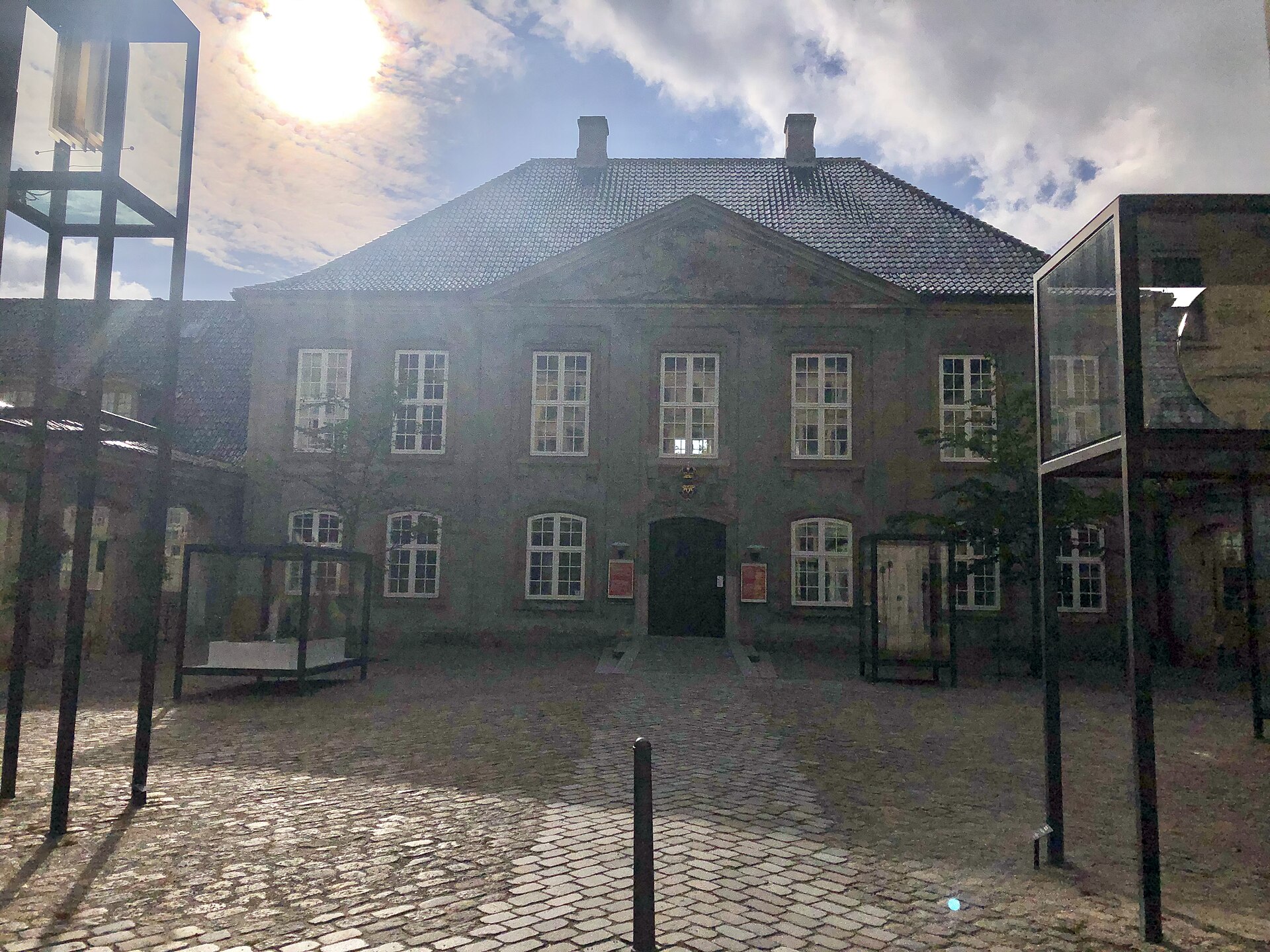
Designmuseum Danmark
68 Bredgade, Copenhagen, København K, 1260, Denmark
The museum that tells the story of Danish design is housed in a building that is itself one of the finest examples of Danish architecture. The former Royal Frederik's Hospital was built between 1752 and 1757, designed by Nicolai Eigtved and Lauritz de Thurah — the same architects who shaped Amalienborg and the Round Tower. It was Denmark's first public hospital, designed with a systematic, functional layout that would influence hospital design for generations: natural light from large windows, unobstructed access to every bed, and sickrooms proportioned around the dimensions of a sickbed. Function determining form. If that sounds like a design philosophy, it should. Designmuseum Danmark was founded in 1890 and moved into this Rococo palace in 1926, after Kaare Klint — the father of modern Danish furniture design — renovated the interiors. Klint didn't just redesign the galleries; he furnished them, lived in the building, and worked there. The museum became a living laboratory for his ideas about proportion, materials, and the relationship between objects and the people who use them. Today, the building is considered the finest surviving example of Klint's work. The collection spans decorative arts and industrial design from the Middle Ages to the present, with particular strength in the mid-century modern period that made Danish design a global brand. Arne Jacobsen's Egg and Swan chairs, Verner Panton's psychedelic interiors, Poul Henningsen's PH lamps — the greatest hits of Scandinavian design live here. The museum also holds the largest library in Scandinavia dedicated to decorative arts and industrial design, open to the public. The courtyard garden is one of Copenhagen's hidden treasures — a quiet, enclosed space where you can sit with a coffee and reflect on the fact that the Danes managed to turn functional simplicity into a global aesthetic movement. That takes a special kind of genius.
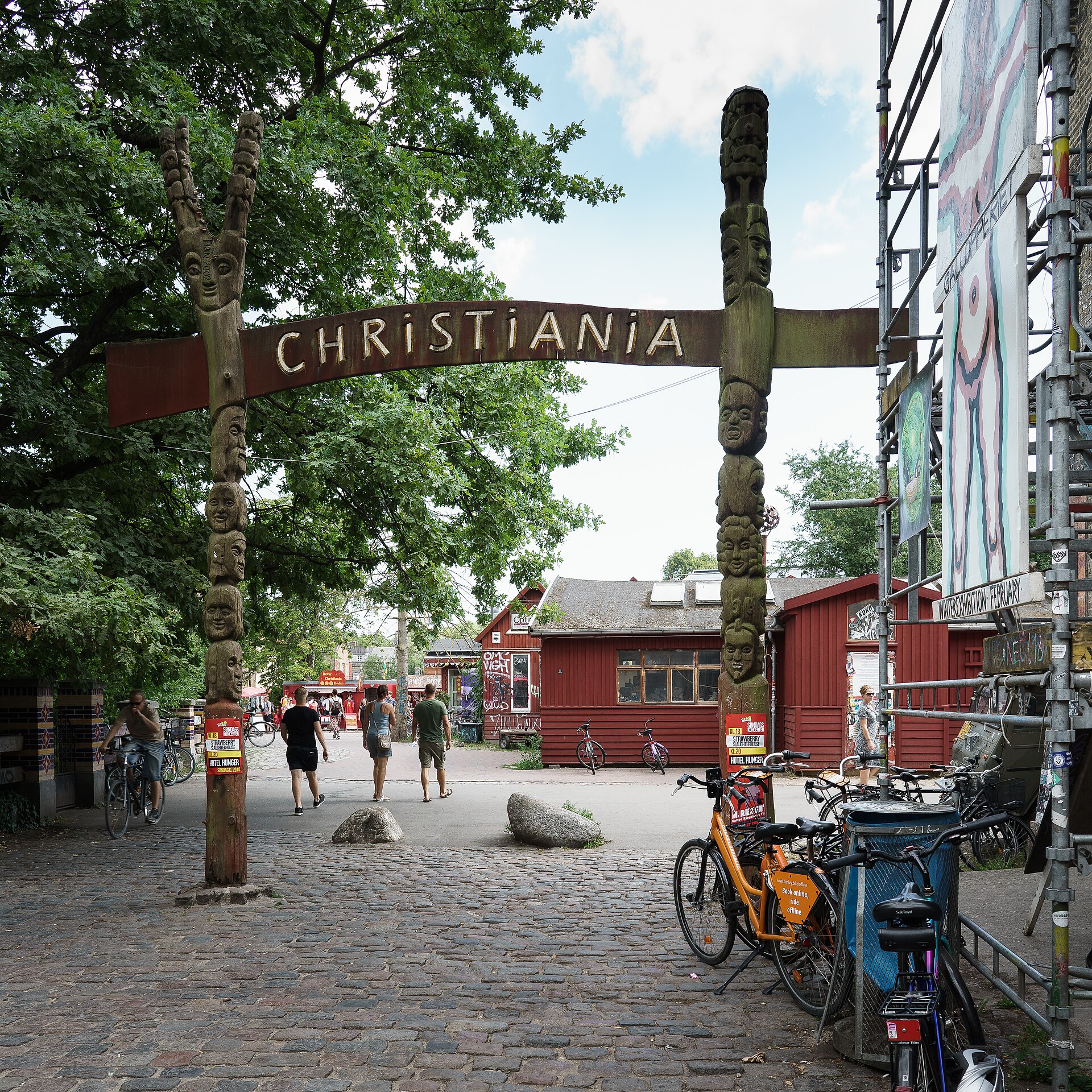
Freetown Christiania
Copenhagen, København K, Denmark
In 1971, a group of squatters broke into an abandoned military barracks on Christianshavn and declared it a free town. Fifty-three years later, Christiania is still there — a self-governing commune of roughly 900 residents occupying 34 hectares of prime Copenhagen real estate, operating under its own laws and governed by consensus at community meetings. No cars are allowed. No private property exists. Decisions are made when everyone in the room agrees, which means some meetings last for days. The site was originally Bådsmandsstrædes Kaserne, a naval barracks built in 1631 that had been decommissioned and left empty. The squatters — a mix of hippies, homeless people, artists, and political idealists — moved in and created what they called a "social experiment." The Danish government has tried to shut it down, regulate it, normalise it, and sell it multiple times over the decades, but Christiania has survived every attempt. In 2012, the residents collectively purchased the land from the Danish state for 76 million kroner, funded through a foundation. Walking through Christiania feels like entering a different country within Copenhagen. The architecture is a wild mix of self-built houses, repurposed military buildings, geodesic domes, and structures that defy any building code ever written. Murals cover every available surface. The famous Pusher Street, once an open cannabis market, was dismantled by residents themselves in 2004 after a shooting, though it has gone through cycles of closure and reopening since. Photography is generally discouraged on that particular street. What makes Christiania genuinely remarkable is that it works. The community runs its own kindergarten, recycling programmes, a music venue (Loppen), workshops, and organic restaurants. The Nemoland outdoor bar is one of Copenhagen's most beloved summertime hangouts. Love it or hate it, Christiania is one of the most radical social experiments in European history — and it's still running.
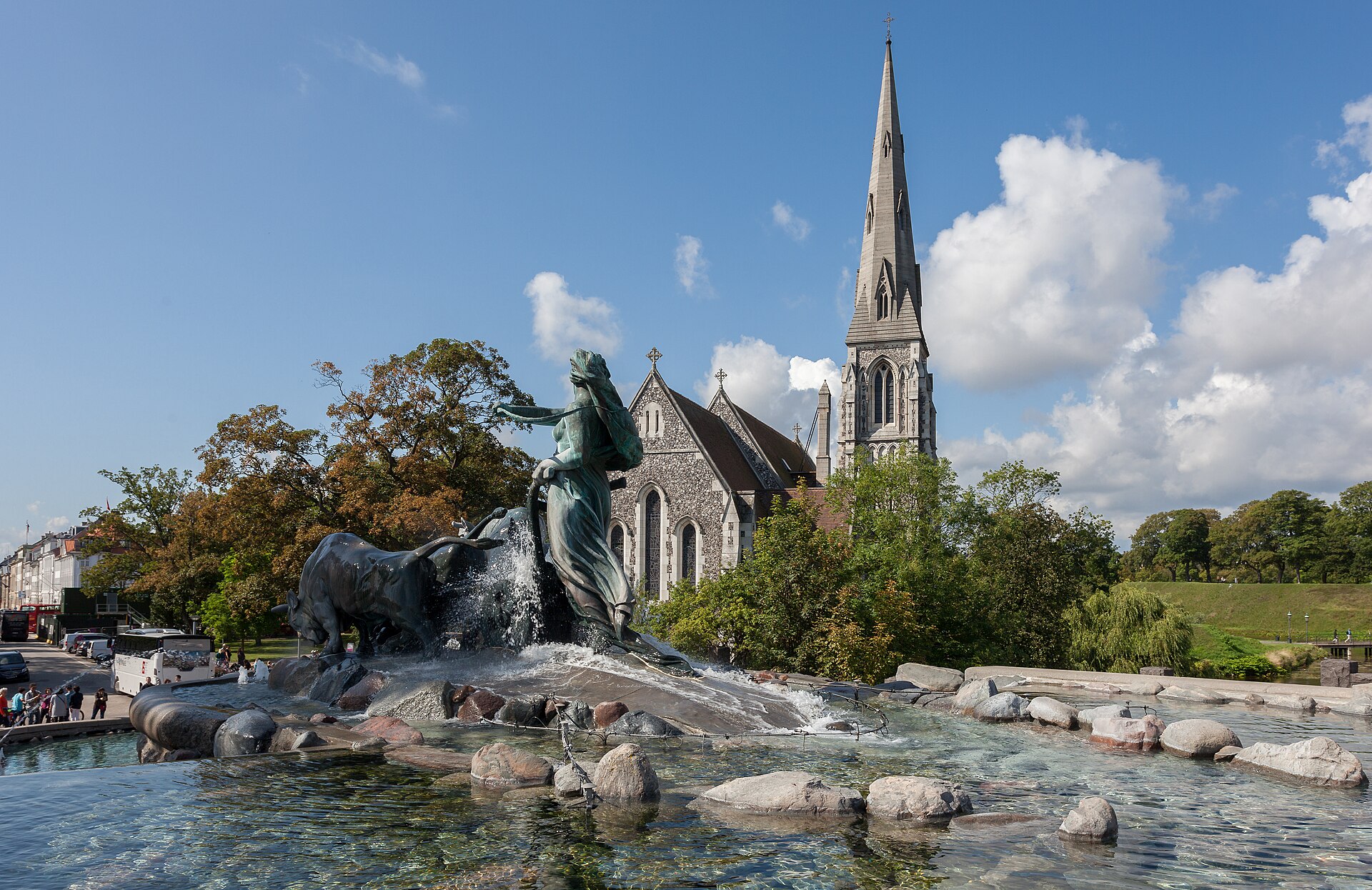
Gefion Fountain
Churchillparken, Copenhagen, København K, 1263, Denmark
The largest fountain in Copenhagen depicts the Norse goddess Gefjon whipping four enormous oxen forward as they drag a plough through the earth — and the mythology behind it is wonderfully dramatic. According to legend, the Swedish King Gylfi promised Gefjon as much land as she could plough in a single day and night. Gefjon, not one to be outmanoeuvred by a mortal king, turned her four sons into oxen and ploughed so furiously that she ripped an entire chunk of Sweden loose and dragged it into the sea. That chunk became Zealand, the island on which Copenhagen sits. The hole left behind filled with water and became Lake Mälaren in Sweden. The fountain was donated by the Carlsberg Foundation in 1908 to celebrate the brewery's 50th anniversary — because nothing says "cheers to beer" like a massive Art Nouveau sculpture depicting Norse mythology. Danish artist Anders Bundgaard sculpted the naturalistic figures between 1897 and 1899, and the granite basins and decorations were completed in 1908. The fountain was first activated on July 14, 1908, and the sheer scale of the bronze sculpture group — Gefjon straining at the reins, the four massive oxen lunging forward, water cascading around them — is genuinely impressive. It was originally planned for City Hall Square, but someone sensibly decided that a monumental water feature depicting the mythological theft of Swedish real estate should perhaps face the sea, and it ended up near Kastellet instead. The fountain underwent extensive restoration starting in 1999 and was re-inaugurated in September 2004 after years of being out of commission. Sitting in Churchillparken between Kastellet and the Little Mermaid, the fountain is often overshadowed by its more famous neighbour. That is a shame, because pound for pound, the Gefion Fountain is the more impressive sculpture — bigger, more dynamic, and backed by a far better story.
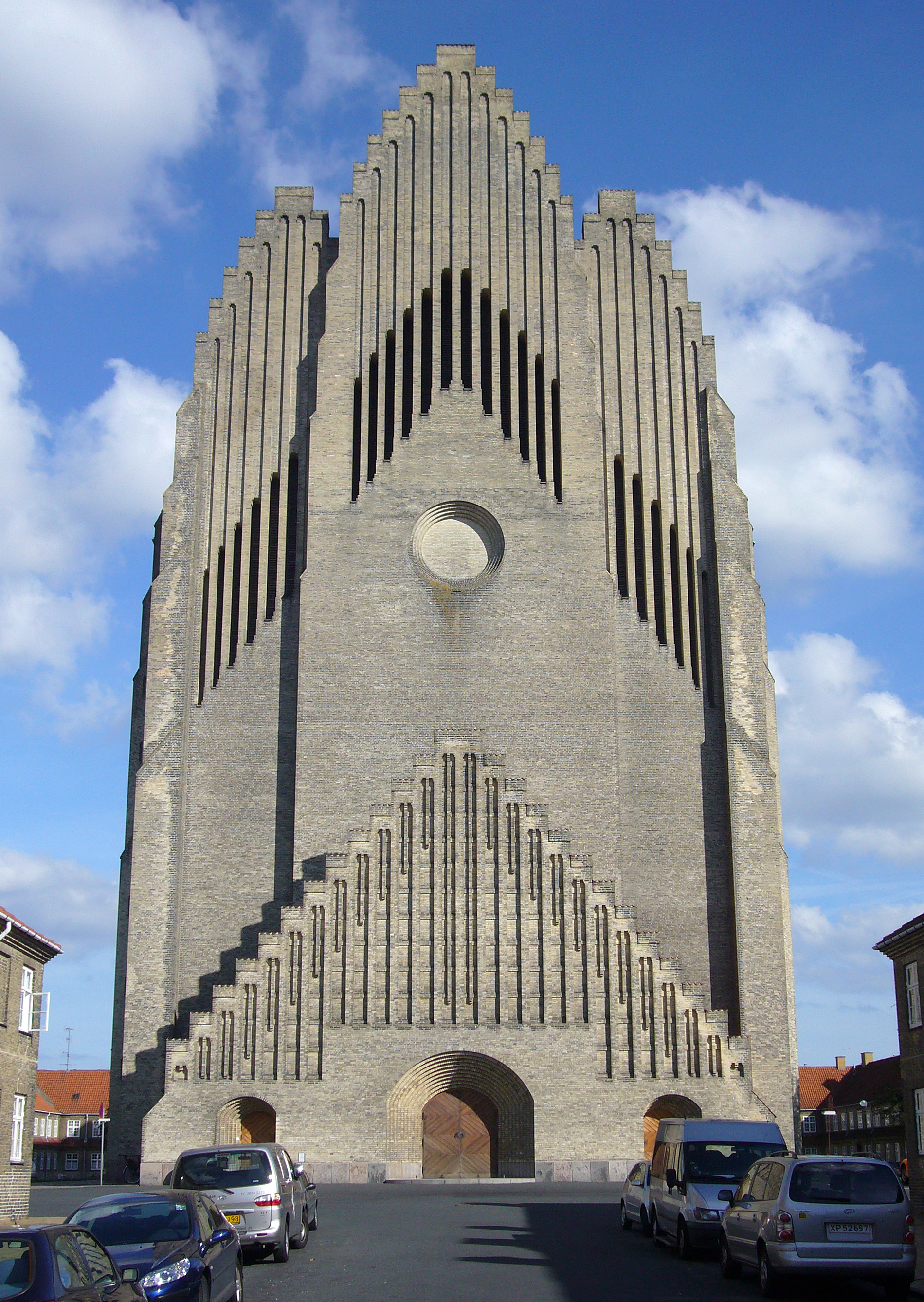
Grundtvig's Church
14B På Bjerget, Copenhagen, København NV, 2400, Denmark
Five million yellow bricks. That is what it took to build one of the most extraordinary churches in Europe — a building that looks like a pipe organ grew to the size of a cathedral and decided to sit on a residential street in a quiet Copenhagen suburb. Grundtvig's Church was designed by Peder Vilhelm Jensen-Klint, who won the competition in 1913, and it is a jaw-dropping fusion of Brick Expressionism and Gothic verticality that has no real equivalent anywhere in the world. Jensen-Klint spent years studying Danish village churches on the island of Zealand, particularly their stepped gables, before creating a design that abstracted those vernacular forms into something monumental. The west facade rises 49 metres and resembles the exterior of a church organ — or possibly a crown, or a fortress, depending on the light. The interior is equally stunning: a long Gothic nave with pointed arches, ribbed groin vaults, and a height that pulls your eyes upward with the same force as the great medieval cathedrals. It seats 1,800 and is comparable in size to Copenhagen Cathedral, despite being far less known. Construction began in 1921, and the main structure was completed in 1926. Jensen-Klint died in 1930, and his son Kaare Klint — the same designer who would later reshape Danish furniture — took over and completed the interior by 1940. This was a father-and-son project that spanned decades: the elder Klint envisioned it, the younger Klint finished it. Kaare later designed the furniture for the Designmuseum, making the Klint family arguably the most influential design dynasty in Danish history. The surrounding residential neighbourhood, Bispebjerg, was designed in a matching yellow-brick style that radiates outward from the church in symmetrical rows, creating a planned community that frames the church as its centrepiece. Getting here requires a deliberate journey from central Copenhagen, which keeps the tourist crowds thin and the atmosphere genuinely contemplative.
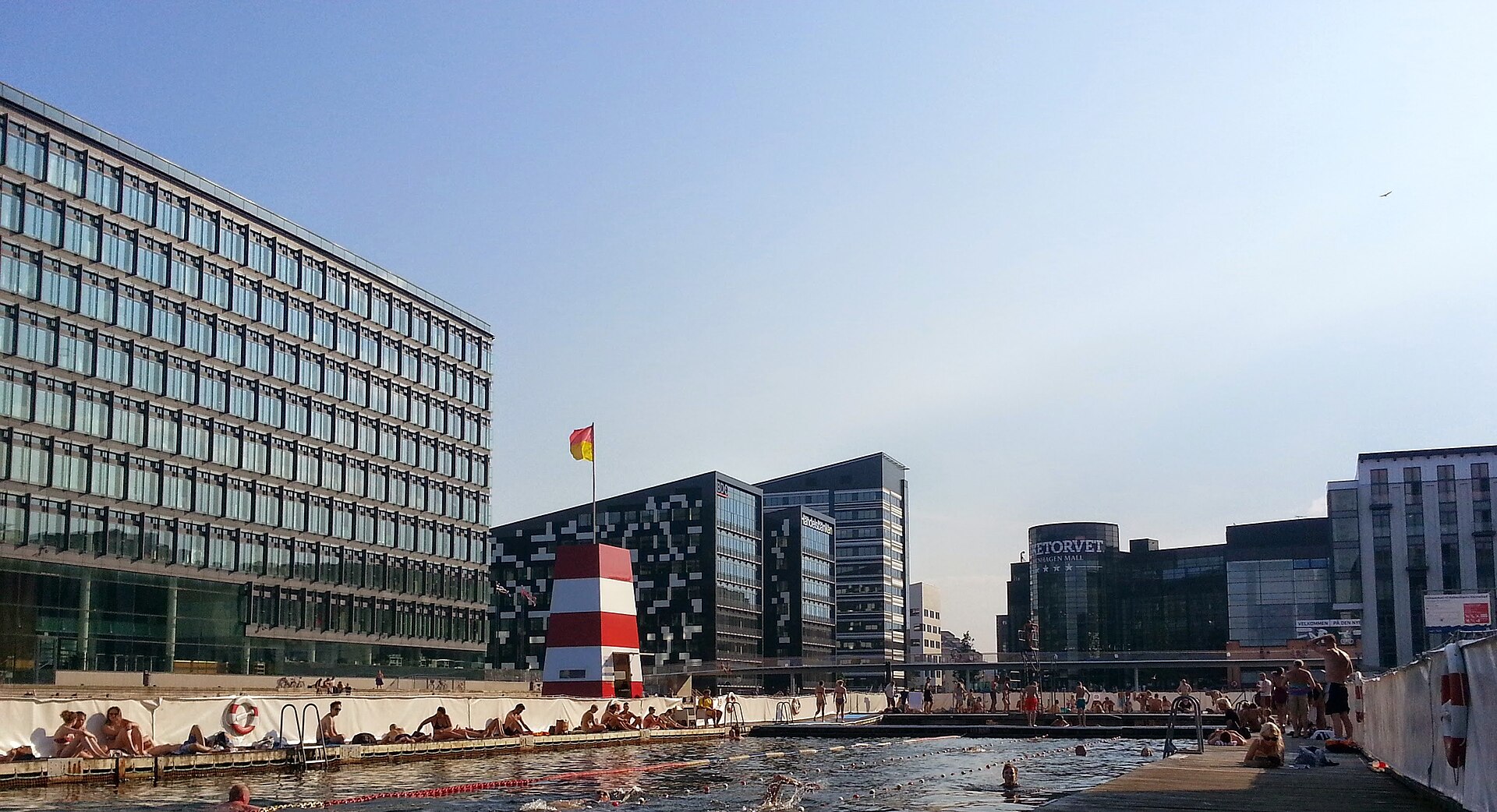
Islands Brygge Harbour Bath
14 Islands Brygge, Amager Vest, København S, 2300, Denmark
The idea that you could swim in Copenhagen's harbour would have been laughable thirty years ago. The water was filthy — decades of industrial pollution, untreated sewage, and shipping traffic had turned the harbour into something you crossed on a boat but would never willingly enter. Then Copenhagen embarked on one of the most ambitious urban water quality campaigns in European history, investing billions of kroner in wastewater treatment, stormwater management, and harbour cleanup. By 2002, the water was clean enough to swim in, and Islands Brygge Harbour Bath opened as the first public swimming facility directly in the harbour. Designed by PLOT Architects (Bjarke Ingels and Julien De Smedt before they split into BIG and JDS), the harbour bath consists of five pools — a diving pool, two children's pools, and two swimming lanes — built on platforms extending into the harbour. The design is elegantly simple: wooden decking, angular diving towers, and direct access to the harbour water. It is free to use, open from June to September, and on a hot summer day, thousands of Copenhageners pack the surrounding lawns and platforms. The water quality is monitored daily and a flag system indicates whether swimming is safe. Islands Brygge itself was once an industrial waterfront, and its transformation into one of Copenhagen's most desirable residential neighbourhoods is directly linked to the harbour baths. The swimming facility proved that the harbour could be a public amenity, not just an industrial corridor, and the property values followed. Today, several harbour baths operate across Copenhagen, but Islands Brygge was the first and remains the most popular. What makes this genuinely remarkable is the ambition behind it. Copenhagen decided its harbour should be clean enough to swim in, spent the money, did the engineering, and delivered. The harbour bath is not just a swimming pool — it is physical proof that a city can reverse decades of environmental damage. Watching Copenhageners dive into water that was once too toxic to touch is one of the most hopeful things you can witness in any European city.
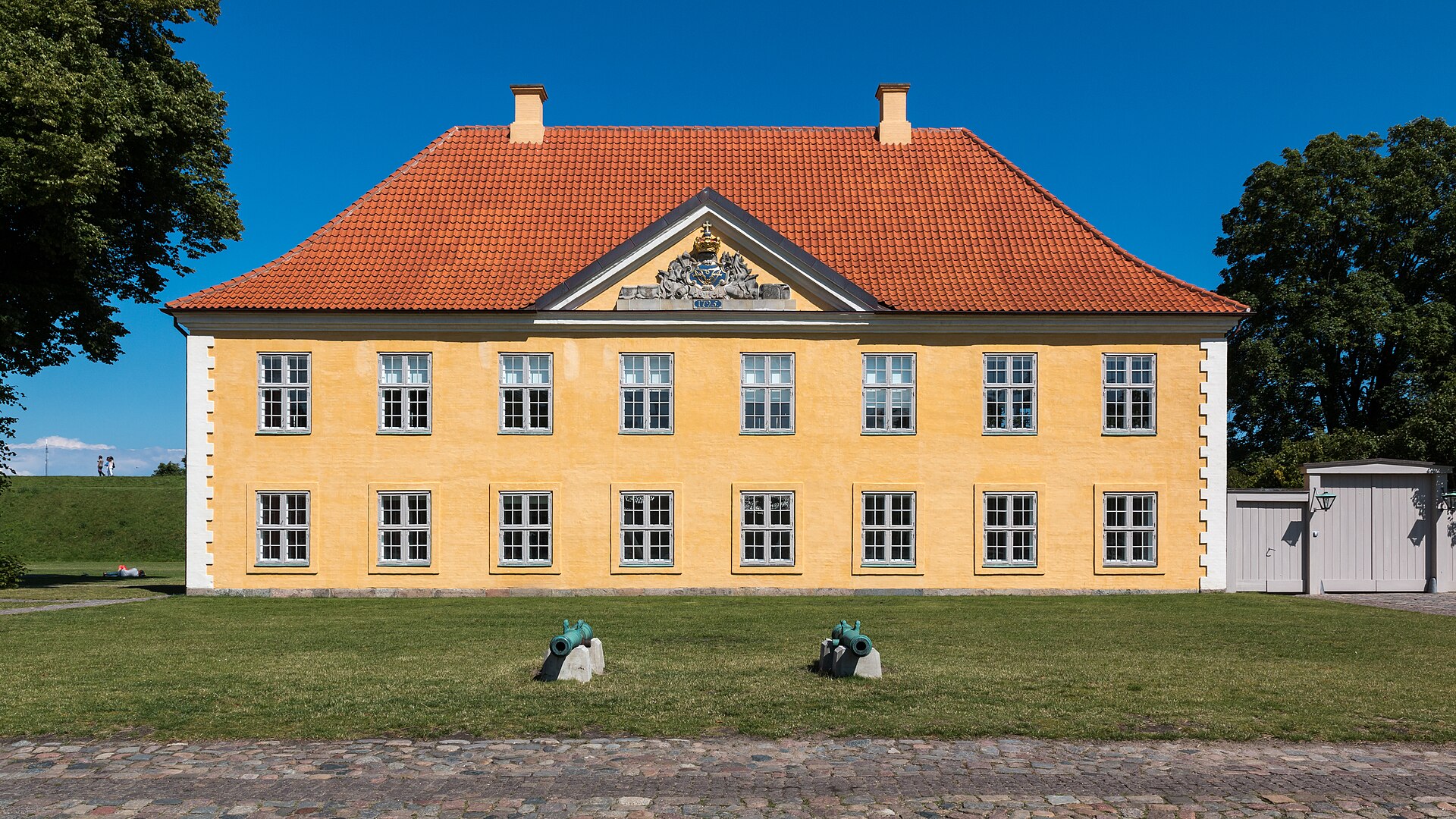
Kastellet
1 Kastellet, Copenhagen, København Ø, 2100, Denmark
This five-pointed star fortress is one of the best-preserved military fortifications in Northern Europe, and it is still an active military installation — the Danish Defence Intelligence Service operates from within its walls. Built between 1662 and 1665 by Dutch fortress builder Henrik Rüse, Kastellet was originally named Citadel Frederikshavn after King Frederik III, who commissioned it after the traumatic Swedish siege of Copenhagen in 1658 revealed how vulnerable the city's northern defences were. The first soldiers marched through the gates on October 28, 1664, a date still celebrated annually as Kastellet's birthday. The five-pointed star design, based on Renaissance military architecture, provided clear sightlines from every bastion — an attacker approaching any wall would be exposed to fire from at least two other positions. King Christian IV had started fortifying this area back in 1626 with St. Anne's Redoubt, but the Swedish attack proved those early defences inadequate. The full star fortress replaced them. Walking through Kastellet today feels nothing like visiting a military base. The grass-covered ramparts are public parkland, dotted with joggers, dog walkers, and families with prams. A functioning windmill from 1847 — the current one replaced the original 17th-century mill — sits on one of the bastions, and the red-painted barracks buildings along the central avenue look more like a charming Danish village than a fortress. The moat is filled with ducks and swans, and the surrounding paths offer some of the most pleasant walking in the city. During the German invasion on April 9, 1940, troops landing at the nearby harbour captured Kastellet without resistance. The fortress that had been built to defend Copenhagen surrendered without a shot, a fact that still stings the Danish national memory. Today it functions as both military headquarters and public park — an arrangement that somehow works perfectly in a country where even the army prefers to keep things hygge.
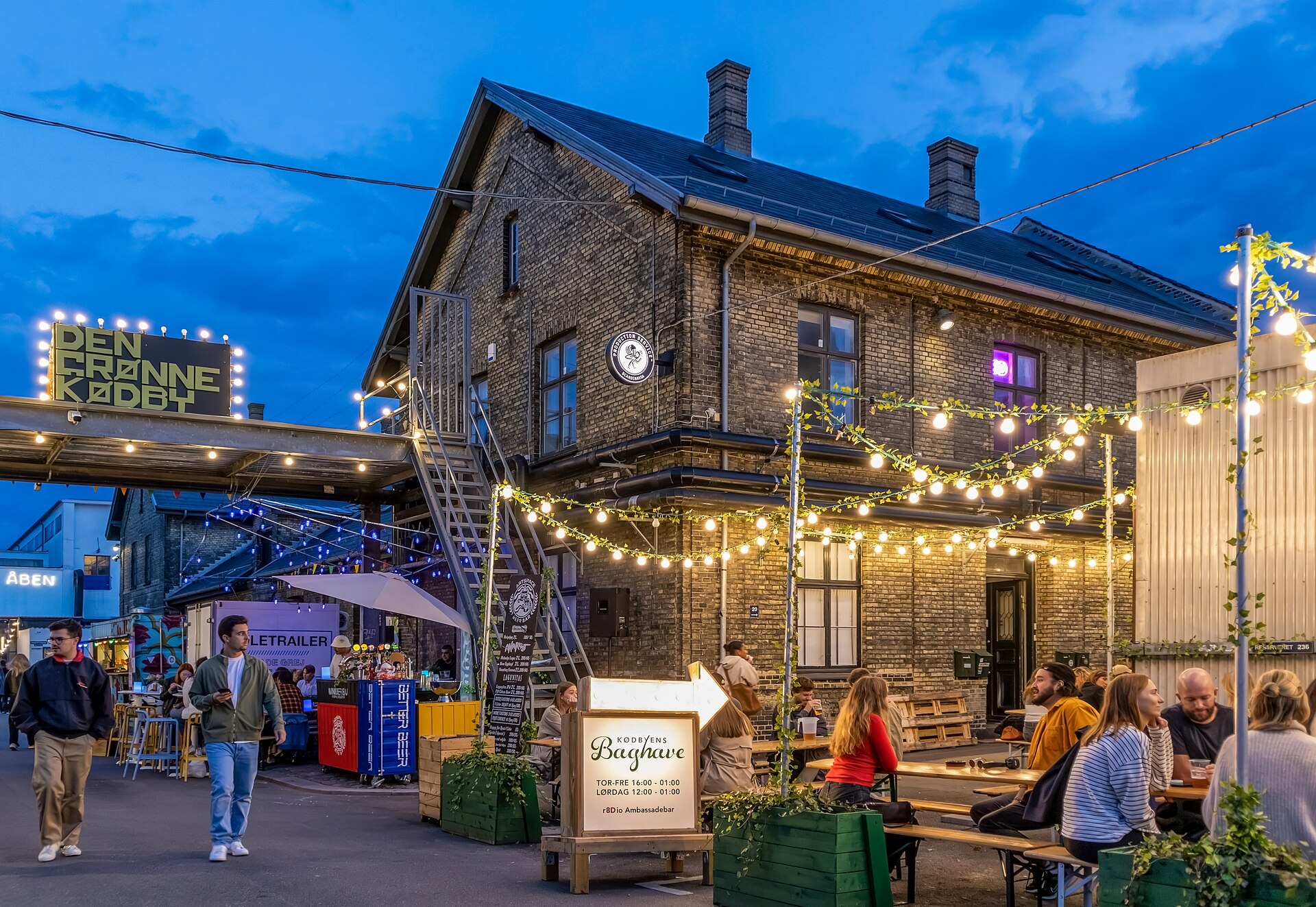
Kødbyen
Flæsketorvet, Copenhagen, København V, 1711, Denmark
Copenhagen's Meatpacking District is one of the few gentrification stories in Europe where the butchers are still around. Kødbyen was established in 1879 because animals were being slaughtered in public streets, which raised rather serious concerns about hygiene, and the city decided to centralise the entire meat industry near the railway lines in Vesterbro. The oldest section, Den brune Kødby (the brown meatpacking district), dates from 1883 and sits closest to Central Station. The larger white section, Den hvide Kødby, was built in 1934 — a 400-by-600-metre enclave of white modernist structures that still looks striking today. The transformation began in the early 2000s when the global financial crisis and rising rents drove many butcheries out of the city centre. The Copenhagen municipality began leasing empty warehouse spaces to restaurants, galleries, and creative businesses, and a neighbourhood that had smelled exclusively of raw meat for over a century suddenly also smelled of craft cocktails and contemporary art. Unlike New York's Meatpacking District, which it was modelled after, Copenhagen's version kept some actual meatpacking operations running alongside the bars and restaurants. The contrast is surreal: you can eat a Michelin-quality meal next door to a working slaughterhouse. In 2007, the white and brown sections were listed as national industrial heritage sites, which ensured the buildings would be preserved even as their function changed. The nightlife scene is now one of Copenhagen's most concentrated: Jolene, Mesteren og Lærlingen, and Bakken sit right next to each other, and Bakken's legendary Thursday night DJ sessions draw crowds that would make a nightclub promoter weep with joy. By day, Kødbyen is galleries and restaurants. By night, it is bars and music. And at all hours, it is a working example of what happens when a city decides to preserve its industrial architecture instead of demolishing it. The meat meets the martinis, and somehow it works.

Kongens Nytorv & Charlottenborg
1 Kongens Nytorv, Copenhagen, København K, 1050, Denmark
Kongens Nytorv — the King's New Square — was carved out of the eastern edge of old Copenhagen in 1670 by Christian V as the grandest public space in the city. At its centre stands an equestrian statue of the king himself, cast in lead because Denmark couldn't afford bronze at the time. The statue, created by French sculptor Abraham-César Lamoureux, has stood on the square since 1688, and every year on the last day of classes, graduating students from the nearby Royal Danish Academy of Fine Arts run around it in a tradition that has persisted for centuries. Charlottenborg Palace anchors the south side of the square. Built in 1683 for Ulrik Frederik Gyldenløve, the illegitimate son of King Frederik III, it is one of the finest Dutch Baroque buildings in Denmark. Since 1754, it has housed the Royal Danish Academy of Fine Arts, making it one of the oldest art academies in Northern Europe. The exhibition hall, Kunsthal Charlottenborg, now shows contemporary art in what was once a royal residence — a transition that Copenhagen handles with characteristic pragmatism. The square itself is octagonal, echoing the shape of Amalienborg, and its grandeur was designed to rival the great European piazzas. The Hotel d'Angleterre, on the north side, has been Copenhagen's most prestigious hotel since 1755, and the Royal Danish Theatre's original building — the Old Stage — faces the square from the south. Together, these buildings create a concentration of cultural institutions that makes Kongens Nytorv the intellectual epicentre of the city. In winter, the square is flooded and frozen into a public ice rink — possibly the most elegant setting for ice skating in Europe. In summer, the gardens return and the square fills with café tables. It is the hinge point of Copenhagen: Nyhavn opens from one corner, Strøget from another, and the rest of the city radiates outward.
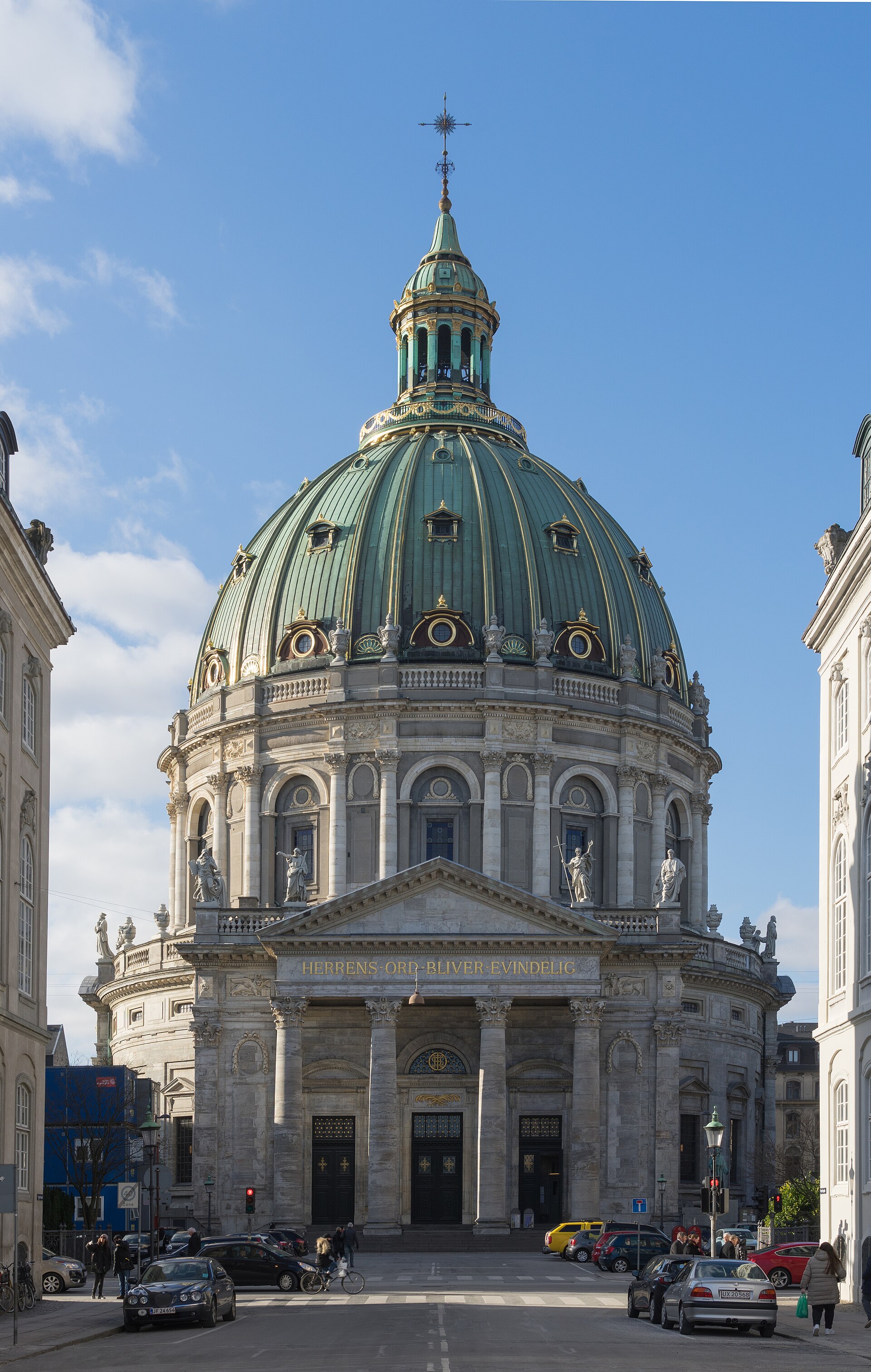
Marble Church
4 Frederiksgade, Copenhagen, København K, 1265, Denmark
The Marble Church — officially Frederik's Church — is the most expensive embarrassment in Danish architectural history. Construction began in 1749 as the centrepiece of the new Frederiksstaden district, designed by Nicolai Eigtved to rival St. Peter's in Rome. The original plan called for the entire building to be clad in Norwegian marble, and King Frederik V laid the foundation stone with tremendous ceremony. Then the money ran out. Eigtved died in 1754. The project stuttered, stopped, and eventually stalled completely in 1770, leaving an unfinished ruin that sat in the middle of Copenhagen for over a century. For 145 years, the half-built church was one of the most prominent eyesores in the city — a roofless shell of Norwegian marble slowly deteriorating in the Danish rain. Various proposals were made to finish it, demolish it, or convert it into something else, but nothing happened until industrialist C.F. Tietgen purchased the ruin in 1874 and funded its completion. Architect Ferdinand Meldahl redesigned the building, replacing the unaffordable Norwegian marble with Danish limestone to actually finish the job. The church was finally consecrated on August 19, 1894 — 145 years after construction began. The dome is the star attraction. At 31 metres in diameter, it is the largest church dome in Scandinavia and one of the largest in Europe, inspired by St. Peter's in Rome. The interior is decorated with painted panels depicting the twelve apostles, and the dome itself is supported by twelve buttresses that give the exterior its distinctive circular profile. Twelve statues of religious figures line the roof, visible from the street below. Standing on Frederiksgade, you get the perfect view: the Marble Church dome framed at one end, Amalienborg Palace in the middle, and the Copenhagen Opera House across the harbour at the other. It is one of the great architectural axes in Europe, and it only exists because someone finally had the decency — and the money — to finish what a king started.
National Museum of Denmark
10 Ny Vestergade, Copenhagen, København K, 1471, Denmark
Denmark's largest museum of cultural history is housed in the Prince's Palace, a Rococo masterpiece designed by Nicolai Eigtved and built between 1743 and 1744 as the residence of Crown Prince Frederik, later King Frederik V. The building alone is worth the visit — ornate staterooms with original interiors provide the setting for a collection that spans 14,000 years of Danish history, from the first reindeer hunters who arrived after the last ice age to the modern welfare state. And admission is completely free. The prehistoric collection is the crown jewel. The Sun Chariot — a Bronze Age sculpture of a horse pulling a golden sun disc, dating to around 1400 BCE — is one of the most important archaeological finds in Northern European history. The Gundestrup Cauldron, a massive silver vessel from the Iron Age decorated with Celtic deities and ritual scenes, was pulled from a peat bog in 1891 and remains one of the finest examples of ancient European metalwork ever discovered. And then there is the Egtved Girl, a Bronze Age teenager buried in 1370 BCE whose oak coffin preserved her clothing, hair, and even her fingernails for over three thousand years. The museum also holds an extraordinary collection of Viking artifacts — rune stones, weapons, jewellery, and the personal effects of people who lived a thousand years ago. But what makes this museum special is context. The curators don't just display objects; they tell the story of how Denmark became Denmark, from tribal societies through medieval kingdoms to the modern constitutional monarchy. The ethnographic wing contains treasures from the Danish colonial period — Greenlandic kayaks, objects from the former Danish West Indies, and collections from early expeditions to the Pacific. It is a museum that is genuinely, almost aggressively, generous with its knowledge. You could spend an entire day here and barely scratch the surface.
Ny Carlsberg Glyptotek
7 Dantes Plads, Copenhagen, København V, 1556, Denmark
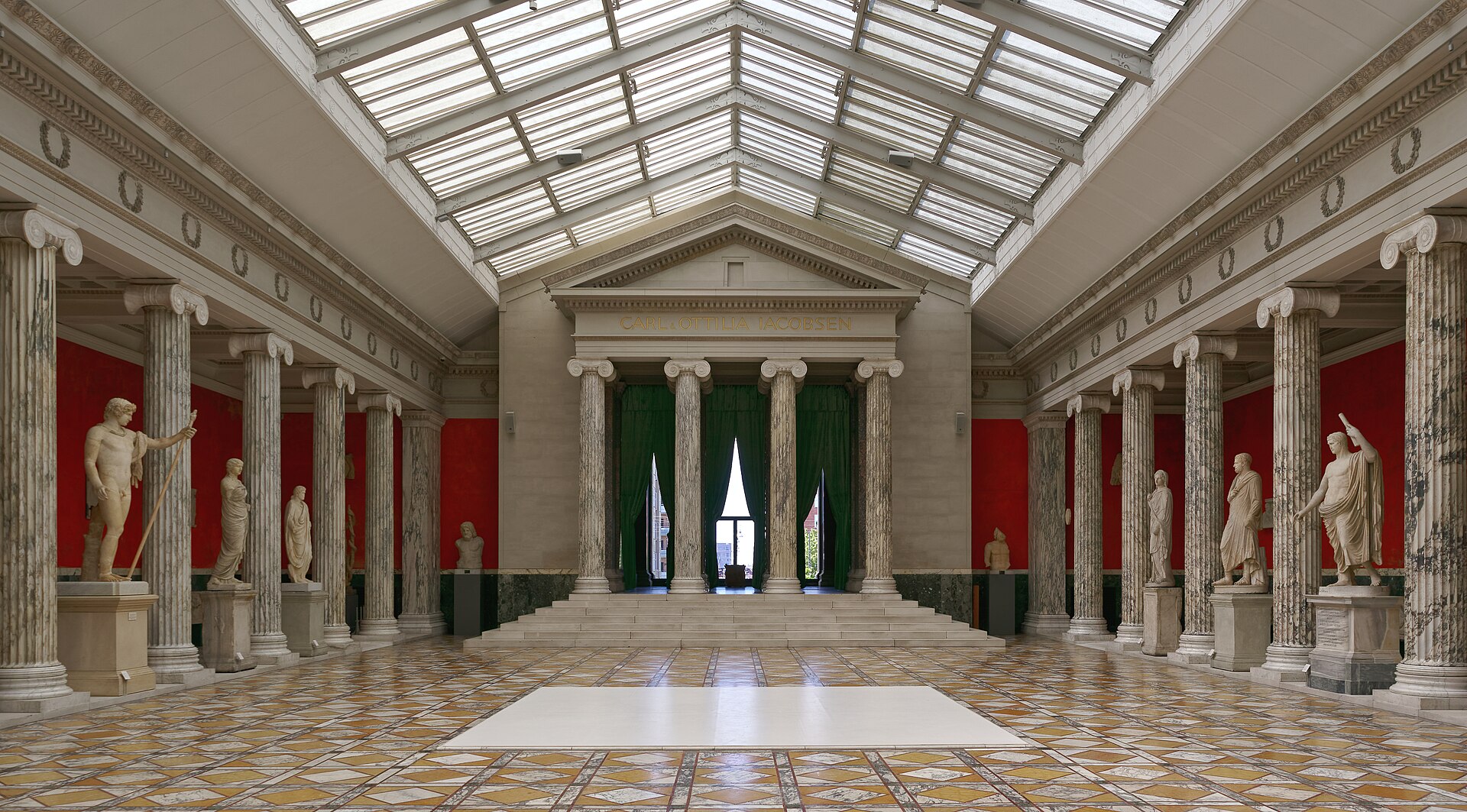
Carl Jacobsen made a fortune selling beer and spent it buying art — specifically sculpture, because he believed three-dimensional art came closest to the fundamental condition of being human. The son of Carlsberg founder J.C. Jacobsen, Carl donated his staggering personal collection to the Danish state in 1888 on one condition: they had to build a museum worthy of it. The Ny Carlsberg Glyptotek opened in 1897, and the name itself tells you Carl had ambitions — he borrowed it from Ludwig I's Glyptothek in Munich, tacking on "Ny" (new) because modesty was apparently not a family trait. The collection now holds over 10,000 works spanning 6,000 years, from Egyptian sarcophagi to Impressionist masterpieces. The ancient Mediterranean collection is extraordinary: 950 Greek, Roman, and Etruscan sculptures, many procured by German archaeologist Wolfgang Helbig, who spent 25 years as Jacobsen's buying agent in Rome. The Egyptian collection contains over 1,900 pieces dating from 3000 BCE, anchored by a sarcophagus Carl purchased from the Egyptian Museum in Cairo in 1882 — his first acquisition and the seed of everything that followed. But the building itself is half the experience. The original wing, designed by Vilhelm Dahlerup, is lavish historicism — all marble and mosaic. The 1996 extension by Danish architect Henning Larsen added a stunning modernist wing. And at the centre sits the Winter Garden, a soaring glass-domed conservatory filled with palm trees, where Copenhageners come to sit on rainy afternoons surrounded by Mediterranean plants and Roman busts. It is one of the most beautiful indoor spaces in Northern Europe. Every Tuesday, admission is free — a tradition that would have pleased Carl Jacobsen enormously. He believed art should be accessible to everyone, not just the people who could afford to brew beer.
Nyhavn
Nyhavn, 1051 København K
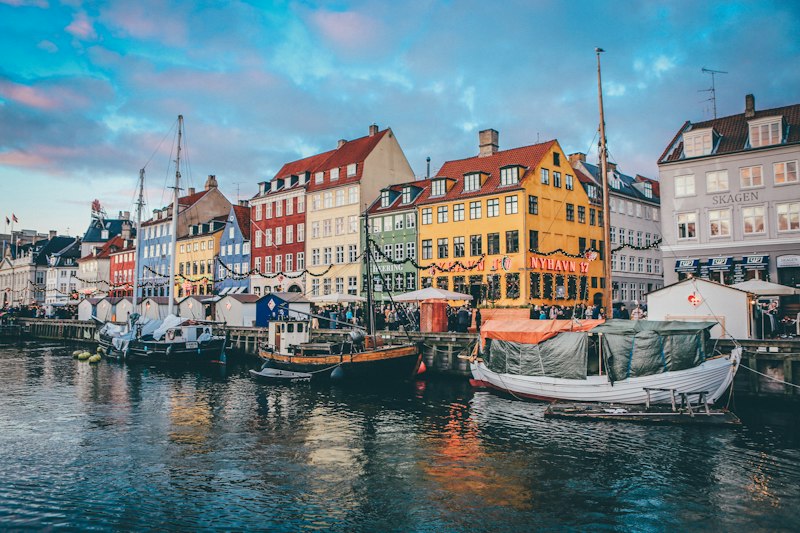
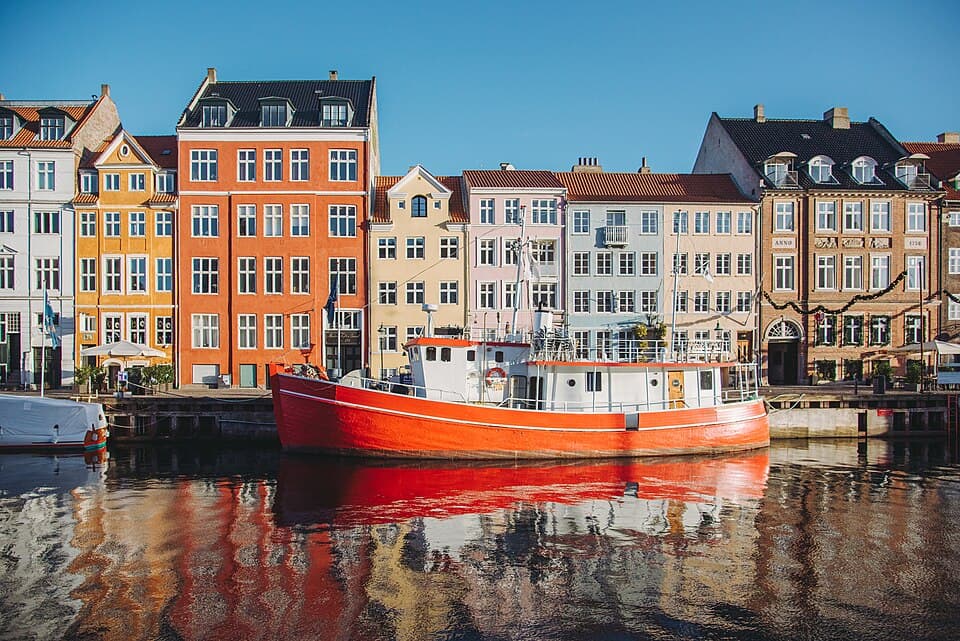
Every postcard of Copenhagen features this canal, and for good reason — but Nyhavn's candy-coloured facade hides a past that would make a sailor blush. King Christian V had the canal dug between 1671 and 1673, using Swedish prisoners of war from the Dano-Swedish conflict as labour. The original purpose was entirely commercial: a gateway from the sea to the King's New Square, where merchants could unload cargo directly into the heart of the city. For the next two centuries, Nyhavn was not a tourist attraction. It was a rough, rowdy waterfront strip packed with alehouses, brothels, tattoo parlours, and the kind of establishments where a knife fight was considered light entertainment. Hans Christian Andersen lived at three different addresses along this canal — No. 20, No. 67, and No. 18 — spanning thirty years of his life. He wrote his first fairy tales at No. 20 in 1835, including The Tinderbox and The Princess and the Pea. The man who invented some of the most beloved children's stories in history did so overlooking a street famous for prostitution and public drunkenness. That irony seems to have been lost on nobody, least of all Andersen himself. The oldest surviving house is No. 9, dating from 1681, just eight years after the canal was completed. The colourful painted facades that define the street today were not always so cheerful — the tradition of painting harbour buildings in bright colours was practical, helping inebriated sailors identify which house they needed to stumble back to after dark. The sunny northern side became the fashionable address, while the shadier south side remained grittier for longer. Today Nyhavn is Copenhagen's most photographed spot, lined with restaurants where you can sit with a beer and watch the old wooden ships moored along the canal. The transformation from den of iniquity to Instagram backdrop took roughly a century, but the buildings haven't changed. Only the clientele has.
Paper Island (Papirøen)
Trangravsvej 14, 1436 København K
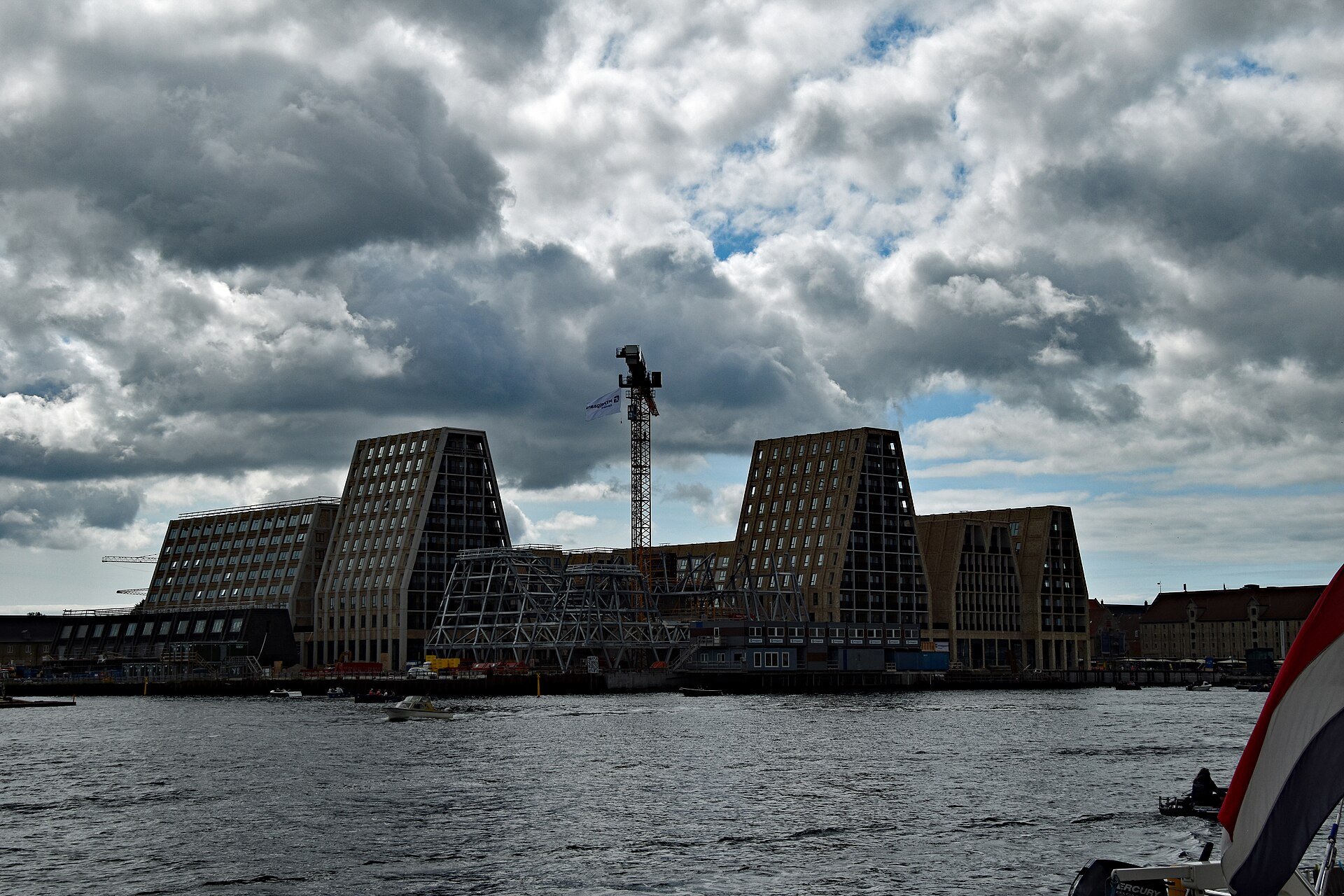
Paper Island — Papirøen in Danish — earned its name from decades as the storage site for Copenhagen's major newspapers. For most of the 20th century, newsprint was warehoused in these harbour-front buildings before being distributed across the city. When the newspaper industry contracted, the warehouses emptied, and the island sat largely unused until 2014, when Copenhagen Street Food opened in the old storage halls, turning industrial paper storage into one of the most popular food destinations in Northern Europe. The original Copenhagen Street Food market operated from 2014 to 2017 and packed dozens of food stalls into a single warehouse, creating the template that Reffen would later build on at a larger scale. At its peak, the market drew thousands of visitors daily to eat everything from Korean tacos to Danish hot dogs overlooking the harbour, with views across to the Opera House and the old city. When the lease expired in 2017, the food vendors relocated to Refshaleøen and became Reffen, while the island itself entered a new phase of development. Today, Paper Island is being redeveloped into a mixed-use neighbourhood designed by COBE Architects, featuring residential buildings, cultural spaces, and a public swimming area in the harbour. The project aims to maintain the island's creative DNA while adding permanent structures to what was previously temporary use. The harbour bath — part of Copenhagen's broader mission to make its waterways swimmable — is designed to integrate the island into the city's unique relationship with water. Paper Island sits at the junction of Christianshavn and the inner harbour, a short walk from both the Opera House and Christiania. Its transformation from newsprint warehouse to street food mecca to residential neighbourhood mirrors Copenhagen's broader story: a city that keeps finding new uses for old infrastructure, rarely demolishing when it can repurpose.
Reffen Street Food
Refshalevej 167A, 1432 København K
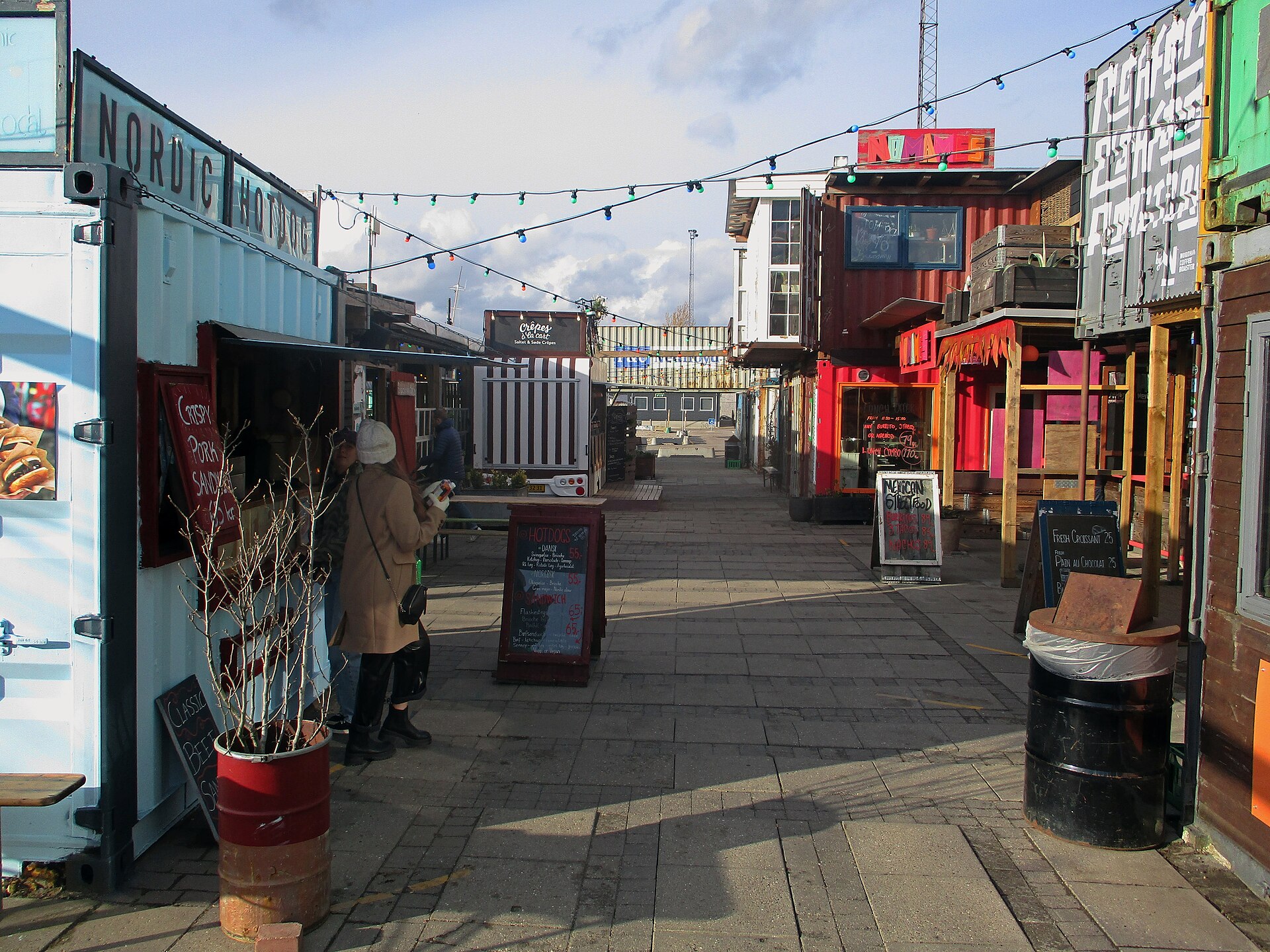
For over a century, Refshaleøen was home to the Burmeister & Wain shipyard, one of the largest in Europe, churning out everything from cargo vessels to diesel engines. When the shipyard closed in 1996, the island sat derelict for two decades — a dusty peninsula of abandoned warehouses and rusting workshops on Copenhagen's eastern harbour. Then in 2018, Reffen opened, and the island got a second life as the largest street food market in Northern Europe. Built primarily from repurposed shipping containers arranged across a 12,000-square-metre waterfront site, Reffen has the raw, industrial aesthetic you would expect from a place built on a former shipyard. Around 35 food stalls and 10 bars serve everything from Korean bibimbap to Argentinian empanadas, all run by independent entrepreneurs who had to pitch their concept to be accepted. The diversity of the food reflects Copenhagen itself — a city that is far more multicultural than its hygge-and-minimalism image suggests. The old B&W machine hall has been transformed into Werkstatt, Reffen's largest indoor venue, hosting concerts, exhibitions, flea markets, and club nights. Four creative workshops offer everything from pottery classes to metalworking. There is an on-site brewery. The whole operation runs from April to October, closing for the Danish winter, which gives it a festival energy that permanent venues rarely achieve. What makes Reffen work is the location. Sitting on the water with views back toward the city skyline, the Copenhagen Opera House visible across the harbour, it feels genuinely separated from the polished tourist centre. Getting here requires a bike ride or a harbour bus, which filters out the casual crowds and attracts people who actually want to be there. On a summer evening, with the sun low over the water and a dozen different cuisines competing for your attention, Reffen is Copenhagen at its most relaxed and cosmopolitan.
Rosenborg Castle
Øster Voldgade 4A, 1350 København K
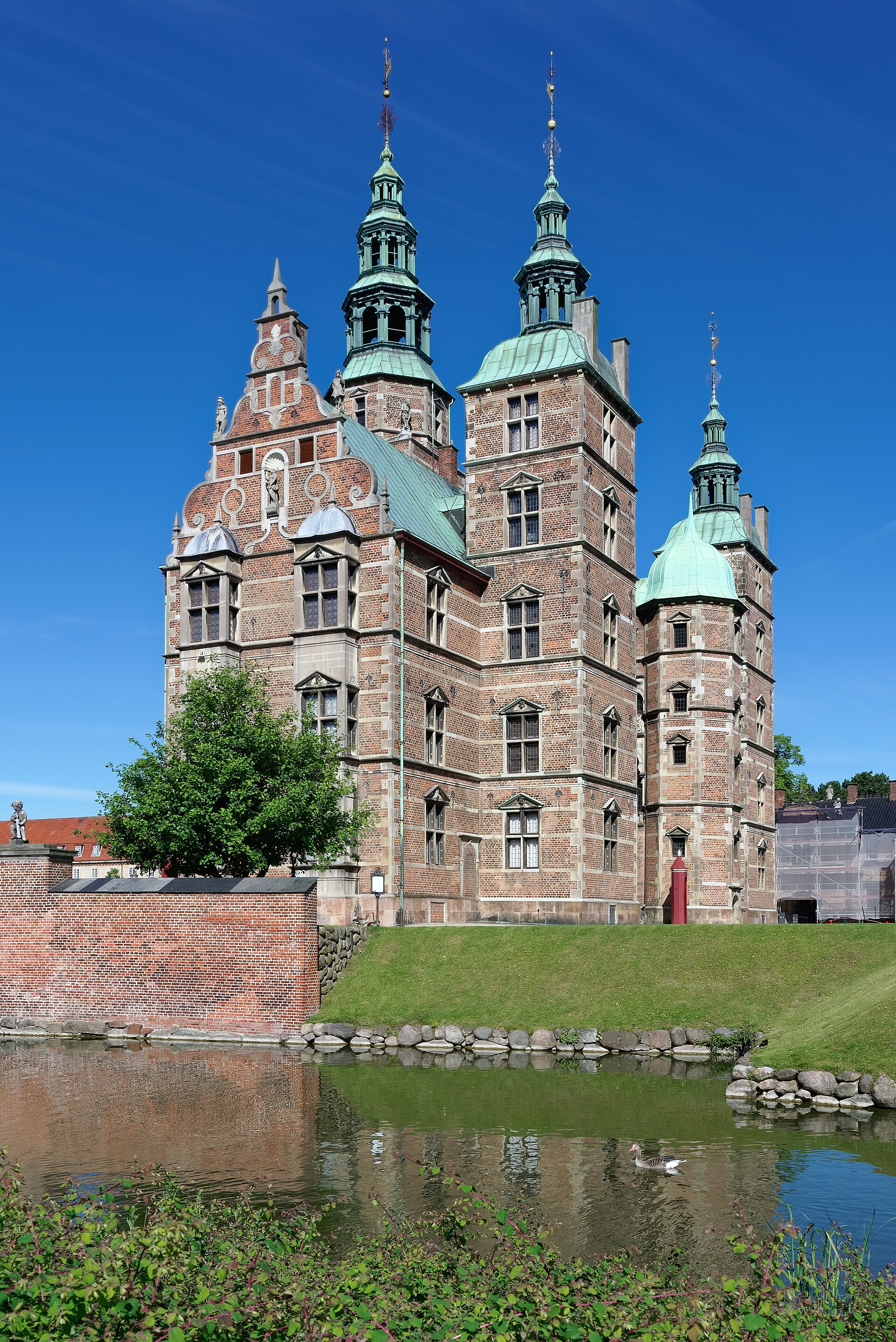
Christian IV built Rosenborg between 1606 and 1634 as a summer pleasure palace, and he loved the place so much that he chose to die there. Literally — in 1648, the aging king insisted on being carried to Rosenborg for his final days, and he expired in the very rooms he had designed. The castle started as a modest two-storey summer house and grew over three decades into the Dutch Renaissance jewel you see today, with its red brick walls, sandstone ornaments, and copper-green spires rising above the King's Garden. The crown jewels in the basement vault are the real draw. Unlike most European crown jewels, which are locked behind glass and retired, the Danish regalia is both on public display and still in active royal use. The collection includes four garnitures — diamond, ruby, pearl, and emerald sets — with the emeralds considered among the finest in the world. The pearl necklace in the Pearl-Ruby Set dates to the late 17th century and is still worn by the Danish queen on state occasions. Christian IV's crown, made in 1596, sits in a vault guarded by the same three life-size silver lions that have stood watch since 1670. The Knights' Hall on the top floor is a masterpiece of royal intimidation. The coronation thrones are flanked by those silver lions, and the ceiling is covered in elaborate stucco work. But the strangest detail is the throne canopy supports: they are made of narwhal tusks, which in the 17th century were believed to be unicorn horns and were worth more than their weight in gold. Christian IV knew exactly what he was doing — using the rarest material on earth to frame his seat of power. The surrounding King's Garden is Copenhagen's oldest park, laid out in the early 1600s, and today it is the most visited park in the city. In summer, Copenhageners treat the lawns like their living room.
Round Tower
Købmagergade 52A, 1150 København K
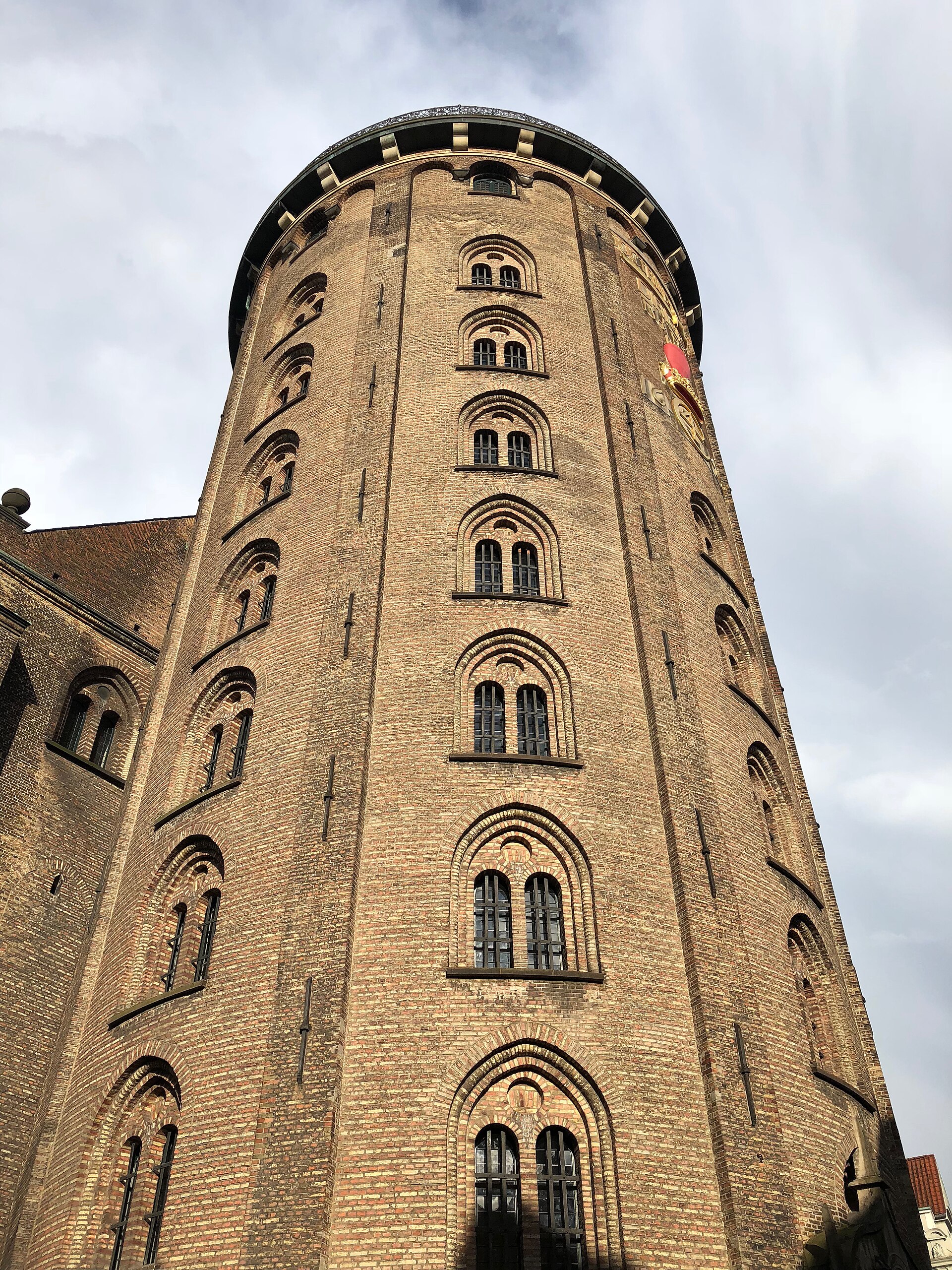
King Christian IV — who seems to have built half of Copenhagen — completed the Round Tower in 1642 as Europe's oldest functioning astronomical observatory, and the design choice that makes it unique is the absence of stairs. Instead, a 209-metre spiral ramp winds seven and a half times around the hollow core of the tower, wide enough for a horse and carriage to reach the top. This was not decorative whimsy. The ramp was built to transport heavy astronomical instruments and library books to the upper floors, because dragging a 17th-century telescope up a narrow staircase would have been a nightmare. In 1716, Tsar Peter the Great of Russia visited Copenhagen and reportedly rode his horse all the way up the spiral ramp, while his wife Tsarina Catherine followed in a horse-drawn carriage. The story comes from architect Lauritz de Thurah, writing in 1748, and a patch of the original stone floor from that ride is believed to survive. The tower stands 34.8 metres tall and was the go-to observation platform for Danish astronomers for over three centuries, including Tycho Brahe's successors who used it to map the stars above the city. The library hall halfway up once housed the entire University of Copenhagen library — 10,000 volumes crammed into a single round room. That collection was destroyed in the Great Fire of Copenhagen in 1728, which consumed a third of the city. The tower survived; the books did not. Today the hall hosts rotating art exhibitions, which feels like an appropriate use for a room that has contained both human knowledge and its destruction. At the top, the observatory platform offers a 360-degree view of Copenhagen's rooftops and church spires. On a clear day, you can see across the Øresund to Sweden. The observatory is still used by amateur astronomers on winter evenings — making it the oldest observatory in Europe that actually still functions as one.
Strøget
Strøget, 1100 København K
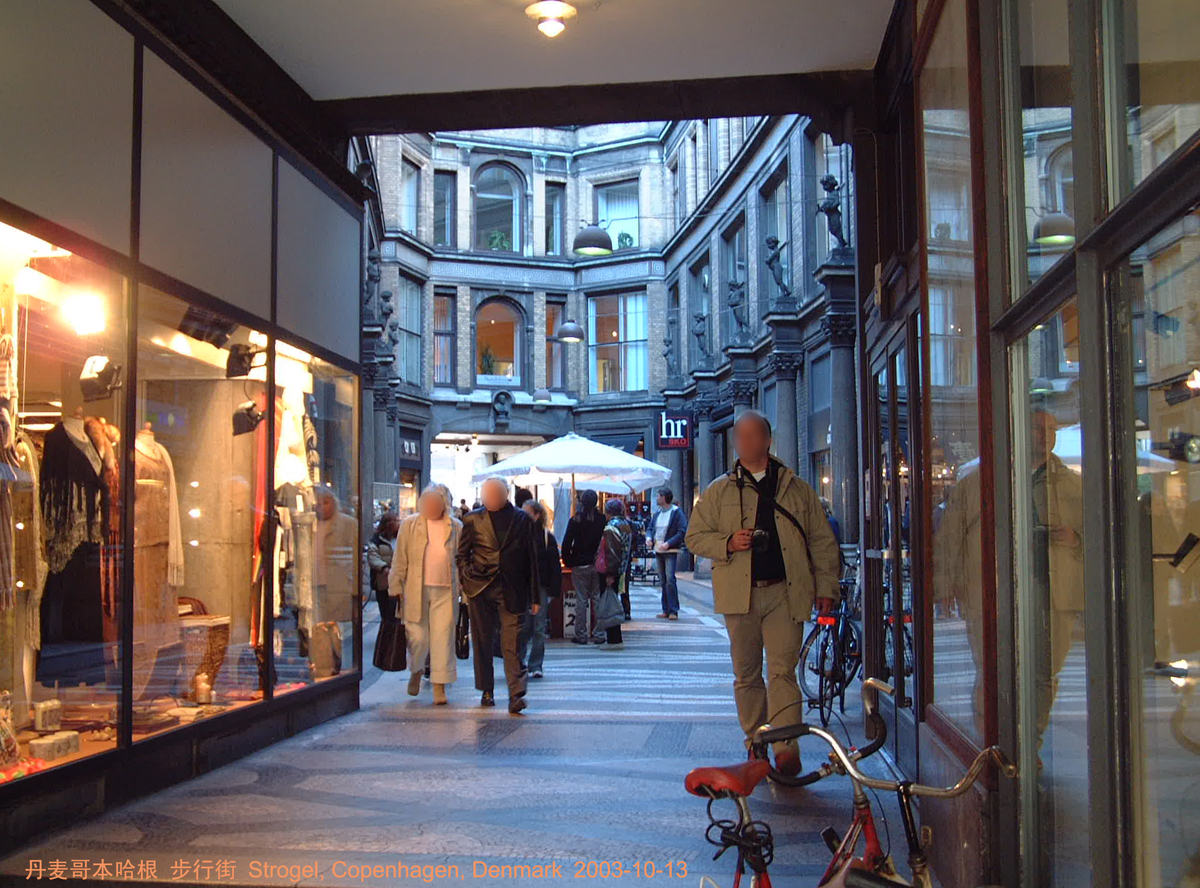
On November 17, 1962, Copenhagen did something that was considered borderline insane at the time: it closed one of its busiest city-centre streets to cars. Shopkeepers predicted economic ruin. Motorists called it madness. The city called it an experiment. Six decades later, Strøget is one of the longest pedestrian shopping streets in Europe at 1.1 kilometres, stretching from City Hall Square to Kongens Nytorv, and it transformed not just Copenhagen but urban planning worldwide. The closure was inspired by German cities that had pedestrianised streets in postwar reconstruction, but Copenhagen took the idea further than anyone expected. Architect Jan Gehl began studying the new car-free zone in 1962, meticulously documenting how people used the space once cars disappeared. His findings — that pedestrian activity tripled, that people lingered, socialised, and spent more money — became the foundation of a global movement. Gehl's research influenced Melbourne, New York, Melbourne, and dozens of other cities to rethink their streets. Copenhagen's little experiment on Strøget essentially invented modern pedestrian urban design. The street itself is actually five interconnected streets: Frederiksberggade, Nygade, Vimmelskaftet, Amagertorv, and Østergade. Each section has its own character, from the chain stores near City Hall to the luxury boutiques approaching Kongens Nytorv. The most beautiful stretch is Amagertorv, with its Renaissance-era buildings and the Stork Fountain, a popular meeting point since 1894. On a summer day, up to 80,000 people walk this single street. What began as a temporary trial that nobody believed would work became permanent in 1964 and has since expanded into an entire network of car-free streets covering the medieval city centre. The shopkeepers who predicted bankruptcy now pay some of the highest rents in Scandinavia.
Superkilen
Nørrebrogade 210, 2200 København N
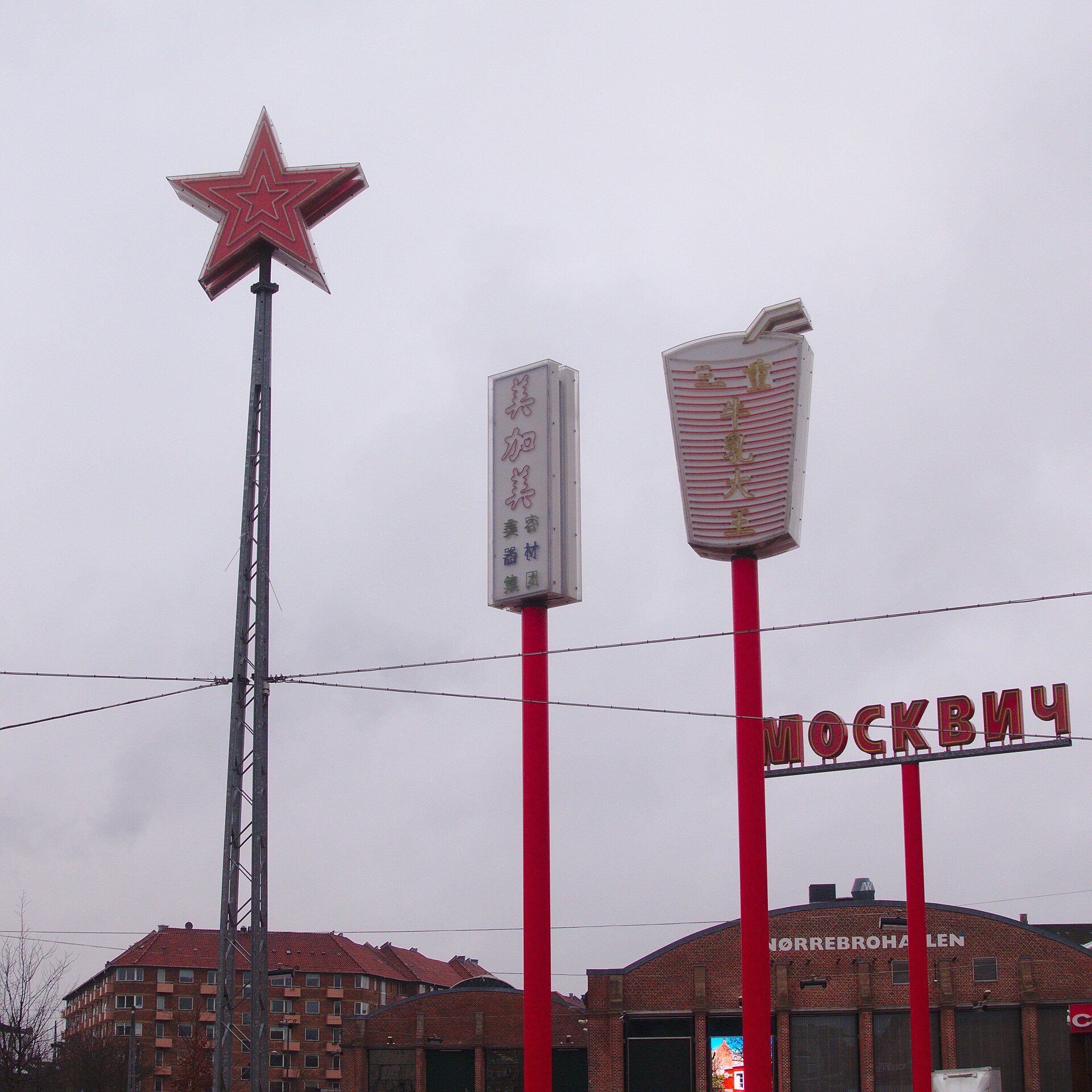
Before 2012, Nørrebro was Copenhagen's most troubled neighbourhood — ethnically diverse, economically disadvantaged, and scarred by gang violence and the 2006 riots triggered by controversial newspaper cartoons. Then Superkilen appeared: a seven-acre public park designed by art group Superflex, Bjarke Ingels Group (BIG), and German landscape firm Topotek1, crammed with 108 objects sourced from 62 different countries representing the nationalities of the neighbourhood's residents. It is quite possibly the strangest park in Europe. The park is divided into three colour-coded zones. The Red Square is covered in a vibrant red-and-orange rubber surface and features a giant swing from Iraq, a sound system from Jamaica, and a bright red neon sign from Russia. The Black Market is paved in dark asphalt with white Arabic-style patterns and contains a Moroccan fountain, a Japanese cherry tree, and drain covers from Zanzibar. The Green Park is the mellow zone — a hill for picnics and play, with exercise equipment from muscle beaches around the world. What makes Superkilen conceptually radical is the design process. Residents of Nørrebro — one of the most ethnically diverse neighbourhoods in Northern Europe, home to over 55 nationalities — were asked to suggest objects from their countries of origin. A local governance board selected the final items, which were then imported and installed. The result is a park that functions as a physical encyclopaedia of global culture, compressed into a wedge-shaped strip in one of Copenhagen's most densely populated areas. The name literally means "super wedge" in Danish. Critics have questioned whether dropping a Moroccan fountain and Soviet bus stop next to each other constitutes genuine cultural dialogue or performative diversity. But the park works. Families gather on the green hill, kids play on the Iraqi swing, and Nørrebro — once associated primarily with urban problems — has become one of the most interesting neighbourhoods in Scandinavia.
The Little Mermaid
Langelinie, 2100 København Ø
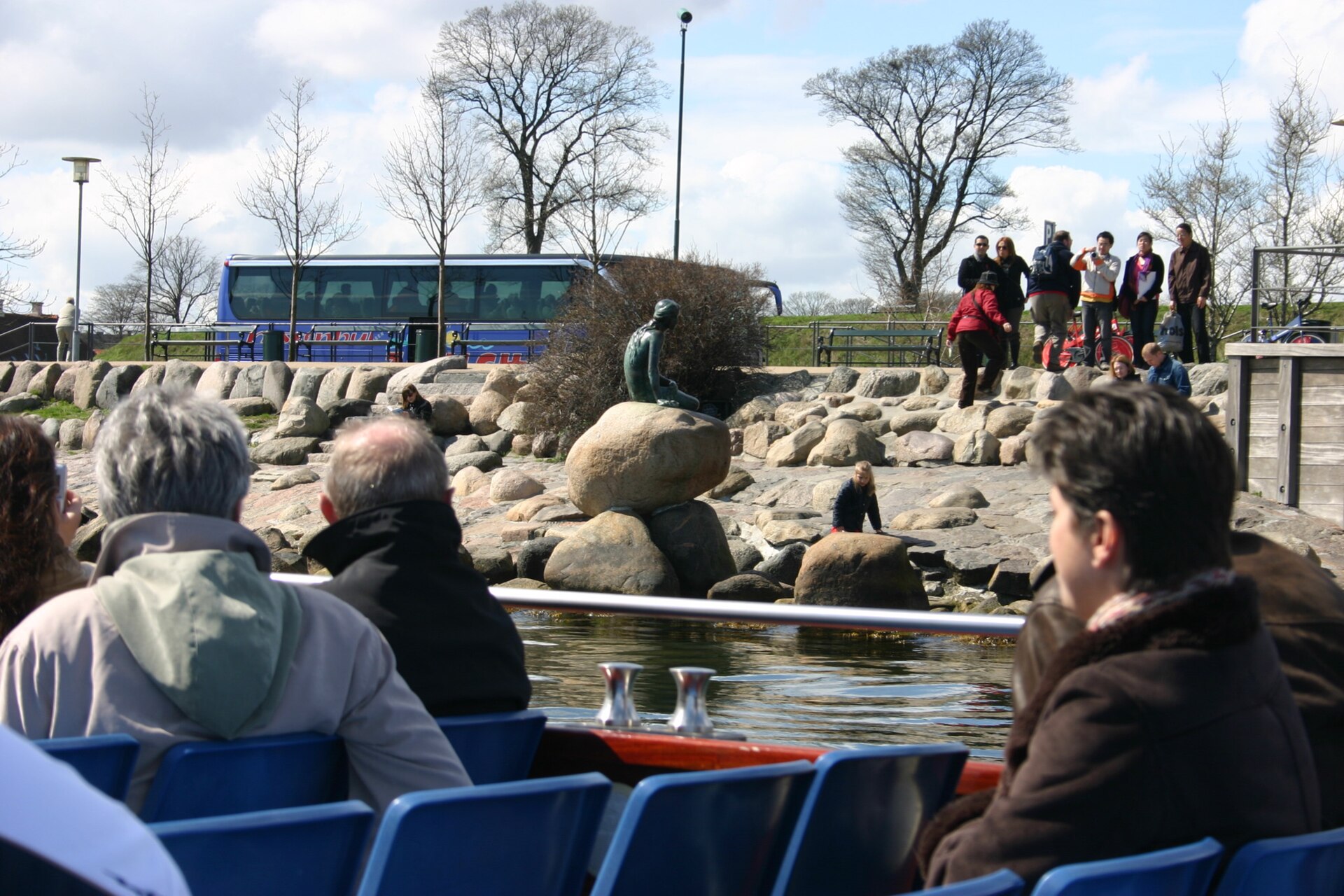
She is 1.25 metres tall, weighs 175 kilograms, and has been the most vandalised statue in Scandinavia for over a century. The Little Mermaid was commissioned in 1909 by Carl Jacobsen — son of the Carlsberg brewery founder — after he attended a ballet performance of Hans Christian Andersen's fairy tale at the Royal Danish Theatre and became so besotted with the lead ballerina, Ellen Price, that he asked sculptor Edvard Eriksen to immortalise her. Price agreed to model her face but refused to pose nude, so Eriksen used his own wife Eline as the body model. The statue was unveiled on August 23, 1913. Since then, the Little Mermaid has endured a catalogue of abuse that reads like a crime blotter. Her head has been sawn off twice — in 1964 and again in 1998. Her right arm was hacked off in 1984. She has been doused in paint at least ten times, in colours ranging from red to green to pink. In 2003, she was blown off her rock with explosives. In 1961, someone gave her a bra painted in red. Through it all, the Eriksen family has retained copyright over the statue and maintains the original moulds, allowing each severed limb and decapitation to be repaired with replacement bronze castings. Despite being one of the most famous statues in the world, she is consistently ranked among the most disappointing tourist attractions in Europe, largely because visitors expect something grand and find instead a small bronze figure on a rock. But that smallness is the point. Andersen's original tale is not a Disney romance — it is a story about sacrifice, transformation, and dissolution into sea foam. The statue captures that melancholy perfectly. In 2010, she made her first and only trip abroad, travelling to the Danish Pavilion at the Shanghai World Expo. Copenhagen replaced her temporarily with a video screen showing a live feed from Shanghai. The Danes, characteristically, found this funnier than anyone else did.
Tivoli Gardens
Vesterbrogade 3, 1630 København V
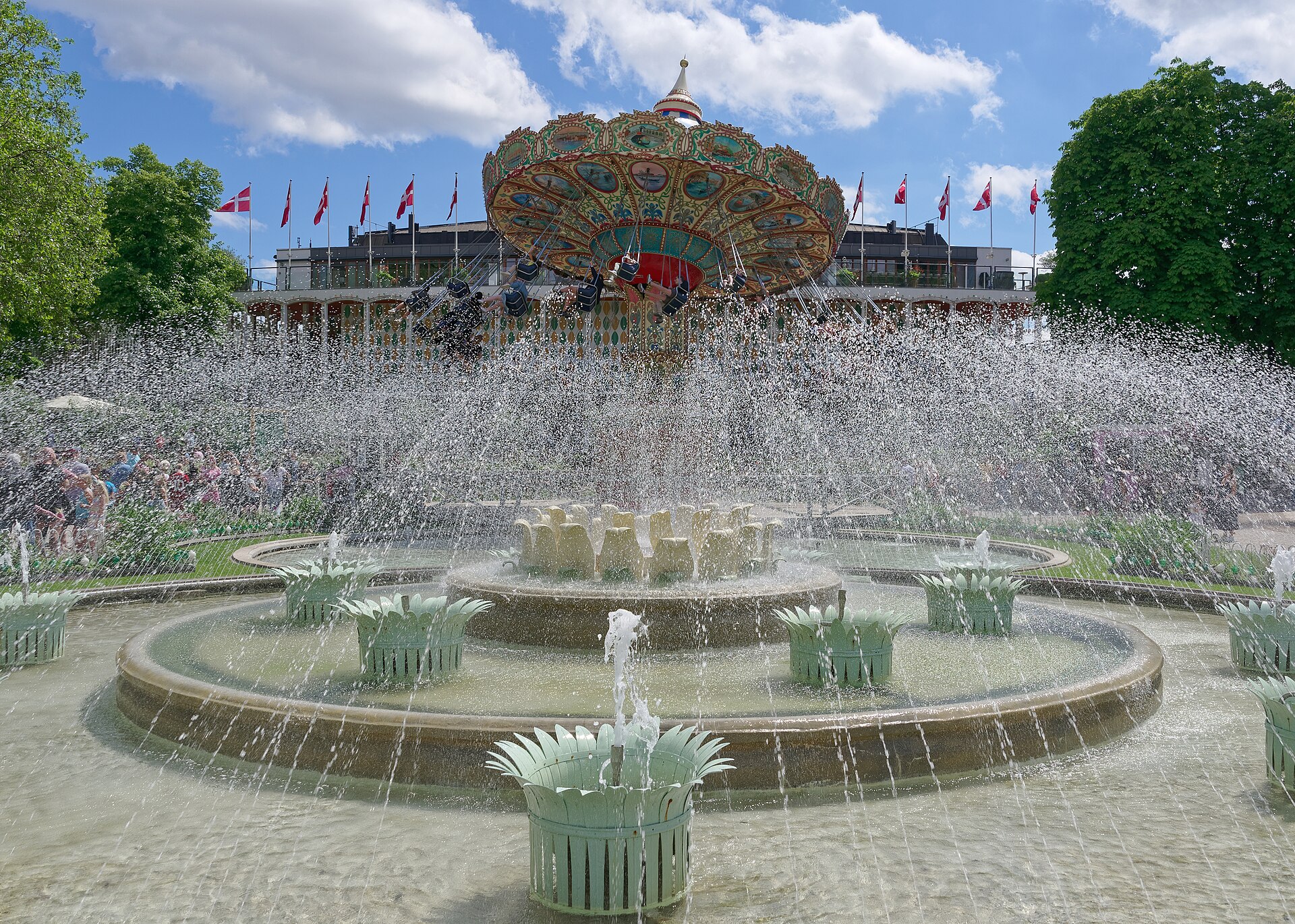
Georg Carstensen talked King Christian VIII into granting him a charter for an amusement park in 1843 with a line that belongs in a political textbook: "When the people are amusing themselves, they do not think about politics." The king, facing mounting pressure for a constitution, apparently agreed that bread and circuses beat reform, and Tivoli opened its gates on August 15, 1843. It is the second-oldest operating amusement park in the world, after Dyrehavsbakken north of Copenhagen, and it has been running continuously for over 180 years in the dead centre of a European capital. The wooden roller coaster, Rutschebanen, has been terrifying riders since 1914, making it one of the oldest wooden coasters still in operation anywhere. It is one of only seven roller coasters in the world that still requires a brakeman riding on every single train. In 1951, Walt Disney visited Tivoli with his wife Lillian and was so captivated by what he called its "happy, unbuttoned atmosphere of fun" that he took extensive notes. Those notes became the blueprint for Disneyland, which opened four years later. Carstensen had said in 1844, "Tivoli will never, so to speak, be finished" — and Disney echoed that sentiment almost verbatim a century later about his own park. During the Nazi occupation of Denmark, the Tivoli Boy Guard — a children's marching band founded in 1844 — became a quiet symbol of Danish resistance. In 1944, the Schalburg Corps, a Danish Nazi collaborator group, bombed and set fire to Tivoli, destroying the concert hall and several rides. The Danes rebuilt it within a year. The park that a king had approved to distract people from politics had become deeply political after all. At night, Tivoli transforms into something genuinely magical. Over 120,000 lights illuminate the gardens, the Moorish-style Nimb hotel glows like something from the Arabian Nights, and the peacock theatre stages pantomime performances using a tradition unchanged since 1874.
Torvehallerne
Frederiksborggade 21, 1360 København K
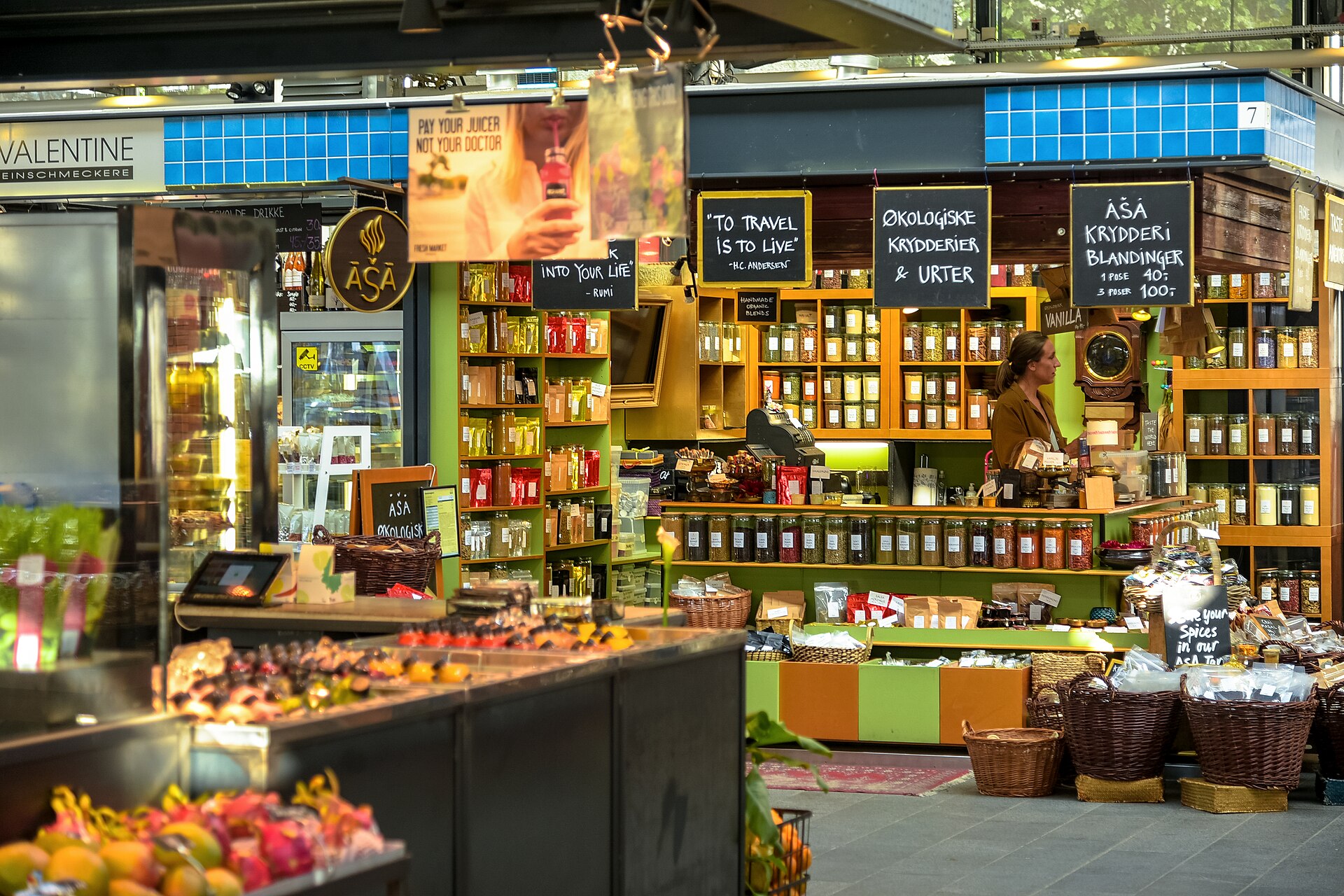
For decades, the site next to Nørreport Station was just an ugly vacant lot — a gap in the urban fabric where market halls had stood until their demolition in 1958. Copenhageners walked past it for over fifty years, and then in September 2011, two glass-and-steel market halls appeared and instantly became the city's culinary nerve centre. Torvehallerne — literally "the market halls" — filled a void that Copenhagen had been ignoring since the 1950s. The location has market DNA running back to the late 1800s, when the area served as Copenhagen's central wholesale produce market after the old city fortifications were dismantled and the city expanded northward. That original market energy never fully disappeared, and when the new halls opened, it was as if the neighbourhood remembered what it was supposed to be. Today, over 60 stalls sell everything from organic Danish cheese and fresh Nordic seafood to gourmet chocolate, artisanal coffee, and smørrebrød that will ruin all other open-faced sandwiches for you forever. What makes Torvehallerne different from most European food markets is the balance between locals and tourists. The morning crowd is largely Copenhageners doing their weekly shopping — picking up rye bread, seasonal vegetables, and herring from vendors they know by name. By lunchtime, the tourist crowds arrive, clustering around the smørrebrød counters and the porridge stand. The market absorbs both populations without losing its character, which is a neat trick that most famous food markets fail at entirely. The renovation of the adjacent Israel Plads in 2014 completed the transformation of what had been one of the most neglected corners of central Copenhagen into one of its most vibrant. On a summer day, the outdoor stalls spill across the square, and the combination of food, architecture, and street life makes this one of the most genuinely pleasant places to eat in the city.