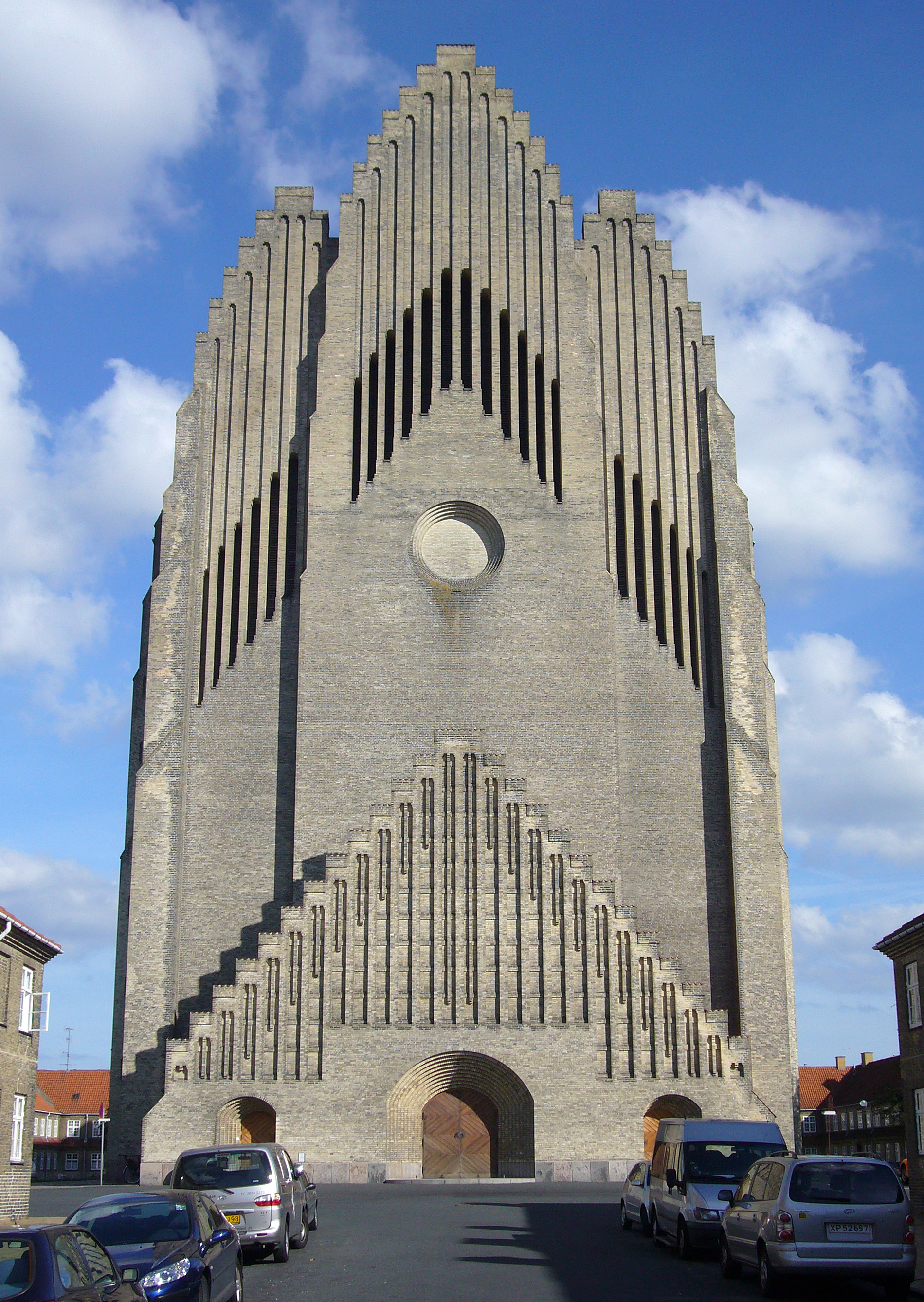
Five million yellow bricks. That is what it took to build one of the most extraordinary churches in Europe — a building that looks like a pipe organ grew to the size of a cathedral and decided to sit on a residential street in a quiet Copenhagen suburb. Grundtvig's Church was designed by Peder Vilhelm Jensen-Klint, who won the competition in 1913, and it is a jaw-dropping fusion of Brick Expressionism and Gothic verticality that has no real equivalent anywhere in the world.
Jensen-Klint spent years studying Danish village churches on the island of Zealand, particularly their stepped gables, before creating a design that abstracted those vernacular forms into something monumental. The west facade rises 49 metres and resembles the exterior of a church organ — or possibly a crown, or a fortress, depending on the light. The interior is equally stunning: a long Gothic nave with pointed arches, ribbed groin vaults, and a height that pulls your eyes upward with the same force as the great medieval cathedrals. It seats 1,800 and is comparable in size to Copenhagen Cathedral, despite being far less known.
Construction began in 1921, and the main structure was completed in 1926. Jensen-Klint died in 1930, and his son Kaare Klint — the same designer who would later reshape Danish furniture — took over and completed the interior by 1940. This was a father-and-son project that spanned decades: the elder Klint envisioned it, the younger Klint finished it. Kaare later designed the furniture for the Designmuseum, making the Klint family arguably the most influential design dynasty in Danish history.
The surrounding residential neighbourhood, Bispebjerg, was designed in a matching yellow-brick style that radiates outward from the church in symmetrical rows, creating a planned community that frames the church as its centrepiece. Getting here requires a deliberate journey from central Copenhagen, which keeps the tourist crowds thin and the atmosphere genuinely contemplative.
Verified Facts
Designed by Peder Vilhelm Jensen-Klint, who won the competition in 1913; built using five million yellow bricks
The west facade tower rises 49 metres and the church seats 1,800
Jensen-Klint died in 1930 and his son Kaare Klint completed the interior by 1940
Construction of the main structure took place 1921-1926, with the opening ceremony in 1927
Get walking directions
14B På Bjerget, Copenhagen, København NV, 2400, Denmark